• 4 min de lectura
• 4 min de lectura
The increasing dimensions of container ships are beginning to place new demands on the infrastructure of Mexico's main container port. Contecon Manzanillo reported on Tuesday that it obtained authorization from the Regional Port Authority to receive vessels with drafts of up to 15.5 meters, a condition that expands the range of ships it can serve and opens the door to operations with larger cargo volumes per call.
According to the company, the authorization makes its terminal the only one in the port of Manzanillo that currently has this operational condition, allowing it to handle large capacity container ships, including Ultra Large Container Vessels (ULCVs), capable of transporting up to 24,000 twenty-foot equivalent units (TEU).
Beyond the increase in draft, this move is relevant due to the transformation international maritime transport is undergoing. The deployment of larger vessels on major trade routes forces ports to have not only sufficient depth, but also docks, cranes, yards, and processes capable of absorbing greater container exchanges during each call.
This evolution also responds to shipping lines' pursuit of economies of scale. Large container ships allow for the concentration of greater cargo volumes in a single voyage, while new generations of vessels incorporate technologies aimed at optimizing fuel consumption and reducing emissions per container transported.
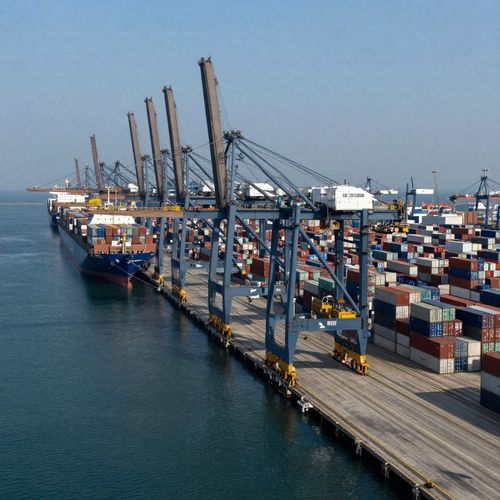
For Contecon, the 15.5-meter authorization is also part of an infrastructure expansion process that seeks to prepare the terminal for this change in the global fleet. It currently operates with STS cranes capable of handling large vessels, and as part of the next stage of its project, it plans to incorporate two new Super Post Panamax cranes in September.
The strategy, however, aims further. The terminal aims to eventually reach an operational draft of 17 meters, a depth considered in the design of its new docks, which would further expand the conditions for receiving vessels with larger cargoes.
"This authorization represents a strategic step for the development of our terminal and confirms that the investments made in infrastructure respond to the evolution of international maritime transport. It is also the first step towards our goal of reaching an operational draft of 17 meters, the design draft of our new docks, which will allow us to receive vessels with more cargo, strengthen the competitiveness of the port of Manzanillo, and offer greater capacities to our clients," said José Antonio Contreras, CEO of Contecon Manzanillo, quoted in a press release.
This approach gains relevance in a port where the growth of containerized cargo demands the simultaneous expansion of maritime and land capacity. The arrival of larger vessels can increase the volume unloaded and loaded during a single call, but it also increases pressure on yards, equipment, access points, and the various links involved in cargo evacuation.
Hence, the draft is only one piece of a broader equation. For Manzanillo, remaining on the routes served by new-generation vessels will depend on the capacity to receive them from the maritime front advancing alongside sufficient infrastructure and efficiency to process the larger volumes that these vessels can concentrate.
In this scenario, the authorization obtained by Contecon represents a new step in the port's adaptation to the evolution of international maritime transport. While shipping companies continue to seek economies of scale through larger capacity vessels, terminals face the challenge of anticipating this transformation and preventing vessel dimensions from advancing faster than the available infrastructure to serve them.
For the first seven months of this year, the port of Manzanillo had operated 2,455,953 TEU, an 11.7% increase compared to the same period last year, of which Contecon Manzanillo contributed 1,022,182 TEU (+20.1%), according to statistics from the National Port System Administration (Asipona) Manzanillo.