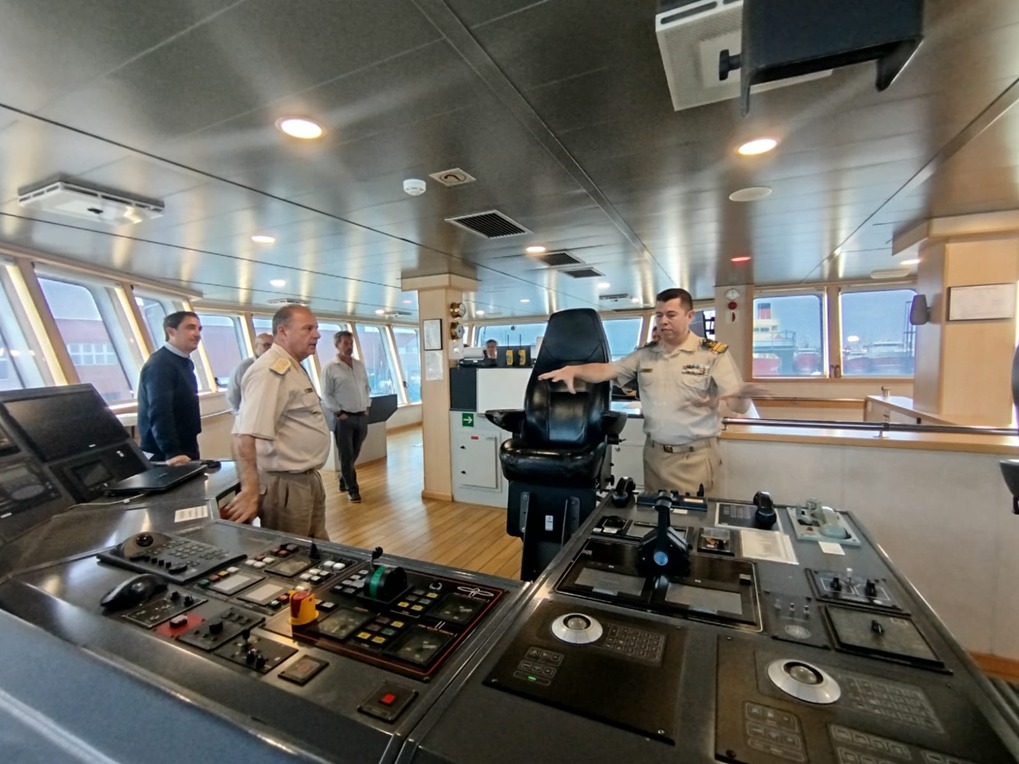
The visit provided an opportunity to deepen understanding of the activities carried out by the Institute and the capabilities involved in its research campaigns. INIDEP is responsible for generating scientific and technical information on fishery resources and marine ecosystems through research programs, stock assessments, oceanographic studies, and work aimed at developing technologies applied to fishing activities. Its results provide scientific foundations to advise national authorities responsible for resource management and conservation.
In this context, the Force's participation takes on a particular dimension. The Institution provides specialized personnel for the operation and nautical command of vessels, integrating the necessary capabilities to conduct campaigns in maritime waters that, due to their distances, hydrometeorological conditions, and operational demands, require rigorous planning and specific navigation knowledge.
Onboard service includes responsibilities that extend beyond commanding a unit. It encompasses navigation safety, watch organization, application of operational procedures, maintenance of safety conditions, and coordination of activities necessary to ensure the development of campaigns. This task requires close interaction between nautical crews and scientific teams, whose research requirements must be compatible with the vessel's operating conditions and the demands of the maritime environment.
During the meeting with the Institution's personnel, the director was able to learn about the specifics of this service, exchange experiences, and make direct contact with the personnel representing the Institution in a specialized technical activity. Training, professional development, and knowledge of navigation systems and unit equipment are relevant aspects for maintaining the efficiency and safety of these operations.
The relationship between both organizations also gains importance from a broader perspective. Scientific research allows for the characterization of living resources, understanding ecosystem variations, and providing information on the environmental and oceanographic conditions of the sea. In turn, the Prefecture's capabilities in surveillance, control, navigation safety, and environmental protection contribute to the exercise of state responsibilities in maritime spaces.
In an increasingly complex maritime scenario, ranging from jurisdictional waters to areas linked to the Argentine Continental Shelf, cooperation between scientific institutions and organizations with control and security responsibilities constitutes a relevant component of maritime governance.