


The meeting was promoted and organized by the United Nations Office on Drugs and Crime (UNODC) and took place in the city of Rio de Janeiro from September 9 to 11. The Argentine delegation was composed of the Director of Maritime, Fluvial, and Lacustrine Traffic, General Prefect Néstor Alberto Kiferling; from the Environmental Investigations Prosecutor's Office (UFIMA), Dr. Romina Hachman; and from the Environmental Prosecutor's Office of Tierra del Fuego, Dr. Eduardo Urquiza.
The Force's participation had as one of its main contributions the operational experience acquired over decades in the prevention, detection, and control of IUU fishing, particularly in the monitoring of distant-water foreign fishing fleets operating in the vicinity of the outer limit of Argentina's Exclusive Economic Zone.
Furthermore, bilateral meetings were held, whose specific working tables allowed for describing the technologies applied to surveillance and monitoring, as well as identifying operational challenges, addressing case analyses, verifying criminal modalities of regional interest, strengthening contacts, and fostering information exchange. Likewise, agreements and lines of work were established to advance coordination and investigations involving transnational components.
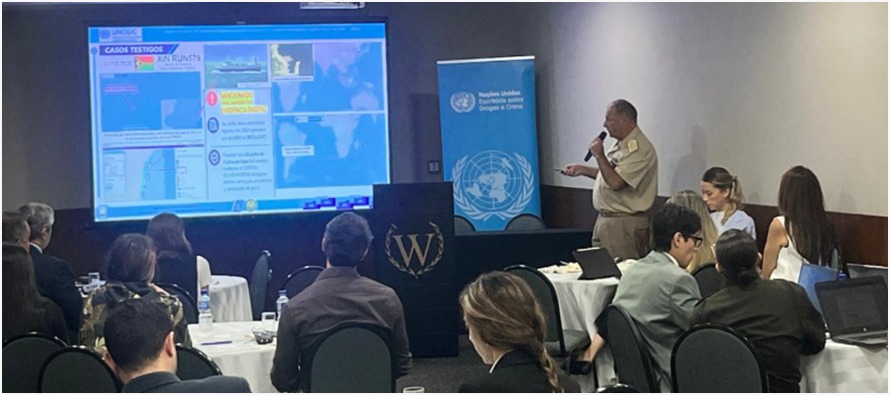
In this regard, it is worth remembering that the Institution develops an integral system for controlling fishing activity that combines surveillance, maritime information, and operational deployment, thus becoming a key player in preventing incursions by foreign vessels and contributing to the compliance with fishing regulations, navigation safety, and the protection of the marine environment.
It is important to highlight that the work of the Coast Guard represents a model to be followed by the countries present, based on Argentina's experience in facing a problem that, due to its transnational nature, requires responses that exceed the individual capacities of each State. In this sense, representatives from the national delegations of Colombia, Ecuador, Peru, Uruguay, and Brazil as the host country, highlighted the commitment of the force and the knowledge provided.
The cooperation and interoperability achieved at the meeting among Environmental Prosecutor's Offices, maritime authorities, security forces, and specialized agencies present, constitute a fundamental tool to discourage these criminal practices in the region. The dimension reached by CORLAC demonstrates that the fight against IUU fishing and illicit environmental activities constitutes a challenge that requires permanent international cooperation.

