

• Carlos Botana today informed the Board of Directors about the temporary authorization of 10,000 m² granted to Suardíaz at the rail siding esplanade for storing Ford Ranger vehicles from South Africa.
• This operation responds to the high activity of the Bouzas Terminal—second in Spain with 538,050 vehicles handled until October—and is part of a statistical balance driven by a record in containerized cargo.
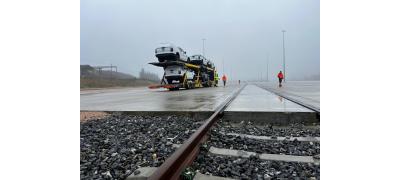
The Salvaterra-As Neves Logistics and Industrial Platform (PLISAN) reinforces its role as a strategic ally for the automotive sector by debuting as a logistics support area for vehicle traffic at the Port of Vigo.
This was conveyed today by the President of the Port Authority of Vigo, Carlos Botana, during the entity's Board of Directors meeting, where the authorization granted to the logistics operator Suardíaz for the temporary use of 10,000 square meters on the platform was reported.
The operation, which began this morning, will extend until January 23rd and will involve the storage of Ford Ranger vehicles manufactured in Durban (South Africa) for their subsequent distribution in the Iberian Peninsula. The units will arrive on ocean-going vessels at the Bouzas Terminal, from where Suardíaz will coordinate their operation and transfer to PLISAN.
A Key Step Towards a Large Intermodal Logistics Center
This temporary concession is located at the recently completed rail siding esplanade in PLISAN, which has a total area of 60,000 m² and is expected to become operational next year. This infrastructure is a fundamental piece in the Port Authority's strategy, which has been negotiating for months with operators and specialized companies to develop a large logistics center for vehicle parking and distribution to the peninsular interior and the rest of Europe in Salvaterra-As Neves.
Once the intermodal terminal comes into service and the work to link the tracks with the general railway network is completed, PLISAN will allow for the articulation of logistics flows in both directions: receiving vehicles unloaded at the port for distribution by train to the rest of the peninsula and Europe, and vice versa—receiving automobiles by rail for maritime shipment from Vigo.
Additionally, value-added services for vehicles are contemplated, such as final adjustments, touch-ups, or the installation of final systems like sound equipment. In this regard, work is underway to connect the ADIF (Guixar) railway terminal with PLISAN and, subsequently, with the plateau, for vehicle traffic (national and European imports).
Support for a Bouzas Terminal at its Capacity Limit
The search for external logistics land directly responds to the sustained growth of the Bouzas Terminal and the existing physical space limitations at the Vigo dock. According to the statistical report presented today by Botana to the Board, automobiles continue to lead the port's cargo ranking. Until October, Bouzas handled a total of 538,050 vehicles—consolidating its second place nationally, only behind Barcelona, after closing last year with 671,665 units.
Although the Bouzas port area covers more than 862,000 square meters—with over 400,000 m² specifically dedicated to ro-ro traffic and complemented by its 60,000 m² multi-story silo in operation, awaiting the addition of a second silo with capacity for about 4,000 vehicles—the Terminal operates at its capacity limit. This saturation makes it essential to enable alternative solutions outside the port area, such as PLISAN and other nearby support yards, to absorb long-stay traffic and avoid bottlenecks in loading and unloading operations.
The Port Exceeds 4.5 Million Tons and Breaks Container Record
The prominence of the automotive sector and the commitment to PLISAN are part of a favorable evolution of overall port traffic. In the accumulated first ten months of 2026, the Port of Vigo has surpassed 4.5 million tons moved, supported by the diversification of its cargo and the strong impetus of containers.
Thus, between January and October, container movement grew by +5.4% to reach 272,133 TEUs, which has allowed containerized general cargo to set a new historical high for this period by exceeding 2.6 million tons (+1% year-on-year). According to Puertos del Estado statistics, this advance is supported by both national traffic (+34.7%) and import and export traffic (+6.4%).
By sector, alongside the industrial leadership of automobiles, frozen fish, and metals, the agri-food sector once again acts as one of the port's major drivers. In this context, fruit leads growth with a rebound of nearly +35% in the annual accumulated total (287,980 tons). Meanwhile, fish approaches 589,000 tons, including frozen fish (482,729 t), canned goods (136,585 t), oils, flours, and fresh fish from O Berbés, which maintains national leadership with over 23,700 tons. Similarly, accumulated increases in slate (+32%), machinery (+2.3%), and food (+1%) stand out.
Operationally, port activity also shows a slight increase in the number of vessel calls (+1%) and a +3% growth in their average gross tonnage, confirming the arrival of larger capacity vessels at the Vigo docks.
October Monthly Balance
In the monthly analysis for October, the total traffic at the Port of Vigo amounted to 498,627 tons. During this month, advances in fruit (+42.36%), raw granite (+34%), slate (+12.5%), automotive parts (+9.7%), food (+7.8%), and machinery (+5%) stood out.


