• 4 min de lectura
• 4 min de lectura
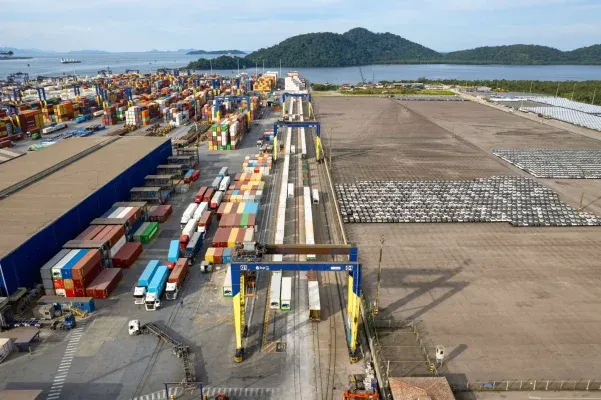
TCP, the company that manages the Paranaguá Container Terminal, and Brado Logística, a multimodal container transport company, have completed the expansion of the railway infrastructure within the terminal's operational yard. The project is expected to increase operational efficiency and expand handling capacity by approximately 20%.
"The railway branch connects Paranaguá with Ortigueira, Cambé, and Cascavel, important production and export centers for chicken meat, paper, and cellulose. With the installation of the third railway line, it will be possible to increase the full cargo transport capacity by rail from 55,000 containers to approximately 66,000 full containers per year, representing a significant improvement in efficiency for customers served in these regions," explained Fabio Mattos, TCP Commercial Manager.
For Vinicius Cordeiro, Brado's Executive Manager of Sales and New Business, the completion of the project represents much more than just the delivery of new infrastructure. The project inaugurates a new stage for logistics in Paraná, expanding the possibilities of connecting producers with national and international markets.
"As a multimodal operator, Brado's role is to transform this structure into concrete solutions, supporting the growth of operations and expanding access to more efficient and sustainable logistics. This evolution at TCP is especially relevant for the state's agribusiness and industrial sectors, which need alternatives capable of keeping pace with increased production and reaching increasingly distant markets. By strengthening railway integration, we contribute to increasing the competitiveness of Paraná's products, offering greater efficiency and predictability in the production flow," affirmed the executive.
TCP is the only port terminal in the southern region of the country that has a direct connection between the operational area and a secondary railway line, and, with the completion of the works, the terminal will receive a third railway track and a new maneuvering area, adding a total of 757 additional meters of track.
Previously, the terminal operated with two lines: while one train arrived at the operational area, another departed, allowing the loading and unloading of 41 containers at a time. With the new line and maneuvering area, two trains will be able to operate simultaneously while a third departs.
The completion of the project also modifies the dynamic of vehicle flow. In the previous model, trains arrived in Paranaguá with 82 wagons and had to be divided into two smaller trains, with 41 containers each, to cross the Avenida Portuária level crossing. This process generated the need for two stops for both trains and vehicles to allow the trains to pass.
Now, a single train can circulate continuously at maximum capacity, which reduces the frequency of crossings at the Avenida Portuária level crossing and ensures constant circulation at reduced speed, avoiding the previous prolonged track blockages.
Investments Expand Logistics Capacity and Strengthen Railway Operations
The expansion of the railway network is part of a broad set of investments made by TCP to strengthen its logistics infrastructure. Over the last five years, the company has invested approximately R$ 500 million in operational improvements and in expanding the terminal's capacity.
To accommodate increased railway traffic, the area began operating with three RTG cranes, one more than before. These cranes underwent an electrification process, with the installation of electrical conductor bars along the railway track, an initiative that resulted in a reduction of approximately 771 tons of carbon emissions per year in the operation of the three cranes.
Additionally, TCP invested in the mobilization of new terminal tractors (TT) to optimize railway operations and in the readjustment of the terminal gate, which allows access to the third line and greater fluidity in cargo movement.
The expansion also included investments by Brado Logística in strategic assets and components for the implementation of the new railway infrastructure.