• 5 min de lectura
• 5 min de lectura
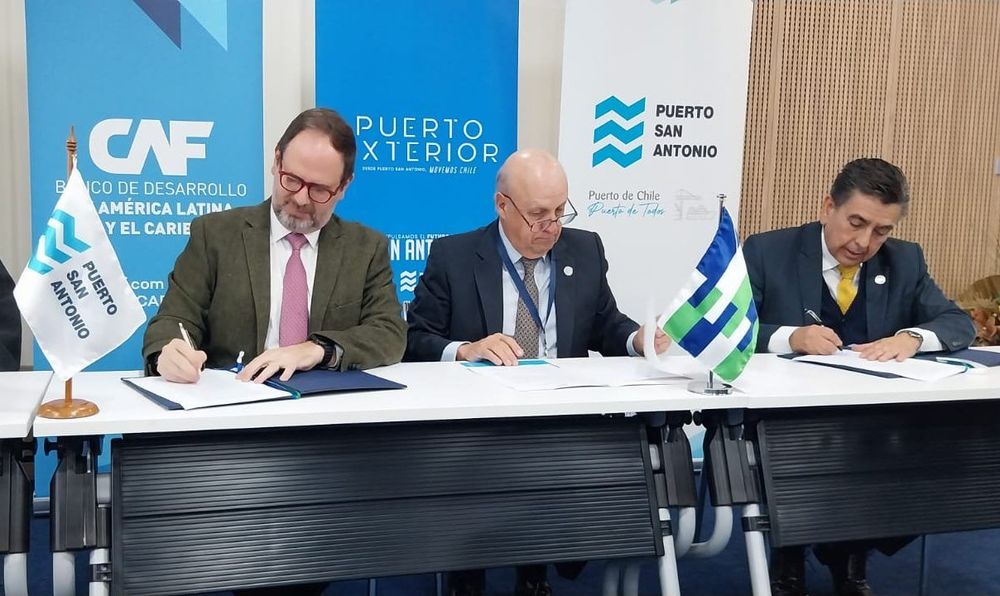
The Development Bank of Latin America and the Caribbean (CAF) formalized the delivery of USD 50 million to the San Antonio Port Company (EPSA), an amount representing 33.33% of the total financing approved by the organization in March 2025. The funds will be used to cover enabling works, environmental compensation measures, and initial works related to the Outer Port project.
The agreement was finalized through the signing of the loan during a ceremony held at the state-owned port company's corporate building. The event was led by the chairman of the EPSA board, Sergio Merino Gómez; its general manager (i), Fernando Gajardo; and the Sustainable Development Manager and CAF representative in Chile, Julián Suárez Migliozzi.
In this context, Sergio Merino commented that "this enables Puerto San Antonio to begin the works for the development of the Outer Port. Obviously, it is not the financing of the Outer Port itself, but it allows us to start with the enabling works for the port's development. The use of the credit will be to develop enabling activities for the construction of the port, meaning it will be used for a part of the environmental compensation measures that the project requires, and this allows us to keep the operation financed until mid-next year."
"Having a favorable Environmental Qualification Resolution is a very significant point in the development of this project. CAF, without a doubt, evaluated this issue and is now helping us with the financing of these measures. I believe that the CAF credit reaffirms the confidence that a multilateral entity like CAF has in the Outer Port, in society, and in the current port," he added.
For his part, Julián Suárez stated that "today is a very important milestone that a first loan of up to 50 million dollars can be signed for what is called stage zero of the new Outer Port construction project. These are basically enabling works so that the breakwater can then be built and, with this, the port terminals can then be developed here with private investment. CAF has considered, as it generally does for its financing, this project from a technical and environmental point of view. So, in all its forms, we have considered it a highly relevant project."
"Initially, we approved a financing operation of up to 150 million dollars. And what happens is that, understanding EPSA's financing needs for 2026-2027, that has been revised to a financing operation that addresses the investments, the financing needs for these two years, and that is consistent with the 50 million dollars. Notwithstanding that, of course, CAF is available to continue supporting this project in the future," he pointed out.
"With this first stage of financing, the company's needs for the years 2026 and 2027 are covered. Afterwards, we will accompany the company in whatever is required, including reviewing the different alternatives or financing schemes that are most useful for the State of Chile and for the company in particular," Suárez expanded.
In line with the original planning, the enabling works for the Outer Port would require an investment of USD 300 million. Half of this budget would be covered by the CAF loan, while the remaining 50% will come from the state-owned port company's own resources.
Debate on public financing
The delivery of these funds coincides with the debate opened at the last meeting of the Infrastructure Policy Council (CPI). In that instance, the biminister of Transport and Telecommunications and Public Works, Louis de Grange, acknowledged certain complexities in securing state resources for the breakwater, warning that fiscal spending would be to the detriment of covering social emergencies.
However, the Secretary of State specified that the Executive is already exploring international financing formulas and schemes with multilateral banks to make this foundational work viable.
For its part, the port project is advancing in its processing after obtaining the approval of its Environmental Qualification Resolution (RCA) by the Environmental Evaluation Commission (Coeva), which took place in May of this year. Following this progress, Fernando Gajardo confirmed to PortalPortuario that the first phase of construction will be executed purely through public investment.
At a macro level, the Outer Port project contemplates the construction of a breakwater of approximately 4 kilometers, in addition to dredging and esplanades that will enable two terminals of 1,730 meters each. Its development is planned in four stages, depending on demand.
The comprehensive investment plan is estimated at USD 4.450 million. Of that total, USD 1.950 million will be contributed by EPSA for preliminary works, the construction of the breakwater, the creation of the basin, backup areas, and access roads, as well as environmental mitigation and compensation measures.
The remaining USD 2.500 million will be contributed by the private sector, through port concessions, for the construction, enabling, and operation of the sites.
The new port will be able to mobilize 6 million TEU per year, equivalent to about 60 million tons annually. In addition, it will be enabled to simultaneously serve up to eight 400-meter container ships, the largest operating globally today.
Source: Portal Portuario