• 4 min de lectura
• 4 min de lectura
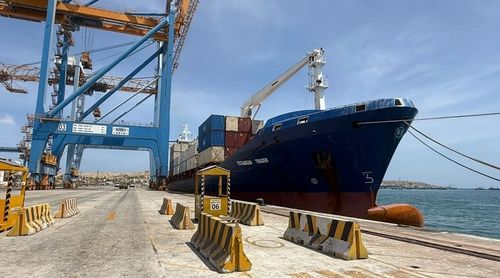
When the Chancay Multipurpose Port was built, the idea was one: to turn Peru into the Latin American hub par excellence, with all the positive consequences that this entails. One year has passed since this terminal began operations, and expectations have been widely surpassed. There is still much to do, but the path is already set, and there is nothing to deter the country from achieving that goal.
In these first 365 days of operations, the port terminal has exceeded 502,646 TEUs mobilized and achieved an accumulated volume of 2.4 million tons of cargo, specified the Deputy General Manager of Cosco Shipping Ports Chancay (CSPCH), Jason Guillén.
"These results strengthen our position as a connection point between South America and Asia-Pacific, with maritime services that allowed for reduced transit times to Shanghai and improved the competitiveness of Peruvian foreign trade," the executive stated.
According to Guillén, between January and May of this year, the number of vessels served at the Port of Chancay registered a 44% growth compared to the same period in 2025. Likewise, there was a 74% increase in the volume of cargo mobilized.
"These results confirm that the Port of Chancay is already a concrete platform to connect opportunities, people, and markets. Thus, we reinforce our commitment to continue strengthening the port's operations and developing its full potential for the benefit of foreign trade, Peru's competitiveness, and regional integration," he asserted.
The commemoration of the first anniversary of commercial operations of the Port of Chancay included a ceremony attended by the General Manager of Cosco Shipping Ports Chancay Peru, Wang Bin; the Ambassador of the People's Republic of China in Peru, Song Yang, and various local, regional, and national authorities.
"Since its inauguration, the total value of imports and exports mobilized through the Port of Chancay reaches 3.6 billion dollars; container movement exceeds 500,000 TEUs; bulk cargo reaches 2.4 million tons; and it manages 42,000 vehicles of various international brands," commented the ambassador.
Furthermore, he stated, the port contributes more than 1.6 billion soles in tax revenue to Peru.
"Thanks to the reduction in maritime transport time and improvements in the cold chain, high-value-added Peruvian agricultural exports are gaining new momentum. Blueberries, grapes, avocados, and other high-quality fresh products represent 50% of the goods exported through the port, significantly boosting the modernization of foreign trade," he said.
The Chinese diplomat noted that, in just over a year, the Port of Chancay opened three main maritime routes and four feeder routes reaching ports in China, as well as ports in Colombia, Ecuador, Chile, and Panama; consolidating itself as an important logistics hub connecting Asia-Pacific and Latin America.
As the first major smart port in South America, Chancay integrates concepts of intelligence and security from the beginning of its planning.
With 5G technology, automated gantry cranes and yard cranes, automated container trucks, digital twins, and intelligent energy management systems, 24-hour supervision, intelligent operation scheduling, and unmanned operation are possible, significantly improving operational efficiency, safety standards, and emergency response capability.
"We are convinced that the Port of Chancay will continue to play its role as a strategic gateway connecting Asia-Pacific and Latin America, and will continue to make an even greater contribution to the common development of our two countries and to cooperation between China and Latin America," he emphasized.
Peru was one of the first countries in Latin America to sign a free trade agreement (FTA) with China and one of the first to join the Belt and Road Initiative. It also remains the third country of origin for imports from Latin America to China.
Ambassador Song Yang of the People's Republic of China in Peru stated that, during his almost four years of mission in the country, bilateral trade between the two nations increased from 34.9 billion dollars recorded in 2022 to 50.9 billion dollars reached in 2025.
"We hope that this year it will exceed 60 billion dollars. This fully reflects the vigor and dynamism of cooperation between both countries," the diplomat said.
Source: Andina