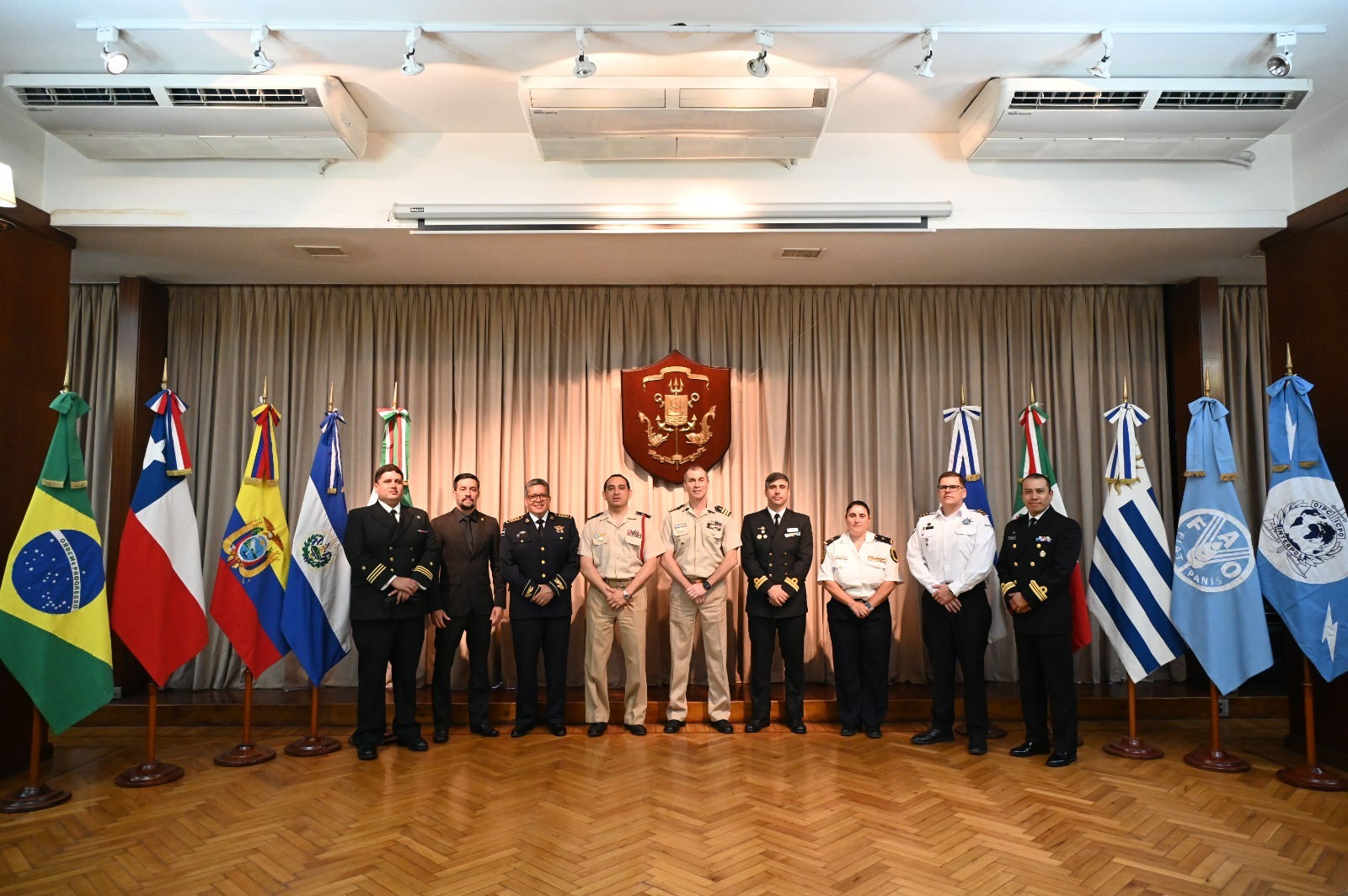
The Argentine Naval Prefecture held the opening ceremony for the fourth edition of the “International Training for Police Interventions Against Illegal Fishing” course, known as the “Coast Guard Course,” this morning in the Deputy Doctor Manuel Florencio Mantilla Hall of the Coast Guard Building.
The event was led by the National Naval Prefect, Prefect General Guillermo Giménez Pérez, accompanied by the Deputy National Naval Prefect, Prefect General Alejandro Annichini, and the Director General of Security, Prefect General Carlos Villarreal.
The ceremony was attended by the Undersecretary of Aquatic Resources and Fisheries, Juan Antonio López Cazorla; the Director of Informatics and Communications, of the General Inspectorate and the Comprehensive Center for Training and Improvement in Telecommunications and Maritime Traffic Services, Prefect General José Antonio Impollino; the Director of Maritime, Fluvial and Lacustrine Traffic, Prefect General Néstor Kiferling; personnel from the Force; representatives from the National Ministry of Security; foreign authorities and INTERPOL representatives.
Coordinated by the Comprehensive Center for Training and Improvement in Telecommunications and Maritime Traffic Services, the course aims to strengthen police and operational capabilities to prevent, detect, and combat illegal fishing through the exchange of knowledge, experiences, and intervention tools.
This edition includes scholarship recipients from Brazil, Chile, Ecuador, El Salvador, Equatorial Guinea, Honduras, Mexico, and Uruguay, who will participate in theoretical and practical training sessions, including a navigation aboard one of the Force's maritime patrol vessels, alongside specialists and speakers from the International Criminal Police Organization (INTERPOL) and the Food and Agriculture Organization of the United Nations (FAO).
During the opening, the National Prefect addressed those present and highlighted the importance of these international training and exchange spaces for strengthening cooperation and response tools against a problem that requires coordinated responses among different countries and organizations.
In this regard, he addressed the participants and stated: “Your participation is a complete demonstration of our country's willingness to work together in the face of challenges that recognize no borders and demand coordinated responses.”
He then added that “perfecting our competencies, integrating technological innovation, and reviewing our operational practices to be at the height of 21st-century efficiencies,” and continued: “It is not only about transmitting techniques or procedures; it is about generating a living space for exchange among peers who, from different attitudes and national realities, face common problems, such as illegal, unreported, and unregulated fishing, which threatens resource conservation, productive sustainability, ideal market competition, and the effectiveness of controls.”