• 4 min de lectura
• 4 min de lectura
Santander, September 16, 2026.
The automated control system at border posts consists of eight modules, each equipped with six self-service stations and one manual control station. In addition, there are ten other stations located in the Maritime Terminal for the verification of passengers traveling without a vehicle.
The Port Authority has invested more than 5.2 million euros, which will be subsidized by the European Union.
César Díaz thanks the National Police and Brittany Ferries for their efforts in implementing the Entry Exit System (EES).
The president of the Port Authority of Santander (APS), César Díaz, announced this morning, during the presentation of the equipment acquired to provide automated control to the border posts of the Port of Santander, of “the culmination of the implementation process of the facility and the success of its commissioning.”
The system, which has been installed both in the Maritime Terminal and in the ferry terminal located on the Maliaño dock, consists of eight modules or containers, each equipped with six self-service stations and one manual control station. In addition, there are ten other stations located in the Maritime Terminal for the verification of passengers traveling without a vehicle.
Furthermore, a service contract for auxiliary passenger assistance personnel has been added. These tasks include, among other things, supporting the National Police in providing information services to third-country passengers at the access points to passport controls in the Port of Santander.
Both actions, which represent a total investment of 5.2 million euros and are necessary to comply with the application of the European Entry/Exit System (EES) and the European Travel Information and Authorisation System (ETIAS), are co-financed by funds from the Instrument for Financial Support for Border Management and Visa Policy (IGFV) of the European Union and European Funds for Internal Security (FESI).
The installation of this new European system, mandatory from this year, is the result, as Díaz explained, of the “arduous work” carried out in recent months by the Port Authority, the National Police, and Brittany Ferries, whom he thanked for their efforts “to implement a project that will contribute to modernizing external border management, improving the detection of overstays, strengthening internal security, and enhancing passenger safety and comfort.”
“Santander is an important gateway for passengers arriving from and departing to the United Kingdom, as evidenced by the more than seven million travelers who have passed through our port,” he noted. It was, therefore, “fundamental” to successfully implement the EES, “while also maintaining the layover times of the Breton company.”
Also participating in the presentation to the port community were the Minister of Presidency, Justice, Security and Administrative Simplification, Isabel Urrutia; the Director of Planning and Development of Puertos del Estado, Manuel Arana; and the Chief of the National Police in Cantabria, Antonio del Amo.
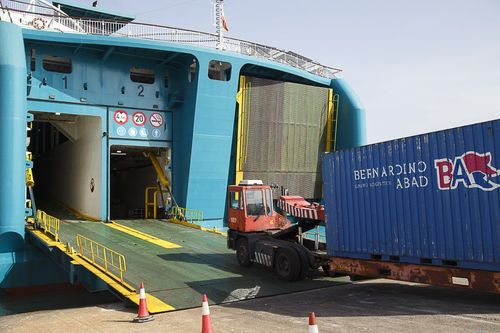
The operation witnessed by those attending the equipment presentation ceremony involved the Brittany Ferries vessel Salamanca, which disembarked a total of 625 passengers and 377 vehicles, while embarking 492 passengers and 317 vehicles.
EES
The Entry/Exit System (EES) aims to modernize and make more efficient controls at the external borders of the Schengen area through an automated digital registration of entries, exits, and refusals of entry, replacing manual passport stamping and including biographical data, date and place of crossing, and biometric data.
This improves the control of authorized stays, enhances security, and streamlines travel, reducing overall waiting times at borders through self-service options for travelers.
In Santander, the contract for the supply, installation, commissioning, and three-year maintenance of this equipment was awarded to the Temporary Business Union (UTE) NTT Data Spain, S.L.U. – Idemia Technologies Ibérica, S.A.U. and NYY Data Spain Sistemas de Seguridad, S.L.U., through a negotiated procedure without publicity, restricted to companies approved by the Ministry of Interior, with a budget of 3,437,610 euros and an execution period of forty months. After a period of three years, the APS will transfer ownership of the equipment to the Secretary of State for Security of the Ministry of Interior.
Also, within the framework of the entry into force of the EES and ETIAS systems, the Port Authority awarded the contract for auxiliary passenger assistance personnel services to the company Interim Services Solutions, S.L. The contract amount totals 1,792,157 euros and has an execution period of thirty-six months.
The investment in both equipment and the personnel necessary for the implementation of the EES amounts to more than 5.2 million euros, part of which will be subsidized by the EU.