• 6 min de lectura
• 6 min de lectura
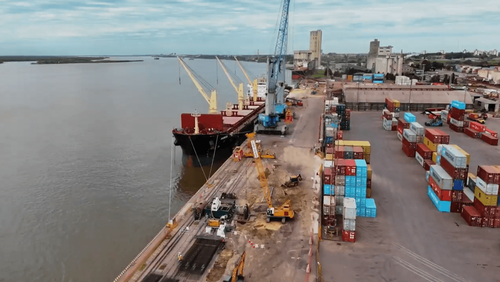
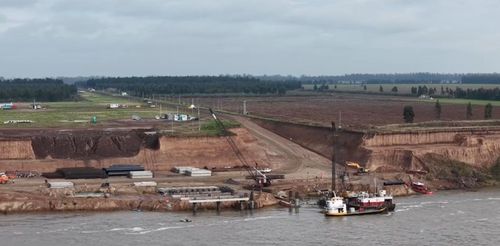
Puerto Las Losas (PLL), a multipurpose terminal located in Huasco Bay, completed 15 years of operation, a period in which the port facility in northern Chile expanded its focus to accommodate a wider range of cargo. The maritime facility's projection aims to expand its capabilities and support the growth of the mining sector in the Atacama Region.
The General Manager of Puerto Las Losas, Karen Pradenas, told PortalPortuario about PLL's main milestones and challenges since it began operations, as well as future prospects, where the market on the other side of the Andes mountain range also appears as a window with new opportunities to increase the range of cargo and products that pass through its docks.
"This 2026 has been a special year for us, as it coincides with the celebration of our 15 years of operation. In addition, in January we began shipping iron concentrate from our main client, a relevant operational milestone for the year. It has been a year in which we have continued to consolidate our operation as a multipurpose port, stably handling both mineral and vegetable bulk as well as project cargo and containers, and advancing in expansion projects that will allow us to continue growing hand in hand with the region," said Pradenas.
The executive commented that "we have evolved from a port primarily oriented to minerals and vegetable bulk to a multipurpose platform. We incorporated fruit shipments in 2014, then expanded our environmental licenses to operate a much wider range of products such as iron, copper, lithium, gold soda ash, among others."
"Additionally, we added the capacity to receive oversized project cargo, such as wind turbines, transformers, and industrial mining equipment, and implemented a conveyor belt loading system that increased our operational efficiency. Today we have an authorized capacity of 6,000,000 tons per year and more than 29 hectares of storage, figures that reflect the growth the port has achieved in a decade and a half of operation," explained Pradenas.
The General Manager of PLL highlighted the role of the maritime terminal within the Atacama Region and remarked that "we are the natural gateway to the Pacific for a large part of the mining, agro-industrial, and energy production of northern Chile. We connect the exporting mining industry of the Atacama Region —iron, copper, and other minerals— with international markets, while also supplying agro-industrial and energy inputs to the regional industry."
Likewise, Karen Pradenas emphasized that "our location in Huasco Bay and the road connectivity with Vallenar and Copiapó position us as a key logistics hub within the bi-oceanic corridor to the Southern Cone. Beyond port operations, we are a relevant actor in the socioeconomic development of the province: we boost local employment and strengthen the supply chains of Huasco and Vallenar."
The executive responsible for Puerto Las Losas reviewed the main milestones that marked the 15 years of operational life of the terminal, as well as the major challenges faced throughout this fifteen-year period.
"First, the completion of construction in 2010 and the start of operations in March 2011. In 2014, we made the first fruit shipment from Puerto de Huasco, which opened a new line of business. The incorporation of the discharge of wind projects such as Parque San Juan and Cabo Leones, among other project cargo, was also key, consolidating us as a port capable of handling oversized cargo for the industry," she said.
"Another relevant milestone was the commissioning of the conveyor belt loading system, which increased our performance in handling mineral bulk. And in terms of safety, we have gone more than five years without lost-time accidents (LTA), a result of which we are especially proud," Pradenas valued.
Regarding the challenges, the general manager stated that "one of the most relevant was facing the climatic event associated with the El Niño phenomenon. Thanks to our facilities being prepared for this type of adverse conditions, we were not significantly affected and were able to maintain our operations and supply services to smaller vessels without interruptions."
"That episode confirmed the resilience of our infrastructure and reinforced our commitment to continue investing in operational capacity that allows us to respond continuously to adverse climatic events, an increasingly relevant factor for the port industry," she stressed.
Karen Pradenas referred to the new possibilities and cargo that could arise to boost the growth of Puerto Las Losas.
In this regard, the executive stated that "we see important opportunities linked to the mining development of the Atacama Region, particularly in copper and lithium, sectors for which we already have environmental authorizations for a copper concentrate storage building with an authorized capacity of 280,000 tons, a mechanized loading system, and currently, we have a modular warehouse for iron minerals."
"We also project continued growth in project cargo associated with the energy transition —wind farms, solar farms, and energy storage systems (Bess)— an increasingly relevant segment in our operation. Added to this is the opportunity to expand our hinterland to northwestern Argentina, particularly to the provinces of San Juan and Catamarca, whose mining production could find a natural outlet to the Pacific in Puerto Las Losas," she affirmed.
Regarding the possibilities offered by the market in Argentina, Pradenas noted that "it represents a concrete opportunity. Our connection, through Paso San Francisco, with provinces in northwestern Argentina such as La Rioja, Catamarca, Tucumán, Santiago del Estero, and Salta, positions us as an alternative outlet to the Pacific within the bi-oceanic corridor. We believe there is room to attract new mining and agro-industrial cargo from northern Argentina, as long as road infrastructure and border crossings between both countries continue to be developed."
The General Manager of Puerto Las Losas stated that "our plans are focused on expanding storage and loading capacity to accompany the growth of regional mining. We already have authorization to build the copper concentrate storage building (280,000 tons) and the modular warehouse for minerals (120,000 tons), investments that will allow us to respond to the growing demand for copper and iron shipments."
"In parallel, we continue to strengthen our capacity to handle project cargo linked to the energy industry, a segment that will continue to grow hand in hand with the country's energy transition," she added.
Regarding the implementation of new tools to strengthen the operation of the multipurpose terminal, Karen Pradenas indicated that "technological modernization has been part of our roadmap: a concrete example is the incorporation of the conveyor belt loading system, which replaced more manual processes such as traditional stevedoring and increased our efficiency in handling mineral bulk."
"We continue to evaluate new technologies that allow us to operate more efficiently, traceably, and sustainably, in line with the standards required by the mining and energy industry we serve," the executive concluded.