

• 6 min de lectura
• 6 min de lectura

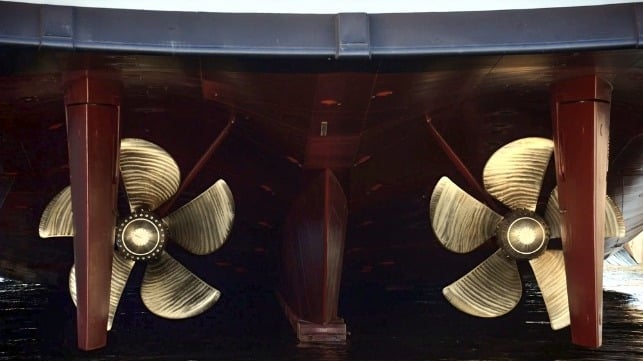 USN file image
Published May 13, 2026 4:11 PM by
James Watson and Elizabeth Bouchard
The Society of Naval Architects and Marine Engineers (SNAME) was founded in 1893 by 13 leaders from across the U.S. maritime sector. They were responding to the weakened state of American commercial and naval shipbuilding after the Civil War and created a forum to advance "practical and scientific knowledge" in shipbuilding, marine engineering, and allied professions.
Headquartered in Alexandria, Virginia, SNAME is an independent, nonprofit professional society for naval architects, marine and ocean engineers, and related specialists. Its community includes more than 4,000 members in 69 countries organized into 20 professional sections in five regions: International, Atlantic North, Atlantic South, Central & Gulf, and Pacific. Its membership is broad enough to be globally relevant, but it is its local focus that provides the unparallelled networking and learning opportunities.
SNAME is largely member-funded, with limited sponsorship from companies and government agencies. This independence helps create a noncompetitive space where industry, government, and academia can compare notes, test ideas, and document what works through committees, panels, and publications. The benefits ripple outward to shipyards, engineering firms, equipment makers, owners and operators, ports, and public agencies that rely on better designs and better technical decisions.
In 2026, SNAME's agenda reads like a roadmap of the modern maritime industrial base: machine learning, robotics, additive manufacturing, digital twins, alternative fuels and power, ice strengthening, port interfaces, dual-use technologies, and secure supply chains. As policymakers press for a U.S. maritime resurgence through public and private investment, naval architects and marine engineers will be central—integrating emerging technologies into producible ships and systems that stay safe, reliable, and sustainable over decades at sea.
SNAME Alignment with U.S. Maritime Industrial Base Aspirations
A closer look at today's maritime industrial base proposals makes one point clear: many of the hardest problems are engineering problems—and they map directly to the expertise inside SNAME's membership and technical committees.
Proposals to establish a national maritime policy advisor and a maritime security board will only succeed if they are informed by technical reality. Designers and engineers, including many SNAME members, should help assess feasibility, set practical innovation priorities, and shape standards. A high-level policy mechanism should be able to draw on SNAME committees as a dependable source of real-world expertise.
Long-term, predictable funding for shipbuilding and maritime R&D is essential because ship design and engineering are multi-year endeavors. Stable demand strengthens the professional base—naval architecture, marine engineering, and detailed design—and SNAME supports those professionals through training, technical exchange, and forums that keep practice aligned with the state of the art.
R&D leadership has long been foundational to SNAME. Many members have built reputations as world-renowned subject-matter leaders through committee work, research, and publishing. Any transformation of the U.S. maritime industrial base will need that kind of organized, readily available technical leadership.
SNAME members also bridge the gap between commercial and military shipbuilding—an advantage as policymakers emphasize ships that are commercially efficient yet militarily useful. Designing for dual requirements adds complexity in hull form, propulsion, survivability, and lifecycle support; specialized naval architecture many SNAME members practice.
Talent development proposals—professional hubs, workforce pipelines, and knowledge transfer—align with long-running SNAME activities. University programs at maritime schools train future naval architects and marine engineers, and SNAME's 49 student sections and engagement in continuing education and professional licensure place the Society at the center of recruiting and development.
As the U.S. maritime sector looks outward for proven practices, SNAME can make global knowledge transfer practical by facilitating professional exchanges that connect members and students with leading design and production approaches worldwide.
SNAME Technical and Research Program
SNAME recently restructured its Technical and Research (T&R) program to reflect new priorities, including themes highlighted in the Maritime Action Plan (MAP). One central question was: what types of vessels does it make sense to build in the United States? Two areas drew particular attention—maritime nuclear power and autonomous marine vehicles.
The T&R program now includes a Maritime Nuclear Power Committee (panels on nuclear-powered ships and floating nuclear power plants) and a new panel on Autonomous Marine Vehicles.
Ship Design
Less flashy—but just as consequential—is work on schedule and cost realism as projects move from concept to Front End Engineering Design, Final Investment Decision, and detailed design. Programs stumble when requirements and engineering maturity aren't de-risked early; late changes then cascade into disputes, overruns, and delays. SNAME's cross-sector experience, including lessons from offshore and energy projects, helps teams set achievable assumptions and share practices that improve execution.
Ship Production
SNAME's Ship Production Committee, working with the National Shipbuilding Research Program (NSRP), is leaning into modular construction, digitalization, and AI—while keeping focus on the fundamentals that determine whether yards can scale: workforce development and productivity. Modularization and distributed fabrication can also broaden the supplier base, supporting the MPZ concept by spreading skilled work across a region.
Together, these efforts position SNAME as a practical partner for rebuilding capacity: convening experts, translating lessons across sectors, and turning ambitious policy goals into designs, standards, and production methods that can be executed and sustained over a ship's full life.
Maritime Prosperity Zones
The Maritime Action Plan proposes Maritime Prosperity Zones (MPZs) to link supply chains, workforce development, and financing to support new shipbuilding activity. Offshore floating wind is one example of a steel-intensive market where SNAME's Offshore T&R Committee is positioned to contribute as projects scale.
Sharing Knowledge
A maritime resurgence will be built on shared knowledge as much as steel. That's where SNAME's publishing and convening roles matter: trusted technical content, peer review, and forums that let practitioners challenge assumptions and carry proven ideas back to yards, design teams, and fleets.
SNAME shares knowledge through several flagship channels, including:
Fuente: Maritime Executive

