Media IntelligenceAgenda
/
ESENPT
DataPortuaria
PortsForeign TradeLogisticsAgro
DataPortuaria

El portal de referencia del sector portuario y marítimo de Latinoamérica. Noticias, análisis y datos en tiempo real.

Seguinos:

Secciones

AgroAnalysisBiofuelsCruisesCurrent AffairsEnvironment and EnergyForeign TradeInterviewsLogisticsPortsShipbuildingShippingWaterway

Ediciones

ArgentinaBrasilEcuadorEspañaInternacionalMexicoPanamaPeru

Servicios

Media IntelligenceAgenda

Legal

AboutPrivacy policyCookie policyTerms of useContact

© 2026 DataPortuaria. Todos los derechos reservados.

Inicio›Ports

Port of Chancay Reaches 323 Vessel Operations and 340,000 TEU in 2026

Two years after its inauguration, the Port of Chancay, located 80 kilometers north of Lima, has solidified its position as a logistics hub connecting South America and Asia. Between January and September 2026, it recorded 323 vessel operations, a 31 percent year-on-year increase, and accumulated container movement reached 340,000 TEU, a 47 percent increase. The maritime network features three long-distance and five regional routes.

Últ. Actualización 16 de nov 2026|Lectura: 8 min

Imagen de portada - Destacan importantes logros del puerto peruano de Chancay tras primeros dos años de funcionamiento

Resumen

  1. According to CFO Jiang Zhiguo, the terminal has three main long-distance routes and five regional connecting routes.
  2. Operations and Planning indicated that the port increased from 8 or 10 movements per hour on initial vessels to over 25 movements per hour.
  3. The direct Chancay-Shanghai route reduced transit time from 45 days to 23 days between South America and the Asian market.
  4. Approximately 90 percent of workers in the operations area are Peruvian, according to Jairzhiño Elías Pérez.

Seguí a dataPORTUARIA en Google News

Agregá este medio como fuente preferida y no te pierdas las últimas noticias.

Agregar como fuente preferida

Two years after its inauguration, the Port of Chancay, located about 80 kilometers north of Lima, the capital of Peru, is consolidating as an important logistics center that strengthens maritime connectivity between South America and Asia, facilitates regional trade, and opens new opportunities for economic integration in the Asia-Pacific region. (Xinhua/Mariana Bazo)

Two years after its inauguration, the Port of Chancay, located about 80 kilometers north of Lima, the capital of Peru, is consolidating as an important logistics center that strengthens maritime connectivity between South America and Asia, facilitates regional trade, and opens new opportunities for economic integration in the Asia-Pacific region.

PROGRESS AND DIVERSIFICATION IN THE FIRST TWO YEARS OF OPERATION

Cosco Shipping Ports Chancay Perú CFO, Jiang Zhiguo, told Xinhua that since its inauguration in November 2024, this megaport "has gone through different stages," including its official opening, testing period, and commercial operations.

During this operational consolidation process, the port infrastructure "has continuously expanded its network of maritime routes," diversifying its activities and improving its capacity to transition from a "recently built" facility to a port hub with regular large-scale operations.

Zhiguo specified that the terminal's maritime network now has three main long-distance routes "that efficiently connect Asia-Pacific with South American markets," as well as five regional connecting routes that integrate containers and roll-on/roll-off cargo.

Through these connecting services, the megaport has begun to consolidate an operational model that combines direct transoceanic connections with regional goods distribution, extending its reach to neighboring countries such as Colombia, Ecuador, and Chile.

This, according to Jiang, "significantly improves the logistical efficiency and stability of transoceanic transport, and provides a more efficient and convenient logistical channel for trade between China and Peru."

Between January and September 2026, the port recorded 323 vessel operations, representing a year-on-year increase of 31 percent, while accumulated container movement reached 340,000 TEU, with an increase of 47 percent.

He specified that the volume of Peruvian products exported through the Port of Chancay "is growing," highlighting fresh grapes (11 percent), fresh avocados (11 percent), silver concentrates (10 percent), fishmeal and pellets (7 percent), and fresh blueberries (6 percent).

Referring to plans related to expanding the capacity of this port and developing complementary facilities, Jiang assured that "they will be governed by market criteria and will be closely linked to Asia-Pacific trade trends."

Former Peruvian Minister of Transport and Communications, Enrique Cornejo, recently stated that with the creation of this megaport, a "new and direct" trade route between Asia and South America is opening, positioning Peru as a regional "strategic center."

Te puede interesarTisur Orders Mobile Harbor Crane from Konecranes for Matarani Port

DEVELOPMENT OPPORTUNITY FOR LOCAL POPULATION

Currently, the Port of Chancay represents a key logistics center for international trade and regional connectivity, standing out for having made positive contributions to local job creation, related industrial development, and the well-being of the neighboring population, as well as boosting local tourism.

For his part, the head of Operations and Planning, Jairzhiño Elías Pérez, highlighted the progress after two years of operation.

"Undoubtedly, we have evolved a lot in this port. We have gone from making 8 or 10 movements per hour on the first vessels, now we make more than 25 movements per hour. The Port of Chancay contributes a lot not only to Peru, but to South America. It is Peru's gateway to Asia," he indicated.

He recalled that previously there was an average maritime route that took 45 days to connect South America with the Asian market, but since the creation of the terminal by Cosco, the direct Chancay-Shanghai route was established, reducing transit to 23 days.

Pérez emphasized that the company has constantly trained local personnel to strengthen a culture of safe and efficient work, and that approximately 90 percent of the workers in the operations area are Peruvians who have successfully assimilated these advanced technologies.

He stressed that almost 90 percent of the people working in this port are Peruvians, many of them residents of the town of Chancay, which has given them the opportunity to develop professionally and in their careers.

Among the workforce is Ítala Ramírez, a 55-year-old local resident of Marítima Baja, who works for the megaport through the company "FF Global," performing supervisory duties during cement unloading operations.

"It's a very beautiful experience. The truth is I didn't think I would participate in working with the megaport, I didn't think so in my life, and it's something satisfying for me," the Chancayana resident expressed with deep emotion.

She affirmed that the local population has benefited because "thousands of businesses have opened" in the central streets of the city, transforming old family homes into active commercial premises, driven by the constant influx of entrepreneurs and visitors.

The resident highlighted that the future development of the Chancay megaport will continue to generate new job and professional development opportunities for the new generations of the coastal town.

In addition to development opportunities for local residents, the port provides opportunities to boost trade and cooperation in the region, as it has begun to receive transit cargo destined for other South American countries.

Now, through Chancay, technological products arrive that are transported by land to Bolivia, while the main goods sent to Brazil are various mass consumer goods. Shipments of technological products have also been made to Colombia.

ECONOMIC INTEGRATION IN ASIA-PACIFIC

According to Juan Carlos Capuñay, former Peruvian Ambassador to China and former Executive Director of the Asia-Pacific Economic Cooperation (APEC) Forum Secretariat, the Port of Chancay not only stands out for its "immediate effects" and for having employed a large number of people, but it is also necessary to consider the effects it will have in the future for Peru and the rest of the region.

In this regard, Capuñay stated that, with a smoothly operating port, cargo can be brought from various parts of Peru and other South American countries. "Its presence will generate possibilities in other areas," he indicated.

For the former Peruvian ambassador, this infrastructure benefits not only Peru, but also simultaneously favors exports to Colombia, Chile, and Ecuador, as it has a shorter journey and lower cost.

He added that the benefits are not limited to the South Pacific, as Brazil will enjoy the benefits of using the port "for its trade to reach Chinese ports with a saving of approximately 15 days, which is quite significant when we talk about exports or international trade."

For his part, Edgar Vázquez, director of the Center for Economic and Business Research of the Association of Exporters (CIEN-ADEX) of Peru, highlighted that Chancay is allowing Peruvian and other countries' products to "competitively reach" Asia, and vice versa.

"But it is also allowing Peruvians, and the rest of South American countries, to have high-quality products at very competitive prices, especially on the technological side, coming from Asia and particularly from China," he added.

One of the Peruvian exporting companies benefiting from this infrastructure is Danper Trujillo S.A.C., dedicated to sending fresh products such as blueberries, avocados, and grapes, as well as a varied offer of frozen agricultural products, to the Asian market, including China.

Briggite Grados, Deputy Manager of International Operations for the Supply Chain area of the company, highlighted that the maritime facility offers them "competitive times" to the main destinations in Asia and is located at a "strategic" point, which optimizes transport logistics from their packing plants.

Grados emphasized that the operation of the megaport represents a fundamental "hub" that gives Peruvian agro-exporters the opportunity to expand their operations to new markets in the Asian region, consolidating the presence of Peruvian products abroad.

Image from November 3, 2026, of cranes and containers seen at the Port of Chancay, in Chancay, Peru. Two years after its inauguration, the Port of Chancay, located about 80 kilometers north of Lima, the capital of Peru, is consolidating as an important logistics center that strengthens maritime connectivity between South America and Asia, facilitates regional trade, and opens new opportunities for economic integration in the Asia-Pacific region. (Xinhua/Mariana Bazo)
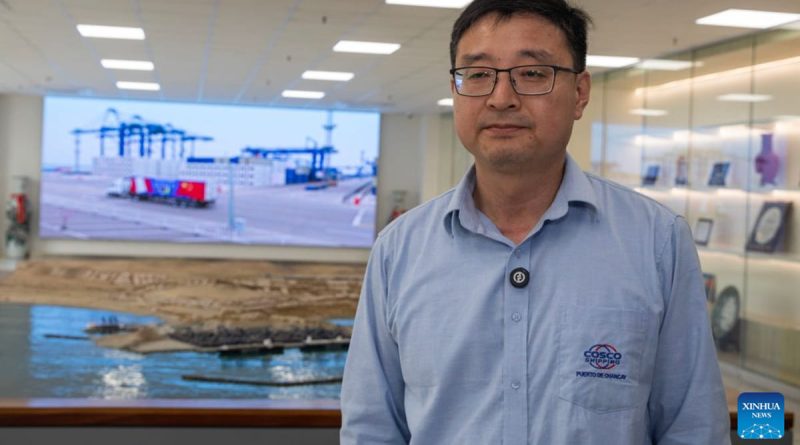
Image from November 3, 2026, of workers unloading goods from a truck at the Port of Chancay, in Chancay, Peru. Two years after its inauguration, the Port of Chancay, located about 80 kilometers north of Lima, the capital of Peru, is consolidating as an important logistics center that strengthens maritime connectivity between South America and Asia, facilitates regional trade, and opens new opportunities for economic integration in the Asia-Pacific region. (Xinhua/Mariana Bazo)

Image from November 3, 2026, of cranes and containers seen at the Port of Chancay, in Chancay, Peru. Two years after its inauguration, the Port of Chancay, located about 80 kilometers north of Lima, the capital of Peru, is consolidating as an important logistics center that strengthens maritime connectivity between South America and Asia, facilitates regional trade, and opens new opportunities for economic integration in the Asia-Pacific region. (Xinhua/Mariana Bazo)

Image from November 3, 2026, of Cosco Shipping Ports Chancay Perú CFO, Jiang Zhiguo, holding a conversation with Xinhua News Agency in the offices of the Port of Chancay, in Chancay, Peru. Two years after its inauguration, the Port of Chancay, located about 80 kilometers north of Lima, the capital of Peru, is consolidating as an important logistics center that strengthens maritime connectivity between South America and Asia, facilitates regional trade, and opens new opportunities for economic integration in the Asia-Pacific region. (Xinhua/Mariana Bazo)

Temas:TerminalsRoutesoperationsCargo
Compartir esta nota

Seguí leyendo

Port of Tumaco Handles 21 Vessels and 72,549 Tons of Hydrocarbons in First Half

Matarani Discharges 13,414.582 t of Iron and Metals for Bolivia

MTC Authorizes Maritime Cabotage in Ports for Humanitarian Emergencies

Most read

  1. 01MTC Drives Works in Callao: Terminals, Foreport, and Airport Access
  2. 02APM Terminals Callao Advances with Stage 3B of the North Terminal
  3. 03Callao Master Plan: APN Coordinates with Mincetur and Sunat
  4. 04APN and DP World Callao Analyze Investments for Master Plan
  5. 05Ositrán Extends Deadline for Truck GPS Monitoring Pilot Until December 4, 2026