• 3 min de lectura
• 3 min de lectura
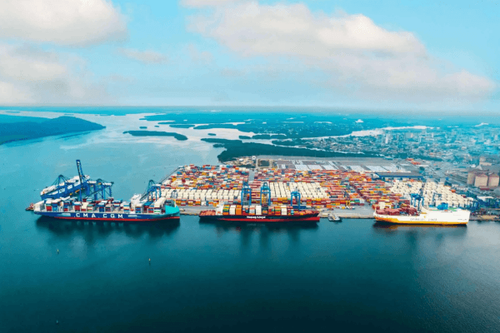
Last Wednesday (24), TCP, the company that manages the Paranaguá Container Terminal, hosted Mauro Sammarco, president of the Board of Directors (CONSAD) of the Brazilian Institute of Infrastructure (IBI), and Caio Marcelo Morel Corrêa, executive director of the Brazilian Association of Container Terminals (ABRATEC).
During the meeting, a detailed corporate presentation was given, sharing recent key results and an overview of the Terminal's shareholders. Discussions also highlighted operational growth, efficiency gains, railway expansion, and TCP's strategic role in national logistics, particularly in serving agribusiness.
Future projects were presented, with an emphasis on expanding the capacity of electrical outlets for refrigerated containers (reefers), modernizing infrastructure, and strengthening intermodality. These initiatives are considered fundamental to sustain demand growth, especially for agribusiness cargo, which is the main driver of the Terminal's operations.
Furthermore, TCP's commitment to sustainable local development was reinforced, showcasing actions aimed at integration with the Paranaguá community, with a focus on social responsibility, institutional relations, and generating value for the region. The visit fostered an exchange among participants, strengthening institutional alignment regarding the challenges and opportunities for the future of the Port of Paranaguá.
On Thursday (25), TCP participated in Movimento Agroportos, an event structured by IBI and held for the first time in the southern region of Brazil. The meeting was organized into four thematic panels and brought together representatives from the public and private sectors, including federal deputies from the states of Paraná and Santa Catarina, such as Tião Medeiros, Pedro Lupion, and Daniela Reinehr, as well as members of parliamentary fronts, such as the Parliamentary Front for Ports and Airports (FPPA) and the Agribusiness Parliamentary Front (FPA).
The event also featured the presence of port and business leaders, including representatives from Portos do Paraná (APPA) and SCPAR, as well as national authorities, including the National Secretary of Ports, Alex Ávila. The discussions addressed the main challenges of the sector, the exchange of best practices, and the importance of coordinated action between private initiative and public authorities to strengthen logistical infrastructure and streamline the distribution of agricultural production.
The panel on logistical bottlenecks, storage, and infrastructure expansion included the participation of Bruno Pinheiro, manager of IBI's Infrastructure Data Observatory; federal deputy Tião Medeiros, coordinator of Movimento Agroportos; José Roberto Ricken, president of the Ocepar System; Caio Morel, president of ABRATEC; and Ágide Eduardo Meneguette, president of the FAEP/SENAR-PR System.
Representing TCP, the institutional and legal superintendent, Rafael Stein, highlighted the strategic role of agribusiness for the Terminal's operations, emphasizing that this segment represents the main driver of cargo movement, notably for refrigerated cargo, paper and cellulose, and wood. Stein also stressed the expansion of the railway network as an essential factor for increasing logistical efficiency, reducing costs, and boosting the sector's competitiveness.
During the debates, the need for structural advancements in infrastructure, especially in ports, railways, and access roads, was also reinforced, along with the importance of a more stable and predictable regulatory environment. In this context, the integration among the various actors in the logistics chain was highlighted as fundamental to promoting synergy between public and private investments and to driving the development of the sector in the country.