• 3 min de lectura
• 3 min de lectura
Valenciaport's private 5G Stand Alone network, which will enable the development of technological solutions aligned with the increasing operational complexity of the Valencian port facilities, is now in the technical execution and infrastructure deployment phase. Its deployment will optimize resource use and reduce emissions, promoting a more sustainable port management model.
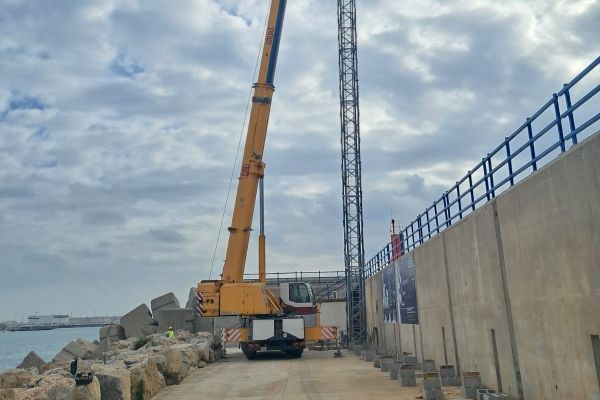
Currently, six of the 17 planned telecommunications towers for the project have already been installed.
This telecommunications infrastructure involves an investment of USD 7.9 million, 75% of which is co-financed by the European Union through the Connecting Europe Facility-Digital (CEF) program. With its implementation, the Port of Valencia will have its own secure and flexible telecommunications infrastructure.
The objective is for the communication network to be independent of conventional operators and adaptable to the needs of the logistics sector. Thanks to this technology, more than 25,000 devices, including vehicles, environmental sensors, drones, and security cameras, can be connected without relying on cables or third-party ties.
In terms of physical infrastructure, the fiber optic ring, which forms the transport base of the network, has already been completed. Likewise, the deployment of the radio network is already visible in the port environment, as six of the 17 planned towers are already fully installed and erected, while the rest are in an advanced stage of construction, assembly, or preparation for equipment installation.
From a technical perspective, work is already underway with radio equipment, and the access network is being deployed, along with other aspects developed with the network core and device cybersecurity.
In parallel, work is being done with the end-users of the network through a series of meetings, where the port's operational teams are conveying their needs while also contributing their ideas and experiences. This process is allowing for on-site validation of proposed solutions, adjustment of developments to real operations, and ensuring that the use cases finally implemented generate tangible value from the outset, both in terms of security and operational efficiency.
The deployment of the 5G network will reduce reliance on cabling and vehicles for inspections, facilitating the use of drones and IoT sensors. This digitalization optimizes resource use, decreases emissions, and thus strengthens the port's commitment to environmental sustainability.
The solution will incorporate the highest cybersecurity standards, along with a double perimeter firewall and network segmentation, guaranteeing the protection of data and critical communications.
Furthermore, the project includes the use of augmented reality for remote maintenance tasks and advanced training, facilitating real-time technical assistance and operator training.