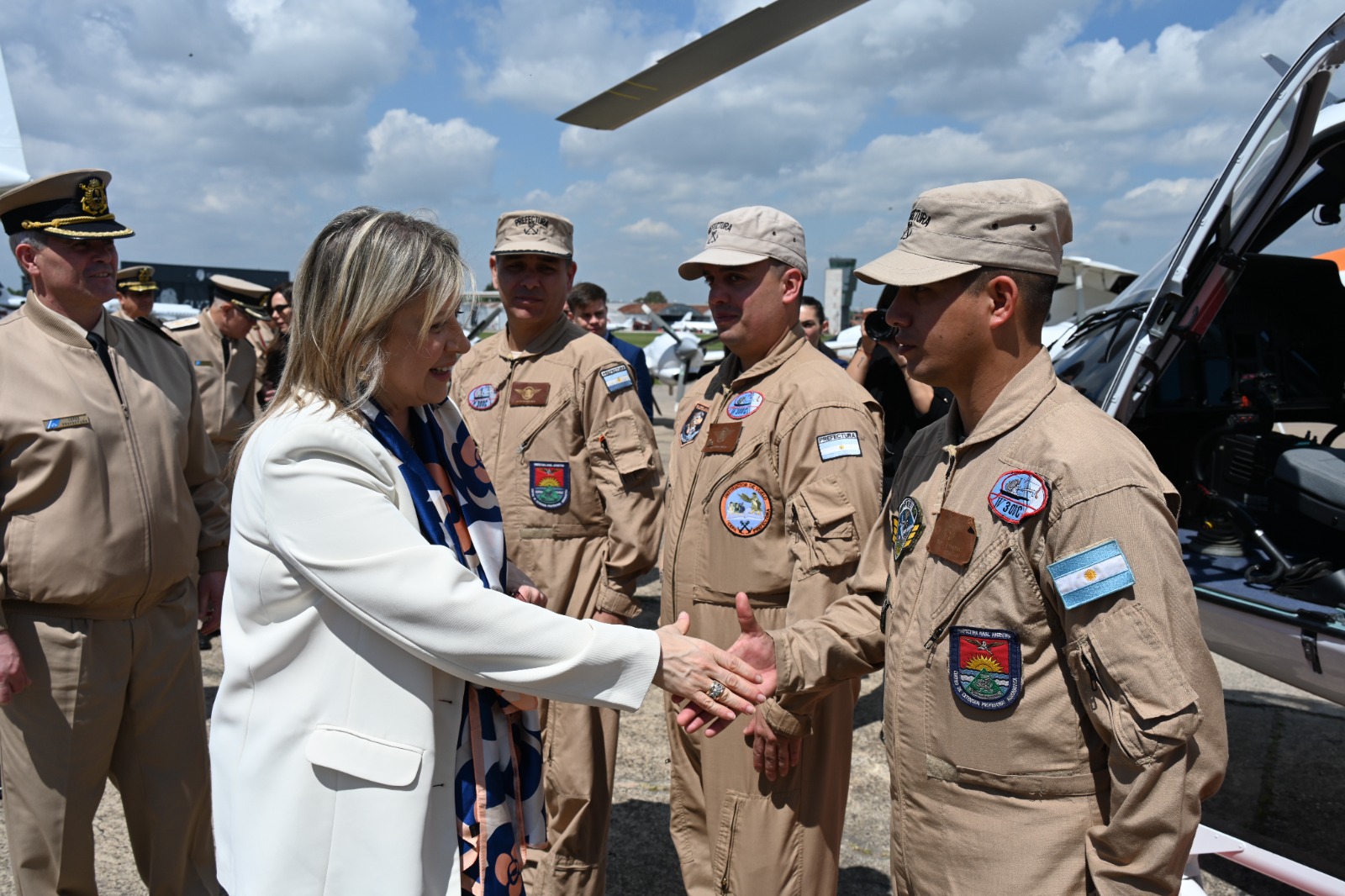
The Argentine Naval Prefecture reincorporated the CASA C-212 PA-72 “Isla Gran Malvina” aircraft and the Ecureuil AS355NP PA-80 helicopter into its operational fleet, after completing maintenance, inspection, and technological upgrade works. The ceremony took place at the Institution's Aviation Service, located at the San Fernando International Airport, Buenos Aires province, and was headed by the Minister of National Security, Alejandra Monteoliva, accompanied by the National Naval Prefect, Prefect General Guillermo Giménez Pérez.
The ceremony was attended by the Secretary of National Security, Martín Ferlauto; and the National Naval Sub-Prefect, Prefect General Alejandro Annichini, among other authorities. The head of the Aviation Service, Prefect Principal Juan Manuel López, also participated and highlighted the scope of the tasks performed and their impact on the force's operational capabilities.
López pointed out that the update of both units represents “a qualitative leap” for the Institution, by optimizing the precision of operations, strengthening operational safety, and improving integration with the national aeronautical system. Furthermore, he explained that the works respond to the growing demands of maritime and fluvial patrolling, search and rescue, and assistance to riverside communities missions.
“The modernization constitutes the first stage of a broader digital update process for the CASA 212 aircraft fleet. The works allow extending their useful life and improving their surveillance capabilities, while progressively advancing with the rest of the units without compromising operational deployment,” explained the head of Aviation.
In this context, he remarked that the anticipated increase in vessel traffic requires reinforcing inspection and emergency response capacity, both for navigation safety and environmental preservation.
During the ceremony, the Prefecture's Music Band performed the Argentine National Anthem and the chief chaplain, presbyter Diego Julio Tibaldo, blessed the aircraft. The disposition for the baptism and sponsorship of the PA-72 was also read, and the corresponding testimony was delivered to Monteoliva, designated godmother of the aircraft. The traditional ribbon-cutting formalized the commissioning of both units.
For his part, the Secretary of National Security, Martín Ferlauto, highlighted the technical and administrative effort required by the project, developed over four years and involving two tenders.
The official acknowledged the coordinated work of the Prefecture's Aviation Service, the Logistics and Equipment teams, and the Foreign Trade area of the Ministry of National Security. He also valued the work of pilots and crews in search and rescue missions.
“This CASA aircraft drastically reduces the search time for a person or any rescue that needs to be carried out,” affirmed Ferlauto. In this regard, he explained that the incorporation of radars, cameras, and night vision complements the pilots' experience with technological tools that improve localization and assistance tasks.
Regarding the PA-80 helicopter, the Secretary detailed that the intervention transformed an aircraft with analog instruments into a digital platform, with alarms and alerts that facilitate the reading of flight parameters. This update allows pilots to concentrate on operational tasks, including border surveillance and crime prevention.
Ferlauto also noted that the fleet recovery plan will continue in successive stages. In this framework, he mentioned that another Ecureuil helicopter is planned for next year.
At the close of the event, the Minister of National Security highlighted that the recovery of the two aircraft strengthens patrolling, surveillance, and emergency response capabilities. “Two aircraft that are once again operational to fulfill a fundamental mission: protecting our waters, combating crime, and caring for Argentines,” she stated.
Monteoliva emphasized that aerial surveillance is indispensable to complement the Prefecture's presence in rivers, lakes, ports, and the maritime coast. As she explained, these means allow detecting suspicious vessels, identifying possible illegal fishing activities, and acting more quickly in incidents requiring assistance or rescue.
“When we talk about aviation in the Naval Prefecture, we talk about time: the time gained to arrive earlier at an emergency and the time taken away from a criminal organization to operate unseen,” affirmed the official.
The minister also linked the commissioning of the units with a policy of recovery and modernization of the federal forces' resources. In this regard, she maintained that keeping the equipment operational extends its useful life and makes better use of public resources allocated to security.
“Every resource must be operational and at the service of the security of Argentines,” she expressed, while acknowledging the work of pilots, technicians, mechanics, and crew members who participated in the process. She also highlighted the support of their families and the commitment of those who perform tasks that, although often carried out away from public view, are decisive for the protection of citizens.
Finally, Monteoliva referred to the name chosen for the aircraft and its link to the force's history. Designated godmother of the PA-72, she stated that the honor has a special meaning due to the name “Isla Gran Malvina,” in homage to the members of the Prefecture who participated in the 1982 war.
“That a modernized aircraft flies again with that name today is a way to honor their legacy with actions,” she affirmed.
With the reincorporation of the CASA C-212 PA-72 and the Ecureuil PA-80 helicopter, the Prefecture recovers capabilities to expand aerial surveillance, strengthen control of its areas of responsibility, and improve emergency response. The continuity of the modernization program will allow advancing in the fleet's update and sustaining security, inspection, and assistance operations in the national territory.

More technology for aerial surveillance
On the PA-72 aircraft, a thorough inspection was carried out, and the cockpit instruments were renewed, including the replacement of the autopilot with a digital system. Equipment was also incorporated to alert about the presence of other aircraft, warn of adverse weather conditions, and monitor engine operation, with the aim of improving the information available to the crew.
One of the main advances was the installation of the HENSOLDT PrecISR 1000 radar, which allows detecting and tracking multiple targets simultaneously in maritime, terrestrial, and aerial spaces. The system is integrated with a HENSOLDT ARGOS-II electro-optical and infrared camera, capable of automatically orienting itself towards the points identified by the radar to facilitate their observation and tracking.
The equipment is completed with a high-power searchlight, linked to the other devices. This integration expands observation possibilities during night operations and contributes to reducing the need for low-altitude approaches, with benefits for crew safety.
For its part, the recovery of the Ecureuil AS355NP PA-80 helicopter included a comprehensive inspection of its structure and the review of its main components, as part of a mid-life overhaul.
Its reincorporation will reinforce patrolling of the northern border, control of unauthorized crossings, and prevention of complex crimes. The aircraft will also be able to intervene in medical evacuations, transfer of supplies, and reconnaissance of isolated riverside communities during emergency situations.
These capabilities will be complemented, at a later stage, by the installation of day and night vision cameras to expand observation and tracking possibilities during patrolling and search missions.