


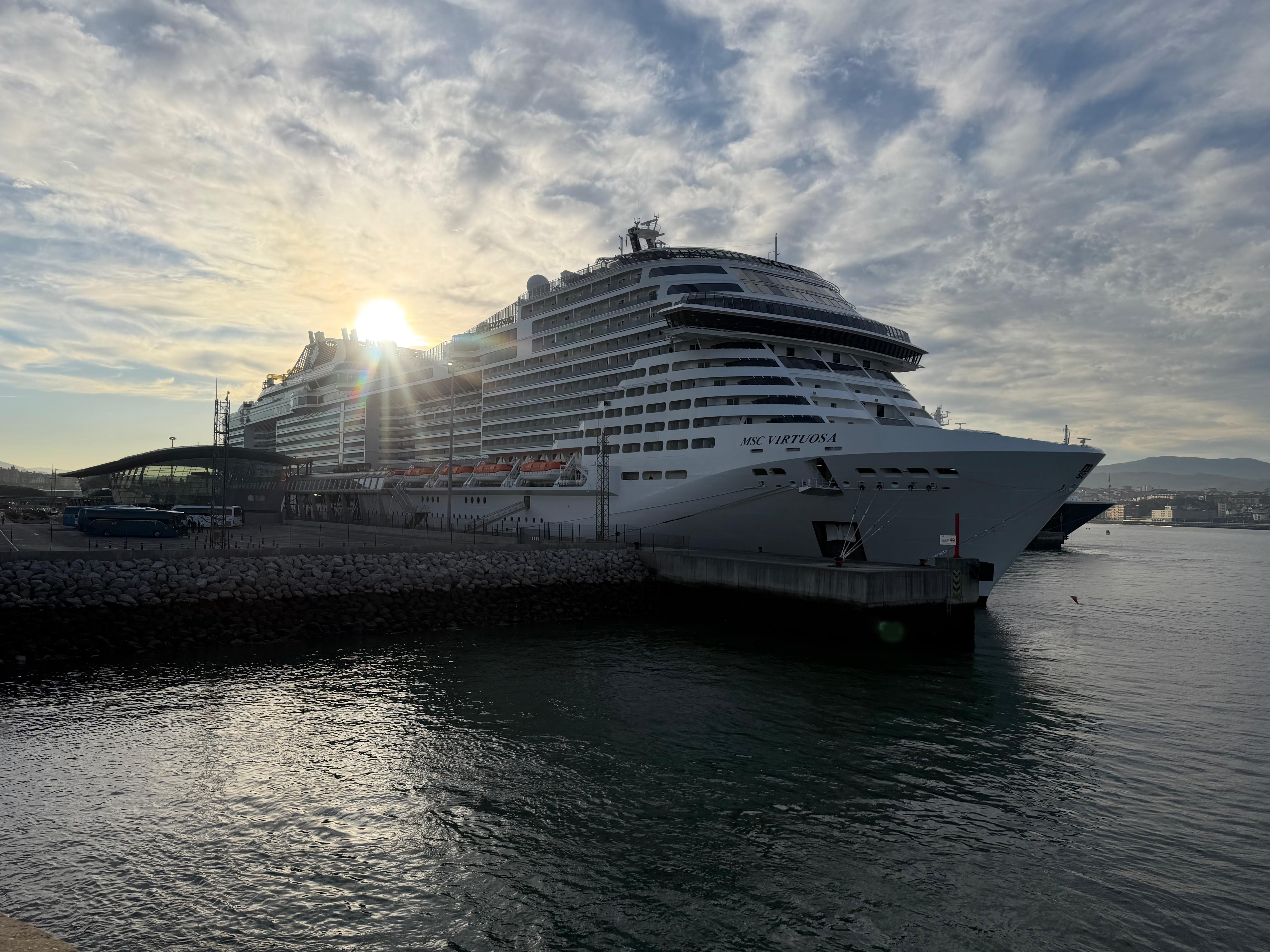
The latest cruise season at the Port of Bilbao has once again set a new record. From the arrival of the first cruise ship on February 25th to the calls of the last two today, the Getxo cruise terminal has welcomed 104 vessels, 9 more than last season, and a total of 233,236 cruise passengers (+29% compared to 2025). This growth is supported by three pillars of sustainability: economic, due to the impact it generates in the region; social, because Bilbao remains a destination without saturation; and environmental, thanks to the shore power connection for ships, which will be available by the end of 2027.
The Port of Bilbao has once again demonstrated its great versatility by accommodating vessels of various sizes and adapting to their specific needs. The length of the ships that have docked ranges from 104 to 344 meters.
In total, 31 shipping companies have trusted the Port of Bilbao for their calls, and 11 of them have done so for the first time. Notably, MSC made eight calls.
Throughout 2026, nine vessels made overnight stays, and three began and ended their journeys in Getxo: Hapag Lloyd (TUI)'s Europa 2, Oceania Cruises' Nautica, and Oceania Cruises' Maria.
Once again, simultaneous cruise calls were accommodated, offering the best guarantees to each vessel. On six days, three ships called, and on August 30th, the embarkation and disembarkation of the Nautica also took place. Regarding passenger nationality, approximately half are from the United Kingdom, followed by German and American cruise passengers.
These figures, in the words of the President of the Port Authority of Bilbao, Ivan Jimenez, "confirm, once again, that Bilbao, Getxo, Bizkaia, and Euskadi, in general, continue to be a destination that attracts and convinces all types of tourism. Shipping companies continue to bet on this call in their routes, which is highly valued in the satisfaction surveys we conduct." Furthermore, another key factor contributing to this growth "is the service provided by a large number of professionals, from pilots and mooring personnel to shipping agents, port operations and commercial teams, port police, and security forces. It is a team effort where collaboration is essential to provide a quick response."
Cruises leave a very significant economic footprint in the region. According to the methodology of Puertos del Estado, each cruise passenger generates approximately 146 euros of economic impact, combining their spending on dining, shopping, transportation, and cultural activities, and the effect that spending has on suppliers and wages.
Applied to the 233,236 cruise passengers this season, this estimate represents an economic impact of about 34 million euros in Bilbao, Getxo, and the rest of Euskadi, supporting around 280 jobs, mostly in hospitality and retail. Added to this is the impact of the crews, who also go ashore: nearly 11 million euros more. In the last five years (2022-2026), more than 800,000 cruise passengers have generated an economic impact of close to 120 million euros in the region.
This impact has been calculated exclusively with the average spending of cruise passengers who do not stay overnight in the region, who account for more than 90% of those received in Getxo. The higher spending of those who do stay overnight, either because they start or end their cruise in Bilbao or because the ship spends the night in port, has not been taken into account: according to Puertos del Estado, an overnight cruise passenger generates more than four times the spending of a non-overnight passenger, a 323% increase. Therefore, the 34 million euros is a conservative estimate.
The Getxo cruise terminal, in service since 2008, has required an investment of 36.6 million euros. The project for shore power connection for ships at the dock (OPS) and the associated photovoltaic installation add another 28.4 million euros. The Port Authority is financed by its own revenues, and cruise activity is not currently profitable on its own.
Growth in cruises does not translate into saturation. With approximately 0.10 cruise passengers per inhabitant in 2026, one for every ten residents in Euskadi, Bilbao remains one of the cruise destinations with the lowest tourist pressure in Spain. According to the latest comparable data from Puertos del Estado for 2025, the average for the main Spanish cruise ports was 0.57 cruise passengers per inhabitant, and 0.22 excluding the Balearic Islands, Canary Islands, and Barcelona, compared to 0.08 in Euskadi.
Cruise passengers are also a small part of the tourism received by Euskadi: in 2025, they accounted for less than 5% of the 3.9 million travelers who stayed in its hotels, according to Eustat. Their visit is organized and predictable, concentrated in a few hours, and distributed among Bilbao, Getxo, and other destinations in Euskadi, without occupying accommodation.
As part of its energy transition plan, the Port Authority of Bilbao continues its work on deploying the Onshore Power Supply (OPS) system, which will allow cruise ships to connect to the terrestrial electricity grid during their stay in port, eliminating the use of auxiliary engines and reducing emissions, noise, and vibrations. The energy supplied to the vessels will be 100% certified renewable, coming from the port's own photovoltaic installation and electricity with a guarantee of origin. The service will be available by the end of 2027, and the investment is financed by the European Commission through the CEF (Connecting Europe Facility) program, the Recovery, Transformation and Resilience Plan – NextGenerationEU, and the EIB.
Thanks to OPS, CO2 emissions from each call will be reduced by at least 85%, and those of nitrogen oxides, sulfur oxides, and particles by around 95%. The cruise passenger will thus become the visitor with the lowest CO2 emissions during their stay: according to estimates by the Port Authority, they will emit 25% less CO2 per person in the region than someone arriving by train, 40% less than someone arriving by coach, 71% less than someone arriving by car, and 78% less than each airline passenger during landing and takeoff.
This commitment already has international recognition. Cruise Europe, the network of cruise ports in Northern Europe and the Atlantic facade, ranks the Port of Bilbao as the eighth most sustainable cruise destination among its member ports, and the only one in Southern Europe on that list, according to the international GDS-Index 2026 sustainability index. In the global ranking of this index, Bilbao ranks 13th: it is the first destination in Southern Europe and the only one on the Atlantic coast of the Iberian Peninsula and France among the top 40. Additionally, the Port of Bilbao is a finalist for the International Association of Ports (IAPH) sustainability awards, along with the ports of Oslo and Hamburg.
"This season demonstrates that cruises can be sustainable tourism in every sense: they generate wealth and employment, do not saturate our cities, and, with OPS, will be the ones with the lowest CO2 emissions," says Ivan Jimenez. "But growth is not guaranteed. Shipping companies decide their calls two years in advance and compare all costs between ports. Maintaining Bilbao's competitiveness as a destination is a task for all institutions, because the commerce and hospitality of Getxo and Bilbao depend on it, as do projects as important for their future as the renovation of the Getxo marina."

