

A single concessionaire company will undertake the development, commissioning, operation, and maintenance of the ship shore power supply network via OPS.
The new company will continue the works initiated in recent years at the Port: the Port substation, medium voltage networks, and the deployment of OPS.
November 25, 2026
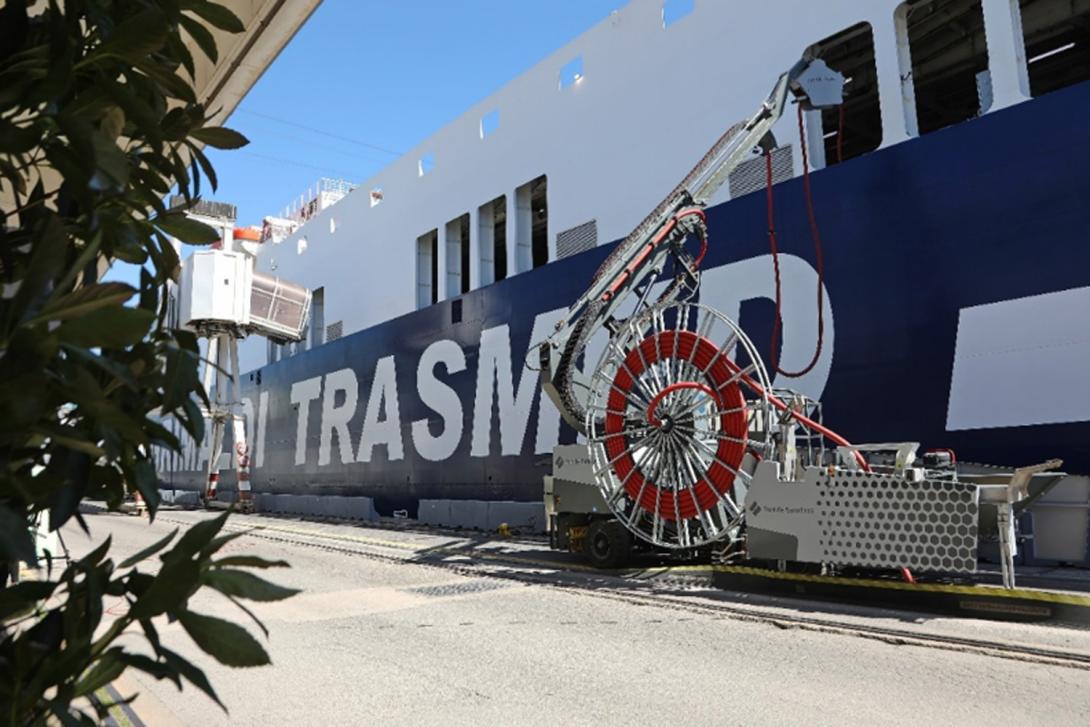
OPS system at Grimaldi Terminal Barcelona.
The Port of Barcelona's Board of Directors, meeting today, approved the launch of a public tender for the granting of a concession for the design, construction, operation, and maintenance of the ship shore power supply service using Onshore Power Supply (OPS) systems, which allow vessels to shut down their engines while docked.
The tender foresees a single concessionaire company, with a 30% stake held by the Port Authority of Barcelona (APB), constituting a public-private collaboration model. Thus, the APB will be an active part of the governance of a strategic service for the port, favoring its alignment with port development and electrification objectives, as well as the coordination of OPS infrastructures with the general planning of the Port of Barcelona.
The new company will continue the works initiated in recent years at the Port of Barcelona — Port substation, medium voltage networks, deployment of OPS at the docks, etc. — and will be responsible for completing the various electrical infrastructures: transformation and frequency conversion centers, deployment of the electrical network, ship connection systems, cable management systems, and control and management systems. In addition to the development of electrical infrastructures, the company will be responsible for operations and maintenance.
The management model for the ship shore power supply service designed by the Port of Barcelona will optimize investments, ensure coordinated planning of future expansions, facilitate homogeneous service provision, and generate economies of scale in the operation, maintenance, and technological renewal of the entire network, making it more resilient and reinforcing its security.
The establishment of this company is part of the Port of Barcelona's Energy Transition Plan, which will involve an investment of 1.7 billion euros — 780 million from public funds and 920 million from private capital — and whose main projects include the Nexigen Plan for dock electrification. With an investment of 215 million euros, this Plan has already begun to provide electricity to container ships and ferries. To date, the Port has executed or is executing 65 million euros of the Nexigen Plan, and the new company must make the remaining investment of 150 million.


