

- The emeritus professor of Urban Planning reviews the joint evolution of the port and the city and raises the need to recover and project Alicante's maritime culture into the future
- The conference concluded with a discussion on the transformation of the Port and its future as a logistics hub serving the productive sectors of the province
Alicante – November 18, 2026.- The Civil Engineer and emeritus professor of Urban Planning at the University of Alicante, José Ramón Navarro Vera, led the conference "Alicante, Port City," a reflection on the historical relationship between the Port of Alicante and the city, and on the influence this infrastructure has had on its urban, economic, and social development.
The conference, held as part of the commemorative program for the 125th anniversary of the Port of Alicante, brought together representatives from the port, academic, and professional fields, as well as former officials of the Port Authority, such as former port president Juan Ferrer, and representatives of various city groups.
The president of the Port Authority of Alicante, Luis Rodríguez, opened the meeting by highlighting Navarro Vera's extensive professional and teaching career and, especially, his commitment to Alicante. Rodríguez defined him as "one of those personalities who have contributed to building the city," and emphasized his critical spirit, his defense of the general interest, and his permanent willingness to dialogue and debate.
For his part, the director of the Port Authority, Luis Fernando Sánchez Villena, recalled his emotional experience as a student of Navarro Vera, whom he described as a source of inspiration for his way of teaching his students to question and critically analyze reality. "Part of my way of understanding the profession, and also life, I owe to his teachings," he said.
The event also featured the participation of José Andrés Coves, representative of the College of Civil Engineers, who highlighted Navarro Vera's figure as a professor, mentor, and reference in the study of urban planning and public works heritage.
A city also built from its port
During his speech, José Ramón Navarro Vera addressed the evolution of Alicante as a port city from a historical and urban perspective, dividing his analysis into two main stages: a first one between the 19th century and the Civil War, and another from the post-war period to the present day.
Navarro argued that Alicante's port status does not derive solely from the physical existence of a port, but from the intensity of the relationships that have been established between the port and the city over time, from the economy and infrastructure to urban planning, architecture, landscape, and the citizens' own perception.
In this regard, he explained how, especially since the mid-19th century, the growth of the city and the development of the port advanced in parallel, generating important economic and urban opportunities, but also tensions arising from the needs of two closely related spaces.
The port, he explained, has had a decisive influence on the urban configuration of Alicante itself. Access roads, highways and railways, the location of industrial and tertiary activities associated with maritime traffic, and the transformation of the transition spaces between the port area and the city have contributed to determining the shape and evolution of Alicante.
Navarro summarized this relationship with one of the central ideas of his intervention: "The port is an infrastructure that simultaneously separates and unites the city with the sea." A condition he related to the very idea of the port as a "gateway" and as Alicante's historical connection with the Mediterranean and the outside world.
Recovering the culture of the sea
The conference also paid special attention to the city's port heritage and memory. Navarro recalled historical elements and institutions such as the old Puerta del Mar, the Consulado del Mar, the Lonja, or the disappeared building of the Junta de Obras del Puerto, and advocated for the need to deepen the knowledge, conservation, and dissemination of a heritage that allows a better understanding of Alicante's maritime identity.
In this context, he raised the need to recover and strengthen the culture of the sea and prevent the port identity built over centuries from being diluted. A perspective that connects with the purpose of the 125th anniversary to recover the memory of the Port to understand its evolution and, at the same time, reflect on the port model for the coming decades.
From the historic port to the port of the future
The day concluded with a brief discussion between Navarro Vera, the president of the Port Authority, the director of the Port, and the attendees, in which the historical perspective gave way to the current and future challenges of the infrastructure.
The debate allowed some of the reflections raised during the conference to be related to the transformation currently being undertaken by the Port of Alicante. A roadmap aimed at reconciling its growth as an economic infrastructure with increasing integration with the city, while strengthening its capacity, competitiveness, and intermodality.
In this regard, the Port Authority is working to consolidate Alicante as a logistics platform serving the productive sectors of the province, improving its connections and generating new opportunities for Alicante's industry to have competitive access routes to national and international markets.
The improvement of rail connectivity and the incorporation of the Port into the Mediterranean Corridor are strategic elements of this process, along with actions aimed at modernizing facilities, increasing their operability and capacity, and attracting new traffic.
The president of the Port Authority stressed that this transformation should also be understood as an opportunity for Alicante and for the entire province: "We have before us the opportunity to build a more competitive and better connected port, but also a port more integrated into the city. Knowing where we come from helps us make better decisions about the port we want to leave to future generations."
The conference thus allowed a journey through more than a century of relations between the port and the city to conclude with a look towards the future: that of an infrastructure that aspires to continue playing an essential role in the economic and territorial development of Alicante, while strengthening its historical link with the city and the Mediterranean.
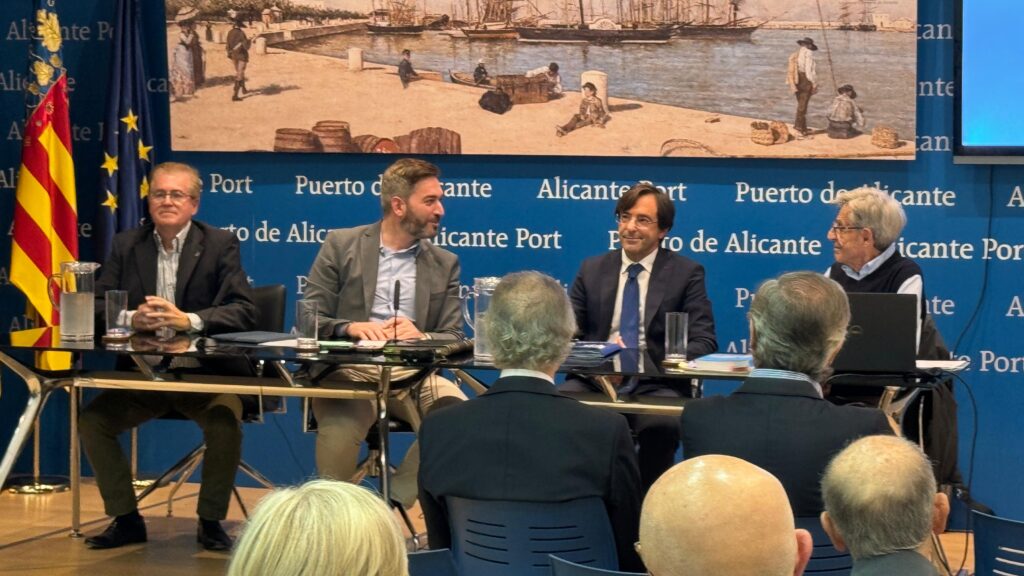
Img: From left to right: José Andrés Coves, Luis Fernando Sánchez, Luis Rodríguez and José Ramón Navarro, during the opening of the event.-
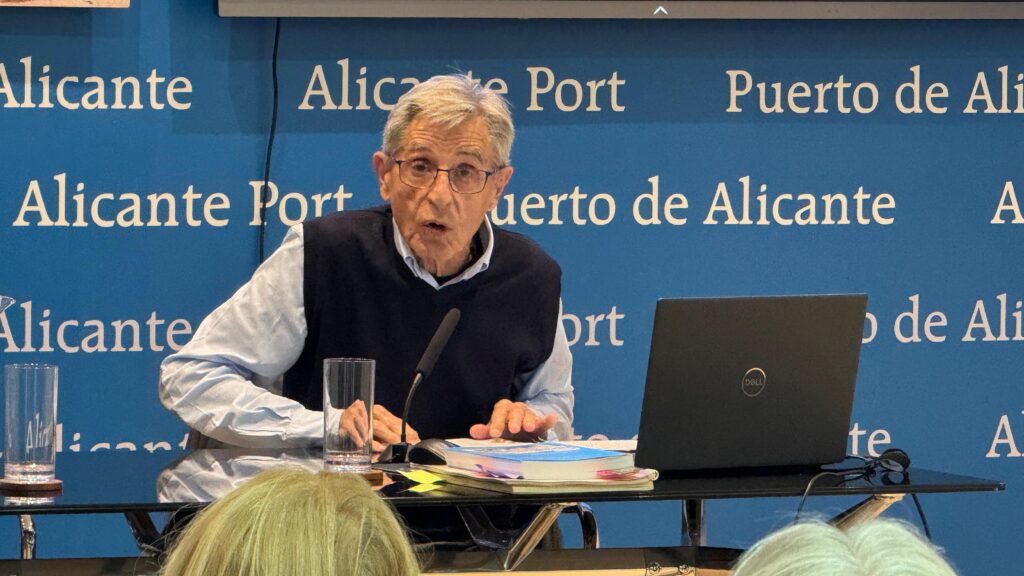
Img: José Ramón Navarro Vera during his conference.-
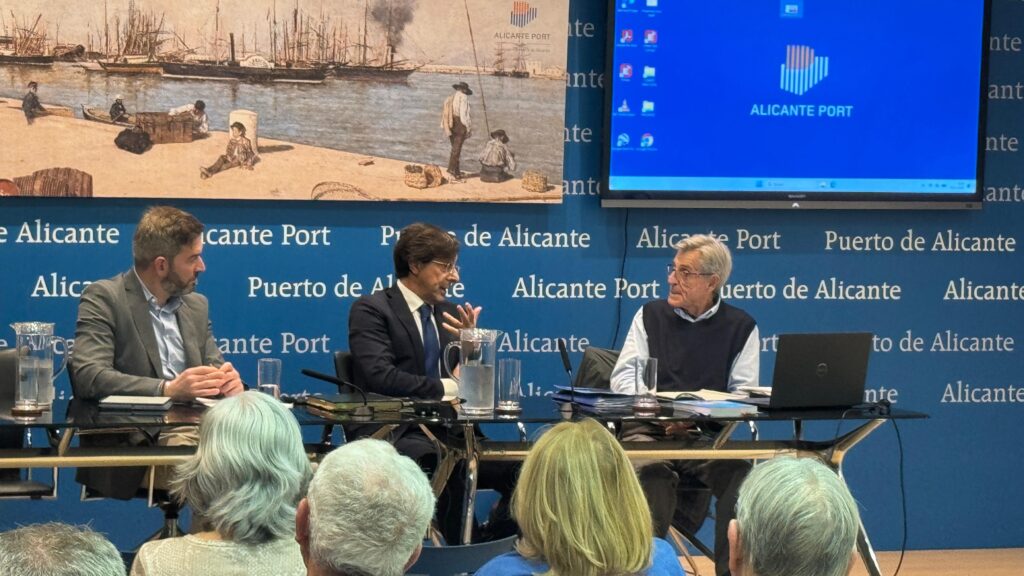
Img: Moment of the debate after the conference.-


