

- November 27, 2026

The port of Almería participates in the XII Spanish-Moroccan Meeting of the maritime, transport, and logistics sector, highlighting its distinctive infrastructures in the Mediterranean and its location as the closest port to Nador.
The meeting was held in Tangier, organized by the Official Spanish Chamber of Commerce in Morocco.
The Port of Almería participated this week in the XII Spanish-Moroccan Meeting of the maritime, transport, and logistics sector, organized in Tangier by the Official Spanish Chamber of Commerce in Morocco - Tangier, Nador, Kenitra, and held in a context marked by the transformation of logistics chains, the growth of commercial exchanges between Spain and Morocco, and the new challenges of international transport.
The Almerian delegation, composed of the heads of the Infrastructure and Innovation and Strategic Planning Departments of the Port Authority of Almería (APA), Antonio Ferrer and Alejandro Martínez, respectively, as well as the Commercial and Marketing Manager, Marco Checa, held commercial meetings with local companies in the logistics and nautical tourism sectors with the aim of analyzing the possibilities of establishment in the Port of Almería in anticipation of the launch of the new Nador West Med port in Morocco. In this regard, the port of Almería has reinforced its geostrategic position in the Mediterranean, south of Europe, being the closest port facility to Nador and with quick access to the Mediterranean highway to connect with the rest of Europe, favoring intermodality. "Corridors such as Almería and Nador West Med have the opportunity to become an example of cooperation, integration, and shared development for both shores of the Mediterranean, taking advantage of the privileged position between both ports and the existing infrastructures," said Ferrer.
Infrastructure, Energy Transition, and Digitalization
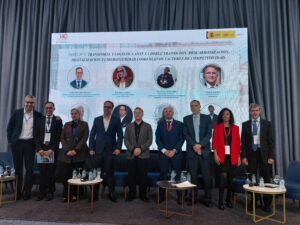
In the framework of the meeting, the head of the Strategic Planning Department highlighted the distinctive technical characteristics of the Port of Almería, with nine ro-ro ramps, 5,100 meters of quay length, and a draft of up to 24 meters; services such as the heavy traffic terminal and the Border Control Post; and consolidated connectivity with Morocco, through the regular line with Nador. During the port panel, Martínez also presented the projects on which the Port Authority of Almería is working, which represent new opportunities for both sides of the Alboran Sea: on the one hand, the expansion of the Pechina Quay, with which the Port of Almería will gain berthing line and surface area, a second heavy traffic terminal, as well as the possibilities offered by the future Níjar Logistics Activities Zone (ZAL) and its connection with the Mediterranean railway corridor. All of this gives the Port of Almería a strategic role as a logistics hub in a multimodal corridor towards Europe.
For his part, Antonio Ferrer detailed the Port of Almería's strategy regarding decarbonization, digitalization, and cybersecurity in a specific panel on this topic. The APA's Head of Infrastructure pointed out the start of the execution in the coming months of a new electrical substation of 8 MW expandable to 20, which will allow the electrification of the quays through the Onshore Power Supply (OPS) system and guarantee supply for new concessions and industries that will be established in the Port of Almería. Regarding digitalization and cybersecurity, the Head of Infrastructure emphasized the work that the APA is developing for the automation and real-time monitoring of the entire industrial network of the Port of Almería and Carboneras, as well as the cybersecurity protection of all this infrastructure at both a preventive and resilience level.


