

The program organizes private sector participation in port, airport, and waterway projects; the model combines investments with public sector regulation and oversight.
Published on 11/25/2026 13:23
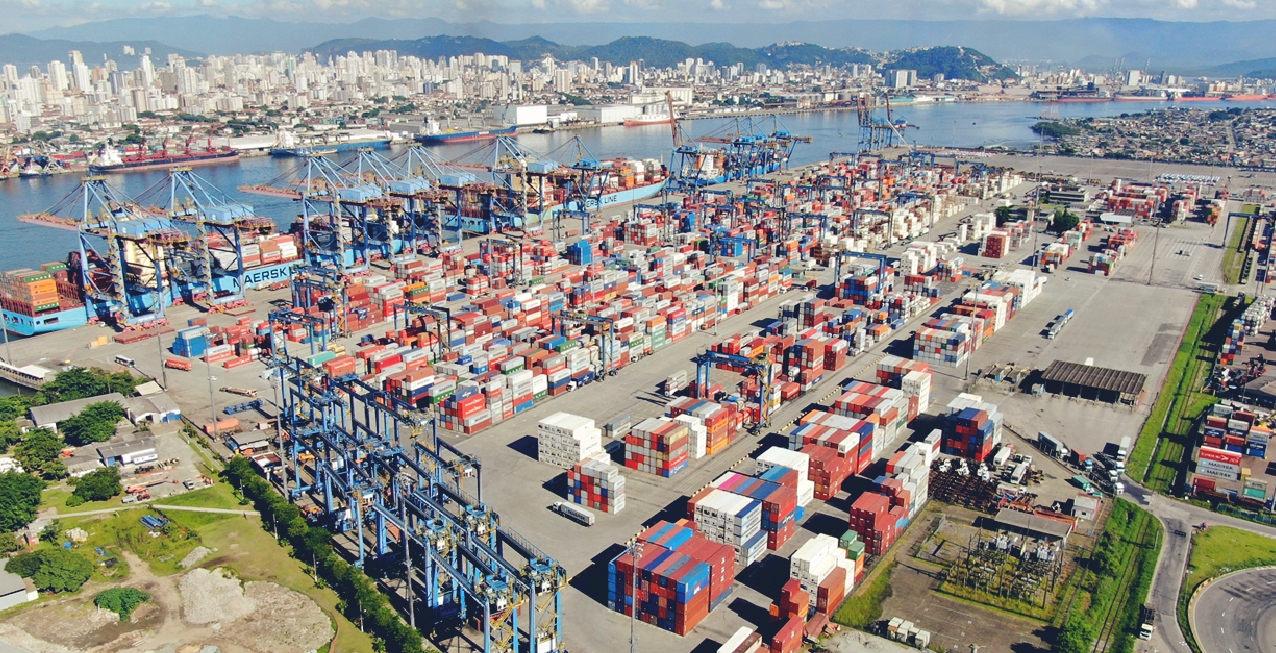 PPI completes ten years enabling projects to expand and modernize port, airport, and waterway infrastructure. Image: Port of Santos/disclosure
Ports, airports, and waterways are fundamental for cargo and passenger transport and for the integration of Brazilian territory. Expanding and modernizing this infrastructure requires long-term planning, resources, and execution capacity. In this scenario, partnerships with the private sector have gained prominence as one of the alternatives to enable projects and expand the offer of services. In 2026, the Investment Partnerships Program (PPI), created to organize and coordinate such initiatives within the Federal Government, completes ten years.
Established by Law 13.334, of 2016, the PPI functions as a coordinating body among public agencies to structure, qualify, and monitor partnership projects with the private sector. The models covered include concessions, permits, authorizations, and leases. The proposal is to organize the project portfolio, provide more predictability to processes, and reduce uncertainties for the agents involved.
However, the program is not a proprietary source of resources nor does it replace state planning. Its role is to help structure projects and organize private participation. The realization of investments depends on studies, environmental licensing, contracts, financing capacity, and project execution. It is also up to the public sector to define policies for each sector, establish rules, and oversee the fulfillment of assumed obligations.
Partnerships in Ports
In the port sector, partnerships can involve terminal operations, area exploration, and the management of essential navigation structures. An example is the concession of the access channel to the Port of Paranaguá, in Paraná. Auctioned in October 2025, and approved by the Ministry of Ports and Airports (MPor) in December of the same year, the project was the first in the country to grant private sector management of a port access channel.
The contract provides for the deepening and widening of the waterway, in addition to its continuous maintenance. The initiative allows the transfer of responsibilities for interventions and services necessary for the channel's operation to the concessionaire, according to the conditions established in the contract. The public sector continues to be responsible for defining these conditions and overseeing the fulfillment of obligations.
The MPor portfolio also includes port projects at different stages of structuring. For the period 2027 to 2030, the Ministry foresees more than 18 port infrastructure projects, with investments exceeding R$ 2.15 billion. Among the listed interventions are dredgings in the ports of Santos (SP), Itaguaí (RJ), and Ilhéus (BA), in addition to the completion of infrastructure works in Paranaguá (PR) and Santos.
Another front is the portfolio of port auctions planned for the same period. There are 34 projected auctions, with over R$ 20.6 billion in investments. Among the highlighted projects are the Tecon Santos 10 container terminal, in the Port of Santos, and projects in the ports of São Sebastião (SP), Itajaí (SC), Vila do Conde (PA), and Itaqui (MA). These values correspond to investments foreseen in projects still subject to the necessary stages for their contracting and execution.
Modernization of Airports
In the airport sector, concessions are also instruments to attract investments, modernize facilities, and expand service capacity. The Rio de Janeiro – Galeão International Airport is one example of an undertaking included in the partnership agenda, having been acquired for R$ 2.9 billion.
In addition to large terminals, the concession policy includes regional airports. The AmpliAR program, for example, foresees the inclusion of regional units in existing concession contracts or in new blocks. The initiative seeks to expand investment possibilities and improve the infrastructure of these airports, which serve locations often distant from major urban centers.
The ministerial portfolio for 2027-2030 foresees more than 70 airports under study for integration into existing concessions or new blocks. The estimated volume of investments is R$ 1.5 billion. Also planned are R$ 2 billion in works, studies, and projects for 59 regional airports in the public portfolio. These are distinct areas of activity, combining public investments and private participation according to the characteristics of each undertaking.
Partnerships Also Reach Waterways
Partnerships are not limited to the port and airport sectors. Inland navigation has also become part of this agenda, with projects aimed at the operation and maintenance of waterways. One of the projects being structured is the concession of an approximately 600-kilometer stretch of the Paraguay River Waterway, between Corumbá (MS) and the mouth of the Apa River, also in Mato Grosso do Sul.
The project foresees estimated investments of approximately R$ 64 million, allocated to services such as dredging, nautical signaling, buoyage, siltation control, and monitoring of hydrological conditions.
The MPor's planning also includes concession projects in the Madeira, São Francisco, and Tocantins river waterways, as well as Lagoa Mirim and the Green Waterway. The structuring of these initiatives still depends on the technical and institutional stages necessary for each project.
The Ministry foresees R$ 7.6 billion in waterway works for the period 2027 to 2030. The portfolio includes maintenance dredgings, removal of the Pedral do Lourenço, construction and recovery of small port facilities, as well as interventions in locks and waterway terminals.
The Permanent Role of the State
Private sector participation does not remove the public sector's responsibility for infrastructure development. The State remains in charge of planning sectors, defining priorities, structuring projects, establishing rules, and overseeing contracts. It also needs to monitor the fulfillment of investment and service quality targets and ensure that projects serve the public interest.
Therefore, a concession does not mean the absence of the State. The public sector defines the conditions for private action and monitors the execution of contracts. This action is essential for the foreseen investments to be converted into works, services, and effective improvements for users and for the country's logistics.
A Long-Term Agenda
The MPor's planning for the next four years foresees approximately R$ 160 billion in investments in the port, airport, and waterway sectors. The value brings together projects and opportunities in different modalities and stages of development.
The portfolio includes public works, concessions, authorizations, and promotion initiatives. The set shows the dimension of infrastructure challenges and the variety of instruments available to face them.
As it completes ten years, the PPI offers an opportunity to discuss how partnerships can contribute to the development of Brazilian infrastructure. More than attracting private resources, the challenge is to structure projects that respond to the country's needs, have well-defined contracts, and are monitored by the public sector.
Special Social Communication Advisory
Ministry of Ports and Airports


