• 5 min de lectura
• 5 min de lectura
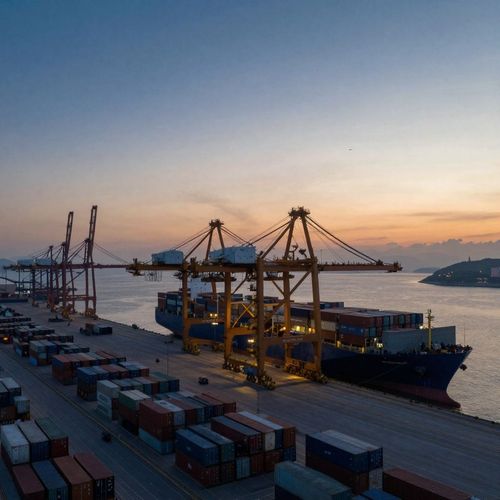
The division of the national territory into macro-zones is strengthening the work carried out by the Public Ministry to confront organized crime that uses Chilean ports to commit its illicit activities.
The spatial segmentation allowed focusing the State's efforts, through greater capacities with a local approach that addresses the problem of trafficking in port facilities from a local perspective, considering the particular elements and characteristics of criminal dynamics.
In this regard, Ignacio Castillo Val, director of the Specialized Unit for Organized Crime and Drugs of the National Prosecutor's Office, explained that "the important thing is what the State is doing differently to combat trafficking in our ports. From the Public Ministry's point of view, since the National Prosecutor, Ángel Valencia, took office, he made working in ports to prevent drug trafficking one of his priorities and commissioned the creation of a port project".
Along these lines, Castillo added that "the port project divided our country into macro-zones so that a regional prosecutor would be in charge of each one to provide more professionalism and specialization, improving inter-agency coordination with other institutions and being able to identify phenomena that are different. We have seen this clearly: the phenomenon of organized crime associated with port drug trafficking in the north, in Arica and Iquique, is very different from what it is, for example, in Valparaíso and San Antonio, and even the southern zone, that is, Bio Bio, Los Ríos, and Los Lagos, but it is also different from what it is in the far south".
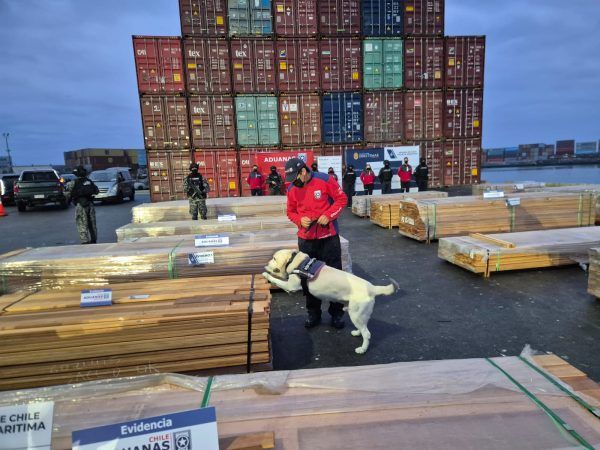
"So, the first thing was to design that. The second is to work towards achieving results, and I believe that the results we have seen, both in the Valparaíso Region and, more recently, in the Arica Region - where more than 100 tons of cocaine were seized - show that this work is being done. What we seek is to protect our ports to also protect our country, a port and coastal country, therefore, that is also its commercial asset. We must strengthen it to take care of it," added the lawyer.
Regarding the resources and technologies available to combat crime in national ports, the unit director stated that "organized crime will always seek mechanisms to anticipate, gain ground on the State, and have more technology than the State. I can speak from our sphere of the Public Ministry, and I recognize that we have seen a significant strengthening of our institutions".
"Today we have the Ecoh project (Organized Crime and Homicide Teams), for example, which, although not directly related to port issues, is related to organized crime and, particularly, its toughest side with homicides, kidnappings; but also in port matters, we have had some resources to improve our profiling centers and, especially in institutions, the availability and exchange of information also show that we have adequate resources," he added.
In a broader view, Ignacio Castillo Val addressed the evolution of organized crime at a South American level regarding the use of ports as a space for drug trafficking. From that perspective, he pointed to the possibility that the implementation of the Bioceanic Corridor between Chile, Argentina, Paraguay, and Brazil could be used as an axis for new opportunities for illegal activity.
"Criminal organizations were very oriented towards the northern part of our continent, basically in Brazil and Colombia. We also had important cases of trafficking through our coasts, but basically because it was said that Chile was a transit country, where they somehow 'cleaned' the routes with our ports," he stated.
"Now, the trafficking situation in South America has been changing, in the sense that criminal organizations have also changed ports, because this is like a balloon: you squeeze it on one side and the air comes out on the other; this has to do with what happened in Ecuador, for example, where violence associated with port trafficking increased sharply, and the risks that can also occur in Chile, regarding the Bioceanic Corridor," affirmed the head of the Specialized Unit.
Regarding the logistical road project, Castillo explained that "on the one hand, it has an enormous advantage from the economic and commercial point of view for our ports, but that is where some, the good ones, see opportunities for legitimate business, while those on the other side of the law see these types of corridors and passages as opportunities to further strengthen their organized crime".
"This is an issue that the country is observing, but we, as the Public Ministry, are observing it in the Antofagasta Region. The regional prosecutor has a very serious commitment to this issue, but also - it is worth mentioning - the Supraterritorial Prosecutor's Office, which is a recent institution of the Public Ministry, also has a perspective on this phenomenon and will have an impact on what happens there," assured the director.