• 3 min de lectura
• 3 min de lectura
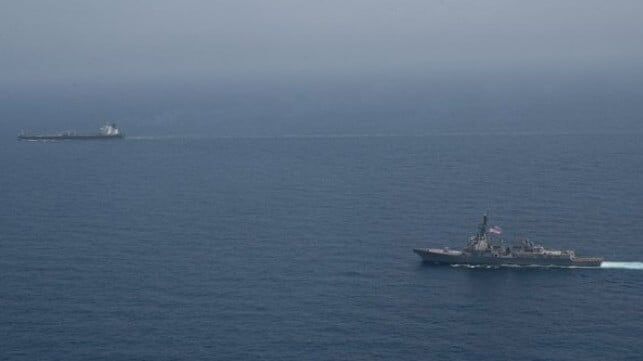
The U.S. has redirected 115 ships in the past six weeks during the blockade (CENTCOM)
Donald Trump announced Friday through social media that the United States will lift its naval blockade of Iran as part of a broader ceasefire agreement. While Trump did not specify when the blockade would be removed, he indicated that vessels currently trapped in the region could begin returning home.
According to Bloomberg's analysis of AIS signals and related data, approximately 29 of the 109 supertankers initially trapped in the Persian Gulf at the start of the Iran conflict have either escaped or obtained Iranian authorization to pass through. However, overall traffic through the Strait remains minimal, with vessel operators reluctant to risk return voyages due to concerns about becoming trapped.
CENTCOM reported that a total of 115 commercial vessels have been redirected to prevent any commerce from entering or leaving Iranian ports. The agency noted that enforcement continues, with the number of redirected vessels increasing by several each day.
On Friday, the International Energy Agency, International Monetary Fund, World Bank Group, and World Trade Organization jointly issued a statement warning of lasting consequences from the ongoing blockade. Beyond the rapid depletion of global oil reserves, the organizations cautioned that the continued disruption is affecting food supplies and other critical supply chains worldwide.
Trump stated that lifting the blockade is contingent on several conditions. Iran must immediately open the Strait of Hormuz with no tolls, permitting unrestricted shipping traffic in both directions. Additionally, while Trump asserted that the U.S. has already detonated most mines in the region, he made clear that Iran must complete the immediate removal and detonation of any remaining mines, noting "which will not be many."
On nuclear matters, Trump emphasized that Iran must never possess a nuclear weapon or bomb. He stated that the U.S. would "unearth" enriched uranium buried deep underground in collapsed structures that the United States bombed last year. Trump claimed that only the U.S. and China possess the mechanical capability to extract this uranium, and that the International Atomic Energy Agency would be involved in its destruction. He made no reference to Iran's uranium enrichment capabilities.
Trump indicated he was entering the Situation Room to meet with advisers to make a "final determination" on the matter. However, reports indicate he left the meeting after two hours without reaching a decision. Iran has not yet issued a public response regarding the proposed terms or whether it has agreed to them.
Hours before Trump's announcement, a military adviser to Iran's Supreme Leader Mojtaba Khamenei warned that Iran would launch attacks if the U.S. naval blockade "continues beyond a certain timeframe."
Experts confirm that Iran's oil exports have been largely halted by the blockade. TankerTrackers.com estimated on Wednesday that approximately 60 million barrels of Iranian crude oil are trapped by the U.S. Navy blockade, representing nearly $6 billion in oil revenue currently not reaching Tehran.
Iran has consistently stated that any agreement must include a withdrawal of U.S. forces from the region. The U.S. currently maintains approximately 20 warships in the area to enforce the blockade line east of the Strait of Hormuz, which Trump announced in mid-April.
Fuente: The Maritime Executive