• 3 min de lectura
• 3 min de lectura
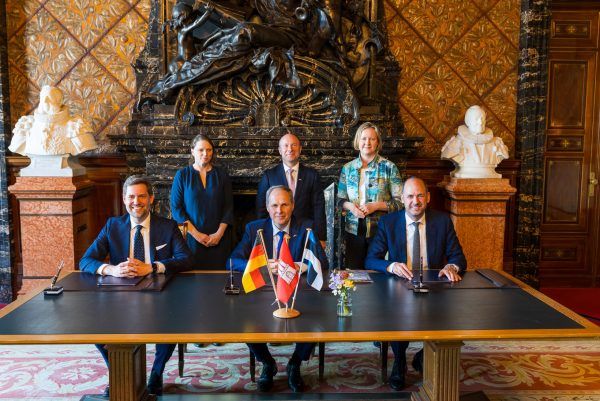
Hamburg's Senator for Economic Affairs, Melanie Leonhard, welcomed Estonia's Minister of Infrastructure, Kuldar Leis, to the City Hall. During the visit, the Hamburg Port Authority (HPA), Port of Hamburg Marketing (HHM), and the Port of Tallinn signed a Letter of Intent (LoI) to further strengthen their cooperation.
The agreement focuses on digitalization, sustainability, resilient supply chains, and the continuous development of a secure and efficient port and transport infrastructure throughout the Baltic Sea region.
The agreement builds on the existing cooperation between the ports of Tallinn and Hamburg and deepens these ties in a specific way. Special emphasis will be placed on the digitalization of port and logistics processes, decarbonization, security and resilience, as well as the development of efficient transport corridors throughout the Baltic Sea region.
Valdo Kalm, CEO of the Port of Tallinn, stated that "for the Port of Tallinn, the German ports of Hamburg and Lübeck are key strategic partners with considerable potential for closer cooperation. A significant volume of cargo between Estonia and Germany is already handled through the ports of Muuga and Paldiski South, in both Ro-Ro and container traffic. These connections create important logistical bridges between Estonia, the main logistics centers of Northern and Western Europe, and the main ports of Germany. Closer cooperation opens new opportunities in trade, the cruise sector, and port development. At the same time, it provides a valuable basis for the exchange of specialized knowledge in digitalization and cybersecurity, key issues for the resilience and security of modern supply chains."
Friedrich Stuhrmann, Commercial Director of the Hamburg Port Authority, added that "I am pleased that today we are further strengthening the long-standing collaboration between the Port of Hamburg and the Port of Tallinn. More than ever, the importance of international cooperation has become evident, whether through multilateral collaboration at the European level or bilateral alliances. This letter of intent lays the groundwork for future cooperation between both ports, not only in traditional commercial areas but also in relation to current challenges such as cybersecurity and military mobility."
Tallinn Port is one of the most important in the Baltic Sea region and plays a fundamental role in the movement of goods and passengers between Estonia, Finland, and Sweden. Thanks to several weekly container services, Tallinn maintains links with the Port of Hamburg, which is a key gateway for intercontinental trade, especially to Asia and North America.
Economic relations between Hamburg and Estonia also continue to develop steadily. Estonia is considered one of Europe's most innovative digital economies and an important partner for Hamburg, particularly in the areas of digitalization, maritime technologies, and logistics.