• 2 min de lectura
• 2 min de lectura
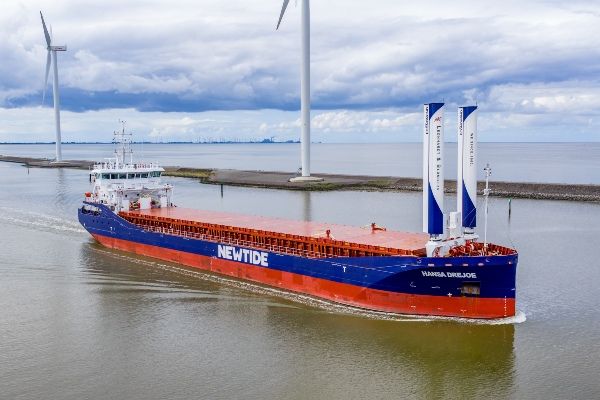
German shipowner Leonhardt & Blumberg equipped the vessel Hansa Drejoe with Econowind VentoFoils hydrofoils, the first of four newly built general cargo ships to receive wind propulsion technology.
This reflects Leonhardt & Blumberg's practical approach to reducing fuel consumption and emissions, while gaining experience in wind-assisted ship propulsion.
The first installation was completed at the Royal Niestern Sander shipyard, while the Hansa Christiansoe is currently on site to receive the upgrade. Econowind estimates that the hydrofoils will provide approximately 10% additional thrust, reducing fuel consumption and CO2 emissions. The evaluation is based on the vessels' actual trade routes throughout the year.
"We consider wind propulsion a logical step on our path towards more sustainable operations. Of course, economic viability is important, but we also feel a responsibility to drive the sector forward. Econowind's practical and advanced technology allows us to achieve both goals, while gaining real operational experience," said Christoph Meier, Naval Architect at Leonhardt & Blumberg.
The four vessels were designed by Groot Ship Design. Two were delivered in the first half of 2025, while the others are currently under construction in China. The Groot XL type ships have been designed from the outset to facilitate the integration of wind propulsion, ensuring optimal placement and flawless installation. The two units under construction are expected to arrive in Europe in the first half of 2027 for final outfitting and commissioning.
"Our goal with VentoFoils is simple: to achieve quantifiable fuel savings with a clear economic justification. Leonhardt & Blumberg's choice reflects their focus on proven technology and tangible results at sea. The systems will contribute visibly and immediately to efficiency," stated Stijn Engelage, Sales Director at Econowind.
By combining conventional propulsion with modern wind propulsion technology, Leonhardt & Blumberg continues its long-term strategy to improve the efficiency of its entire fleet. The installation of VentoFoils is part of a broader program to explore complementary technologies that generate a measurable impact, both operationally and environmentally.
VentoFoils are compact, autonomous wing systems that can be tilted in seconds. These units use boundary layer suction, creating additional thrust and optimizing aerodynamic efficiency. The technology has been implemented on various types of vessels, from freighters and tankers to heavy-lift and multipurpose ships.