• 2 min de lectura
• 2 min de lectura
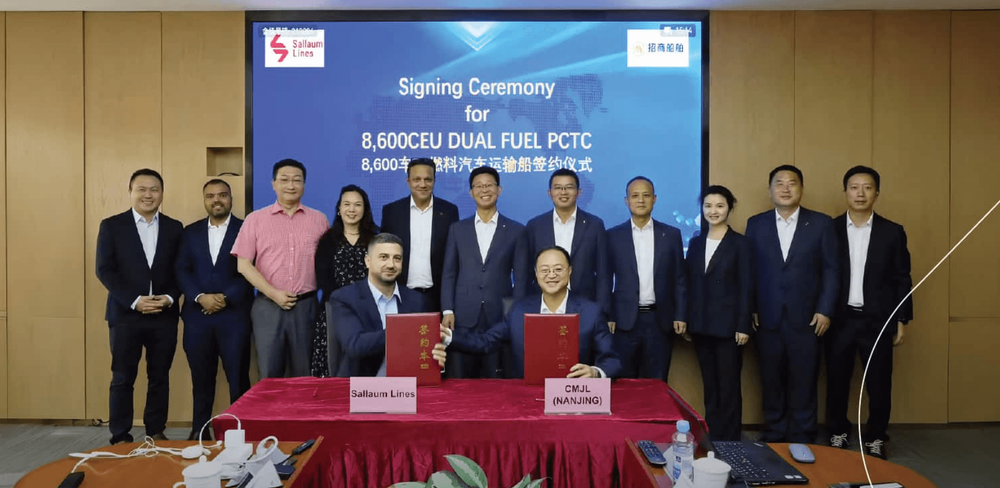
Sallaum Lines announced the signing of a new shipbuilding contract with China Merchants Shipyard for the construction of an additional car and truck carrier (PCTC) vessel with a capacity for 8,600 CEU.
The new vessel will be dual-fuel LNG and ammonia-ready, with delivery scheduled for 2029. This latest firm order comes just weeks after Sallaum Lines announced a separate shipbuilding agreement with Xiamen Shipbuilding Industry Co., Ltd. for two 8,600 CEU vessels, with an option for two additional vessels.
The China Merchants order provides new impetus to Sallaum Lines' newbuild program and confirms the company's investment in modern, high-capacity Ro-Ro vessels at a time when the global passenger and cargo shipping (PCTC) market remains structurally important for the automotive industry's supply chains.
The recently contracted vessel at China Merchants Shipyard brings Sallaum Lines' shipbuilding program to nine vessels, with a total value exceeding $850 million. The program includes four vessels already delivered, one scheduled for delivery in August 2026, another for December 2026, and three for 2029.
Sallaum Lines has already made significant progress in renewing its fleet.
The company had previously ordered six dual-fuel LNG vessels, four of which have already been delivered. The fifth vessel is scheduled for delivery in August 2026, followed by the sixth in December 2026.
The recent 2+2 order from Xiamen Shipbuilding marked the next phase of this expansion, incorporating larger vessels (8,600 CEU) into the company's future fleet. The new order from China Merchants Shipyard adds one more unit to the order book and further strengthens the company's delivery schedule for 2029.
The newly ordered vessel will have a cargo capacity of 8,600 car equivalent units, placing it among the largest vessels in Sallaum Lines' fleet.
The unit will be designed to transport a wide variety of cargo, including passenger vehicles, light commercial vehicles, trucks, heavy machinery, and project cargo. This flexibility is fundamental to Sallaum Lines' global trade network, which operates routes in Europe, Africa, Asia, the Middle East, and America.