

• 3 min de lectura
• 3 min de lectura
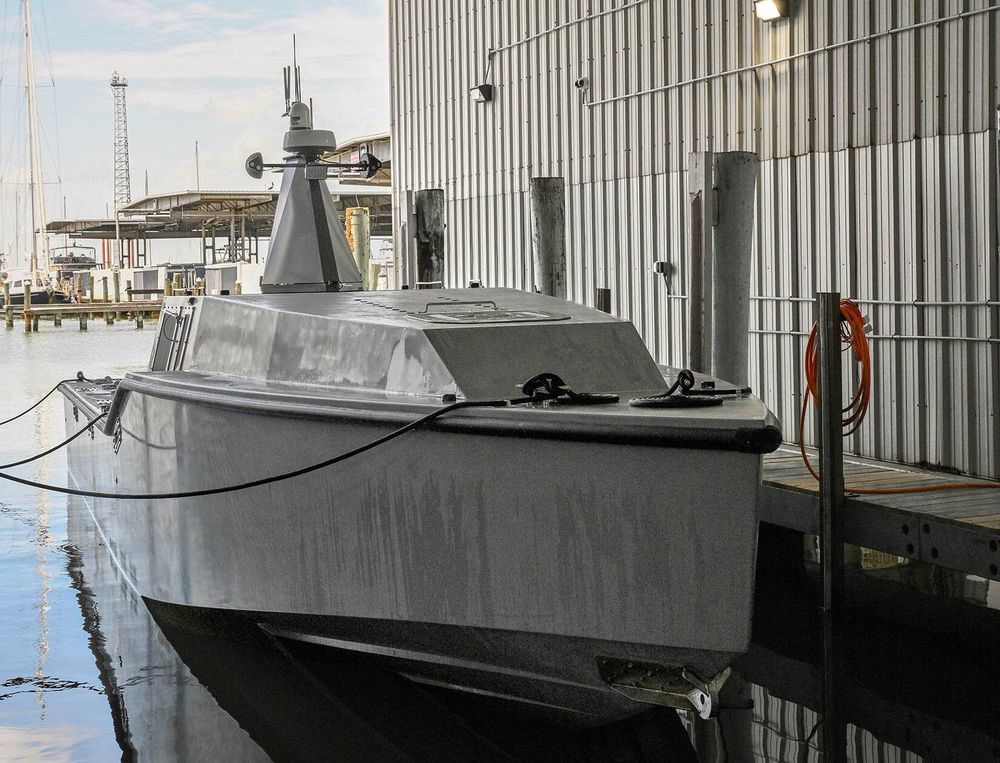
Saronic has launched its newest autonomous surface vessel, expanding its rapidly growing lineup with a 52-foot platform designed for defense, security and commercial maritime missions as the Texas-based company continues to accelerate production.
The new vessel, named Mirage, sits between Saronic's 24-foot Corsair and 180-foot Marauder autonomous vessels. According to the company, Mirage progressed from initial design to launch in less than a year and has now entered on-water trials at Saronic's privately funded test facility in Galveston, Texas. The next hull is already under construction at the company's Austin headquarters.
"We launched our first Marauder four weeks ago, and today we're putting another vessel in the water. This cadence is what our production model was built to deliver," said Saronic co-founder and CEO Dino Mavrookas.
Mirage is designed as a dual-use autonomous surface vessel capable of operating either fully autonomously or under remote human supervision through Saronic's Echelon command-and-control system. The vessel has a top speed exceeding 35 knots, a range of more than 2,500 nautical miles, and can carry payloads of up to 3,500 pounds—more than doubling the range and payload capacity of the company's Corsair platform.
The vessel is intended for missions including maritime domain awareness, maritime security, and aerial and surface detection. Like Saronic's other autonomous vessels, Mirage uses the company's common autonomy software stack and features an open architecture designed to integrate a wide range of government and commercial payloads, sensors and communications systems without major modifications.
Saronic said Mirage is manufactured entirely at its Austin facility, where hardware and software are developed as an integrated system. The company says the site has capacity to build hundreds of Mirage vessels annually while simultaneously producing thousands of Corsair vessels.
The launch comes less than a month after Saronic debuted its first 180-foot Marauder medium unmanned surface vessel, underscoring the company's effort to rapidly scale autonomous ship production for both military and commercial customers.
Saronic has emerged as one of the fastest-growing companies in the U.S. maritime autonomy sector. In April, it raised $1.75 billion in Series D funding at a $9.25 billion valuation to expand its autonomous vessel portfolio and domestic shipbuilding capacity.
The company has also begun demonstrating its technology in the field. Last month, a U.S. Navy-operated Saronic Corsair autonomous surface vessel rescued two U.S. Army aviators after their AH-64 Apache helicopter crashed off Oman, marking what is believed to be the first publicly reported personnel recovery carried out by an unmanned surface vessel. The rescue was conducted by U.S. Naval Forces Central Command's Task Force 59, the Navy's unit responsible for integrating autonomous maritime systems into fleet operations.
The successful rescue highlighted the growing operational role of autonomous surface vessels beyond surveillance and reconnaissance, illustrating their potential for search-and-rescue, logistics, force protection and other real-world maritime missions.

