• 4 min de lectura
• 4 min de lectura
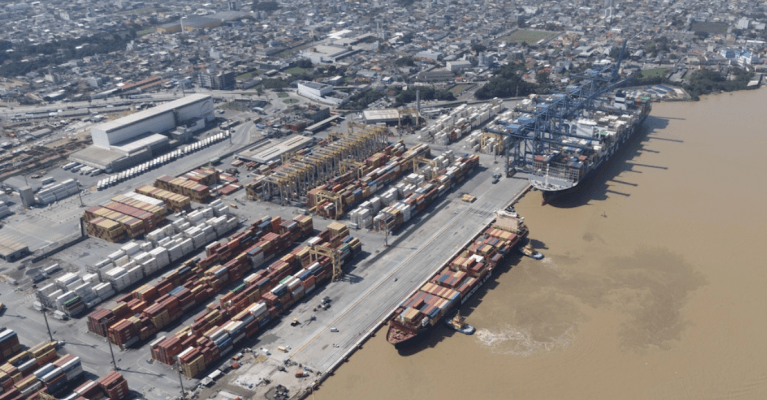
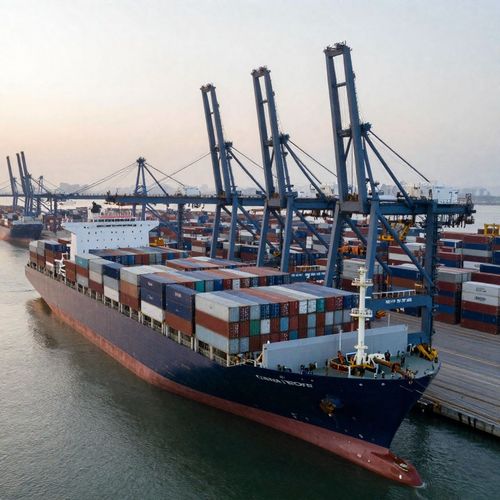
With the delivery of a new 250-meter section of the quay adaptation and reinforcement work, the Port Terminal of Navegantes will have 700 operational meters available. Portonave, in this way, will be able to receive two vessels simultaneously, contributing to greater agility and productivity in port operations.
Since January 2024, when the works began, the terminal received only one vessel at a time.
The new section was enabled for operations on August 18, when the vessels CMA CGM Thorium and Mercosul Suape operated simultaneously. Upon completion of the works, with the entire quay finalized, Portonave will be able to receive up to three vessels simultaneously.
Already prepared for the new generation of vessels, the renovated quay will allow the berthing of vessels up to 400 meters in length, corresponding to the most modern generation of container ships, provided that the necessary adjustments are previously made to the access channel and the maneuvering basin.
From now on, vessels can be served simultaneously, without the need to wait for a berthing position to be freed up. The result will be greater agility in operations, greater efficiency in serving shipping lines' calls, and better utilization of the terminal's infrastructure.
The delivery of this section reinforces progress towards the final stage of the Quay Adaptation Work, which by July had reached 92% completion. The completion of the remaining stage is scheduled for the last quarter of 2026.
The improvements also leave the quay prepared for the installation of a shore power structure, a system that will allow supplying electrical energy to berthed vessels, eliminating the need to burn fuel during their stay at the terminal.
This performance will be accompanied by more powerful equipment. The Quay Adaptation Work is part of a plan focused on efficiency and sustainability that, together with the new machinery, exceeds R$2 billion. In equipment alone, approximately R$500 million is contemplated for 100% electric units, aligned with the company's decarbonization strategy.
At the end of the plan, the terminal will have 8 STS, 32 RTG, 7 reach stackers, 61 terminal tractors, and 4 scanners. All new equipment will be 100% electric.
The project includes two e-STS container cranes, responsible for transferring containers between the vessel and the quay. They will be the first of this size in Brazil. The investment amounts to R$229 million, and their arrival is scheduled for this year.
Likewise, 14 e-RTG yard cranes will be incorporated, intended for the movement and stacking of containers in the yard. The investment is R$210 million. They arrived in July 2026 and will begin operating in August.
Similarly, 30 electric terminal tractors and 6 electric reach stackers will be added to operations, used for the transport and movement of containers in the yard. The investment is approximately R$61 million. Delivery will be gradual, with all machines in operation by January 2027.
Finally, two scanners have been included for cargo inspection and container movement. The investment reaches R$25 million, and they have been operational since 2025.
Even with the works underway, the terminal maintains its growth pace. By the end of July 2026, Portonave mobilized 750,571 TEUs, a volume 21.3% higher than that recorded during the same period in 2025.
This performance reinforces the operation's ability to maintain its productivity during a large-scale intervention in its infrastructure and anticipates the benefits that the completion of the works should generate during the coming months.
As an environmental compensation measure for the Quay Adaptation Work, Portonave is developing a Degraded Permanent Preservation Area Recovery Plan (PRAD) on the coast of Navegantes.
The initiative contemplates the recovery of approximately 40,000 square meters of restinga in the Meia Praia neighborhood, through the planting of native ecosystem species and the control of invasive exotic species.
The execution is supervised by the Environmental Institute of Navegantes (IAN) and the Environmental Institute of Santa Catarina (IMA).