• 5 min de lectura
• 5 min de lectura
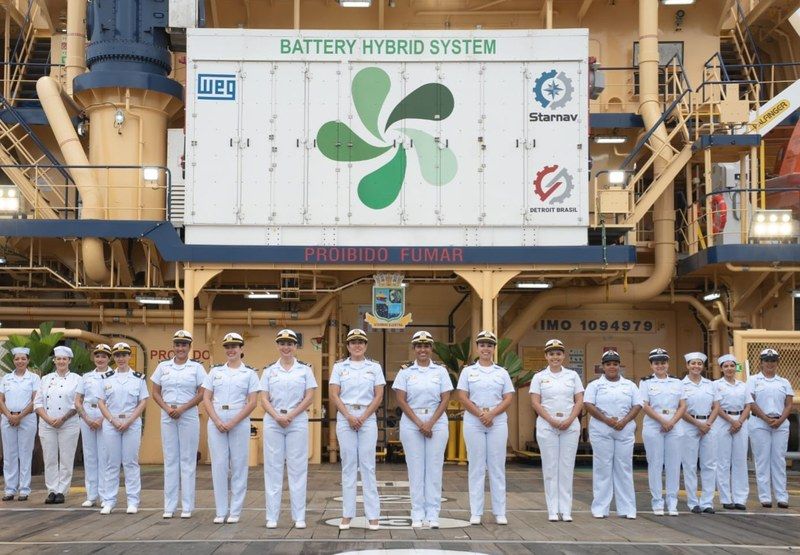
At the helm, in the engine room, in navigation, and in various operational roles, women occupy the spaces of a vessel that combines technological innovation with an exclusively female crew. The Starnav Elektra, built in Brazil by Estaleiro Detroit, in Itajaí (SC), combines the work of professionals in different areas with technological solutions aimed at energy efficiency and reduced fuel consumption.
Leading the vessel is Commander Isabela Teixeira Ponce de Leon. For her, the significance of having an exclusively female crew lies precisely in the qualification of the professionals who hold each position. "Each woman on board earned her position through training, qualification, experience, and professional competence. Therefore, I see this moment not as an exception, but as a demonstration that women can occupy all functions on a vessel when there are opportunities and professionals duly prepared to perform them," she states.
The Elektra's experience occurs in a sector where female participation is still lower than male participation. According to the 2nd Survey on Gender Equity in the Waterway Sector, by the National Waterway Transport Agency (Antaq), women represented 17.8% of jobs in the sector in 2024, an increase of 0.5 percentage points compared to 2022. The survey indicates that female participation was 10% in operational positions, 15% in management positions, and 25% in managerial positions. In administrative positions, they represented 40%.
On the Elektra, the vessel brings together professionals in roles directly linked to operation and command, precisely among the segments where female participation is still lower.
Second Officer and Pilot, Jéssica Gomes, participates in voyage planning, route definition, equipment preparation, checklists, and mooring and unmooring operations, in addition to acting in safety and emergency procedures.
For her, the female presence in different roles should be seen as natural. "It should be normal to have women present in all work sectors. We are as competent as men," she emphasizes.
The female presence is one of the Elektra's distinguishing features, but the vessel also represents a technological advance for Brazilian shipbuilding. Built by Estaleiro Detroit for Starnav Serviços Marítimos, the ship is the first hybrid propulsion vessel built in Brazil.
The vessel is owned and operated by the company and shipowner Starnav and is serving Petrobras through a 12-year contract. The project is part of the Detroit Green Line, a product line developed by the shipyard focusing on energy efficiency, reduced fuel consumption, and environmental emissions.
The hybrid system combines conventional power generation with battery storage. Engines, electrical systems, propulsion, and battery bank are integrated through an energy management system, which allows adjusting the operation of the generators to the vessel's demand and using stored energy under certain operating conditions.
According to Juliano Zimmermann de Freitas, CFO of Estaleiro Detroit Brasil, the basic design was developed by the shipyard's own engineering team. Construction relied on national labor, engineering, and suppliers and achieved an estimated local content of 65% to 70%. The project was also developed with the possibility of using alternative fuels, such as HVO (Hydrotreated Vegetable Oil), a renewable option to fossil fuels.
"The construction of the Starnav Elektra was a project of great relevance for Detroit Brasil and for the Brazilian naval industry, a unique opportunity for the development of knowledge and technology," he points out.
In addition to hybrid propulsion, the vessel incorporates different energy efficiency solutions. The proposal is to integrate technologies to reduce the energy consumption required for operation and, consequently, environmental impacts.
Female participation in the project did not begin when the Elektra went to sea. During the vessel's construction, an average of 58 women directly participated in different stages of the process. They were in areas such as engineering, planning, quality, supplies, safety, production, administration, and construction support activities.
According to Juliano, the female presence in the naval industry has been gradually growing and already reaches technical, engineering, production, quality, and planning roles.
During the second meeting of the Permanent Forum for Discussion of Public Policies for Waterway Workers, held in 2025, the National Confederation of Waterway and Air Transport, Fishing, and Port Workers (Conttmaf) highlighted the growth of female participation in the sector. According to the entity, the first classes with women at the Almirante Braz de Aguiar Instruction Center (Ciaba) began in 1997. In 2025, they already occupied 35% of the vacancies in these classes.
The Elektra's experience comes at a time when female participation is gaining more space in discussions about the future of the waterway sector. in July 2026, Antaq launched the Guide to Encouraging Female Leadership: Navigating Together, a publication that brings together guidelines to increase the participation of women in leadership and decision-making positions in the waterway sector.
The Agency also conducts periodic research on gender equity, with the aim of monitoring female participation in different segments of the waterway sector and identifying advances and challenges.
In this scenario, the vessel puts into practice a reality that is still uncommon: women simultaneously occupying different functions necessary for the operation of a vessel, including command and navigation.
For Commander Isabela Teixeira Ponce de Leon, the expectation is that the female presence in different roles will cease to be exceptional. "Perhaps the greatest result of this moment is to reach a future where a woman in command, in the engine room, on deck, or in any other role on board ceases to be something exceptional and simply becomes part of the reality of the Merchant Marine," she emphasizes.
The vessel brings together a team that performs different technical and operational functions and, at the same time, incorporates technologies that represent an advance for the Brazilian naval industry. The expectation is that experiences like this will contribute to the female presence in command, navigation, engine room, and other areas of the Merchant Marine becoming increasingly part of the sector's routine in the future.