• 3 min de lectura
• 3 min de lectura
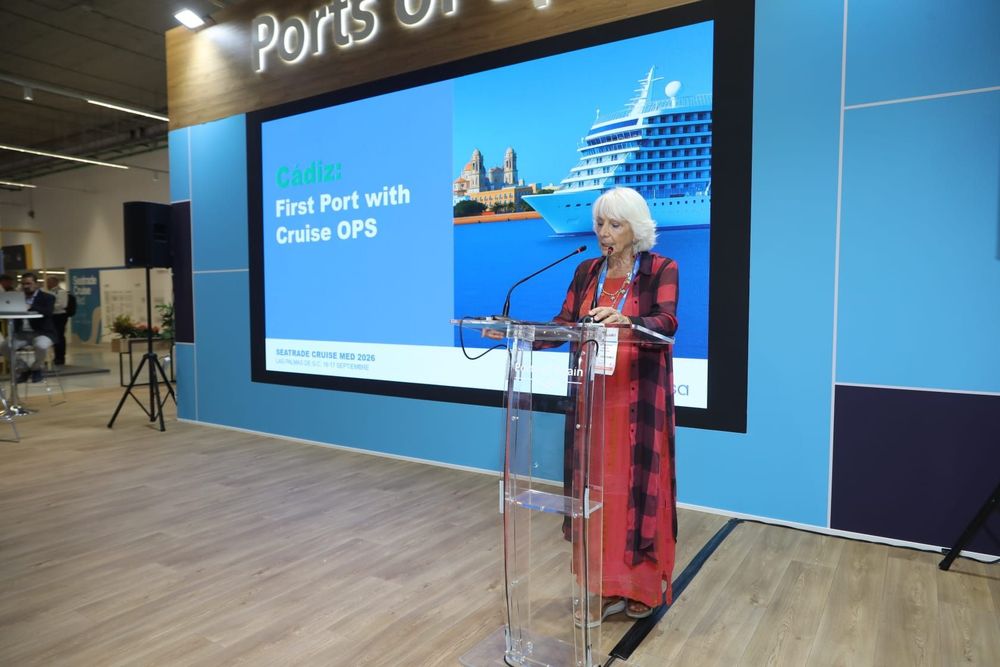
The president of the Port Authority of the Bay of Cadiz, Teófila Martínez, and the head of Endesa's OPS project, José María Reyes, today presented at Seatrade Cruise Med, held in Las Palmas, the OPS (Onshore Power Supply) system for cruise ships at the Port of Cadiz, an infrastructure that places the Cadiz port at the forefront of port electrification and the energy transition of the cruise sector.
The presentation, which took place at the Puertos del Estado stand, allowed representatives of the international cruise industry to learn about the characteristics and benefits of a system that allows vessels to connect their facilities to the electrical grid while docked at Alfonso XIII Pier, thus avoiding keeping their auxiliary engines running to cover their energy needs during the stopover.
This solution significantly contributes to reducing the environmental and acoustic impact of stopovers. According to calculations by Puertos del Estado, the electrical connection can reduce NOx emissions by 96%, SOx by 8%, particulate matter by 94%, and CO₂ by 64% compared to onboard electricity generation using fuel. In the case of the Port of Cadiz, the effect is reinforced by the supply of energy with a renewable origin certificate from Endesa.
The project has involved an investment of 1.5 million euros by the APBC in this first phase, while Endesa has allocated 6.75 million euros, including 2.7 million from the Sustainable and Digital Transport Support Program, within the framework of the Recovery, Transformation and Resilience Plan financed by NextGenerationEU funds.
The installation features a 16 MVA OPS station, equipped to adapt the voltage and frequency of the electrical grid to the vessel's requirements. The system is completed with a mobile connection device equipped with an articulated arm that allows the link between the terrestrial infrastructure and the ship to be made safely and efficiently.
In this first stage, the installation is sized to supply electricity to one vessel, but thanks to its modular configuration, it will allow the power to be subsequently expanded to 24 MVA and serve other vessels at different piers.
The projected demand during the first year is 8.62 GWh, with an estimated saving of around 5,000 tons of CO₂ annually, equivalent to the emissions associated with approximately 2,800 vehicles circulating for one year. Endesa has a 35-year concession for the provision of the service at Alfonso XIII Pier.
During the presentation, Teófila Martínez highlighted the value of the Port of Cadiz being able to showcase an infrastructure at an international specialized forum like Seatrade Cruise Med, whose success will be measured by every vessel that turns off its engines when docking in our port.
The participation of APBC and Endesa in Seatrade Cruise Med thus allows the international cruise sector to see an already operational and scalable solution, aligned with the new environmental demands of maritime transport and with the Port of Cadiz's strategy to move towards a more electrified, efficient, and sustainable port model.