

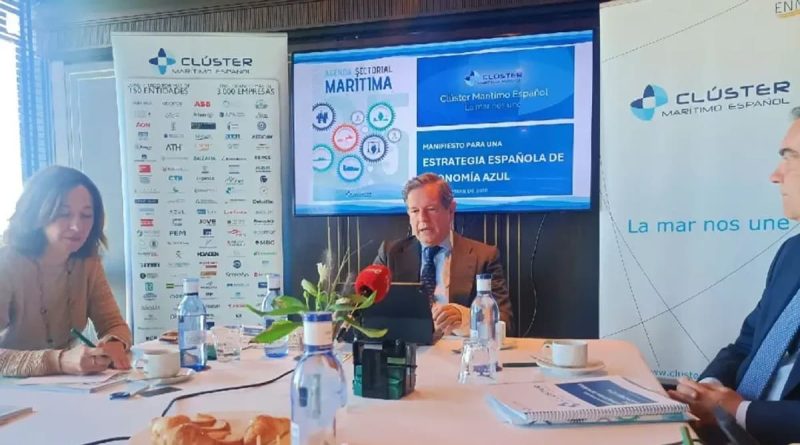
Among its requests are modernizing infrastructure and updating the Special Canary Islands Register to regain fleet competitiveness.
The Spanish Maritime Cluster demands from the political class and the next government, "whoever it may be," a state-level commitment, beyond party lines, to strengthen the competitiveness of the Spanish maritime sector as a whole and reposition it as a benchmark in the international market in certain areas, such as shipbuilding, Spanish flagging, and infrastructure and the logistics-port environment. To this end, the cluster, representing over 150 entities related to the maritime sector—including freight transport, passenger transport, and fishing and aquaculture activities—has prepared a memorandum based on 10 demands for commitments that the association wants to secure from politicians to materialize into a state pact for the blue economy strategy.
"There are dispersed sectoral initiatives, but an integrating vision is lacking."
Javier Garat, President of the Spanish Maritime Cluster
The memorandum, which was presented and sent to the various political forces this Tuesday, advocates for a state vision, beyond the continuity of the executive of one color or another. "The next legislature must convert our geographical, industrial, and maritime position into more investment, technology, employment, and strategic capacity," states the president of the Spanish Maritime Cluster, Javier Garat. "The maritime sector should be a strategic and autonomous sector. We hope that the parties realize its importance." Furthermore, the cluster points out the need for greater coordination among government ministries with maritime competencies, under the supervision of an economic vice-presidency, thus avoiding dispersion and duplication. Among the commitments outlined in the manifesto is, in addition to the recognition of maritime activity as strategic, the creation of a national investment plan in the blue economy to modernize infrastructure and regain the competitiveness of the Spanish fleet through the modernization of the Special Canary Islands Register (REC).
Likewise, it advocates for simplifying regulation and reducing bureaucratic burden, while preserving environmental and safety requirements; fostering blue employment and talent; promoting innovation, digitalization, and energy transition; and developing new industries linked to the blue economy, such as marine renewable energies, blue biotechnology, and underwater robotics. "Spain needs a national roadmap that coordinates all policies related to the sea. Currently, there are dispersed sectoral initiatives, but an integrating vision that aligns economic, industrial, energy, scientific, and environmental objectives is lacking," says Javier Garat. Specifically, and in reference to the state investment plan, the president of the Spanish Maritime Cluster points to considering the blue economy once the next Multiannual Financial Framework of the European Union (EU), corresponding to the years 2028-2034, is approved, endowed with almost two trillion euros. "When we know the definitive amount, the funds, and the allocations that arise from there, it will be very important for Spain to prioritize the sector when distributing them because the sea will compete with other businesses within the same country," Garat asserted. At this point, it is worth remembering that the Council of Ministers approved the Spanish Maritime Strategy 2025-2050, which aims to become the backbone framework for the modernization and decarbonization of the maritime sector. The strategy is articulated in seven priority objectives, including the energy transition of the business—endowed with 250 million euros in public aid between the current year and 2030—its technological development, and the competitiveness of its flags. However, for Garat, "we must move from words to deeds," a point where he still detects a significant bottleneck.
According to data from the cluster's 2025 Maritime Sectoral Agenda, maritime sectors generated 41.909 million euros in direct gross added value in Spain, nearly 15% more than in the previous edition. Of these data, maritime transport contributed 1.203 million euros, 3.8% more than the previous year. However, Spain still has considerable room for improvement to reach levels of economic contribution similar to those of other Member States, with an estimated additional potential of around 5 billion euros, according to the cluster. This situation is explained, in part, by the high dependence on foreign shipping companies, which manage more than 90% of Spanish maritime foreign trade, despite the country holding the second position in Europe in terms of port traffic volume. As a consequence, there is a significant deficit in the maritime freight balance, estimated at approximately 10 billion euros, which highlights a significant development opportunity for the maritime sector. As of January 1, 2026, Spanish shipowners controlled 203 vessels with 4.7 million gross tons (GT). Of these, 84 vessels with 1.7 million GT sailed under the Spanish flag, and another 119, with 3 million GT, were flagged in registers other than the national one.
DECÁLOGO OF COMMITMENTS FOR THE NEXT LEGISLATURE
Create a National Investment Plan for the blue economy
Mobilize public and private investment to modernize infrastructure, boost new industries, and accelerate transformative projects
MARITIME TRANSPORT MARKED BY REGULATORY UNCERTAINTY
This year has been marked by the review of the European Emissions Trading System (ETS) regime, about which the Spanish Maritime Cluster has not received news of significant progress. According to its president, the review is still under discussion in the European Parliament, where he hopes the fight will continue to avoid particularly harsh damage to Spanish ports. "The EU is not currently in the best conditions to compete in the world, so we anxiously await the materialization of Von der Leyen's words about simplifying this rule," Garat asserts. One of the most recent effects of this regulation has been the impact on short-sea shipping, which led to a contraction in both demand and supply, resulting in logistical readjustments to transport cargo by road and avoid costs associated with the ETS. Despite everything, it is not the only environmental regulation within the EU that continues to condition the activity of maritime freight transport: it also remains to be seen what will happen with the decarbonization framework of the International Maritime Organization (IMO), which is beginning to condition investment decisions in the energy transition and has been stalled for a year. According to data cited by the Spanish Maritime Cluster, the percentage of new ship contracts for alternative fuels decreased from 44% in 2024 to 37% in 2025.
Irene LiñánMadrid
The Draghi report extends the EU's transport gap with China and the US to the supply chain
Thus, the cluster points to the "insufficient dimension of the fleet controlled by national shipowners" in relation to the country's economic and geostrategic potential as "one of the main structural weaknesses of the Spanish maritime system." An aspect that requires priority attention, in the cluster's opinion, is the updating of the regulatory and operational framework of the Special Canary Islands Register. "The loss of competitiveness of this register is largely due to structural deficiencies in its labor and administrative regulation, which has led more and more shipowners to consider it an unattractive option," says the association of representatives, which points out that, although the fiscal framework of the register does not require major modifications, "it is imperative" to complement it with urgent reforms, especially in the labor and administrative fields, to strengthen the competitiveness of merchant ships under the Spanish flag. "It is crucial that Spain develops a comprehensive and coherent maritime policy that simplifies administrative procedures and promotes a favorable environment for the growth of the national shipping sector."
Among the indicators included in the 2025 Agenda, the 194.5% increase in new shipbuilding contracts also stands out, reaching 150,835 compensated gross tons (CGT). These data show that the Spanish shipbuilding sector "is in a boom moment and we must continue to take advantage of it," says Javier Garat, as well as "create opportunities to generate new synergies and make use of specialized shipyards," both to renew different fleets of vessels and to achieve efficiency and digitalization in the maritime sector. The contractual and productive activity of Spanish shipyards continued to be at high levels, supported by the technological specialization of their constructions and by a solid and diversified order book. According to data from the Ministry of Industry and Tourism, the order book for new constructions of Spanish shipyards remained between 60 and 65 vessels under construction during 2025. Now, the aim is to promote collaboration agreements to internationally promote the Spanish naval sector, especially in emerging markets linked to decarbonization, and facilitate the attraction of international vessels to Spanish shipyards for repair activities.
Regarding the Spanish investment plan in the blue economy, the cluster believes it is "essential" to, among other things, modernize port infrastructures, another source of hope for generating new activity opportunities linked to maritime logistics. "Competitiveness requires an improvement of infrastructures, and in Spain, we have a business and technological base on which to build all this. The challenge now is for investment to truly translate into innovation," says Garat. In this area, the manifesto presented to political parties proposes reducing administrative burdens and updating the regulatory framework to favor more competitive conditions for Spanish operators; and calls for strengthening maritime security and sovereignty, protecting critical infrastructures—such as ports and submarine cables—and strengthening national capabilities linked to trade routes and logistics chains. For their part, port activities reached a direct added value of 3.459 billion euros last year, when the total volume moved by Spanish ports was around 557 million tons, along with some 19 million TEUs and 74.7 million tons of rolling traffic.
The cluster sees Spain as having the conditions to lead emerging sectors around the maritime industry
Therefore, the cluster's request is to focus on creating infrastructures that allow adaptation to new traffics and types of vessels—such as those propelled by LNG and large container ships—, taking advantage of underutilized infrastructures and the creation of facilities prepared to host LNG and electrical supply to vessels, green maritime corridors, and the promotion of the OPS system, among other projects. "This adaptation is an important line of activity for Spanish shipyards," the cluster points out. The organization also highlights Spain's opportunity to become a European maritime-logistics hub and strengthen its international leadership. To this end, the memorandum states, it is vital to promote intermodality, especially rail-port; promote an integral transport infrastructure system; and modernize technologies and infrastructures and the provision of advanced port services.
Regarding the other factors referred to in the Spanish Maritime Cluster's manifesto for the next Executive, the IMO plans to create a strategy on the digitalization of the maritime sector with the aim of leveraging emerging technologies and boosting efficiency, safety, and sustainability in the maritime transport sector. In addition, it will foster a fully interconnected, harmonized, and automated global maritime sector. In this regard, the cluster points out that future competitiveness will depend on the ability to lead technological transformation and decarbonization. "The digitalization of ports and logistics chains, Artificial Intelligence, automation, cybersecurity, intelligent maritime traffic management systems, or digital twins are redefining the functioning of the global maritime economy," states its 2025 report. And Spain "has the conditions" to lead these emerging sectors: marine renewable energies, blue biotechnology, ocean observation, underwater robotics, marine circular economy, advanced desalination, or services associated with the protection of the marine environment "represent strategic opportunities for Spain."


