• 4 min de lectura
• 4 min de lectura
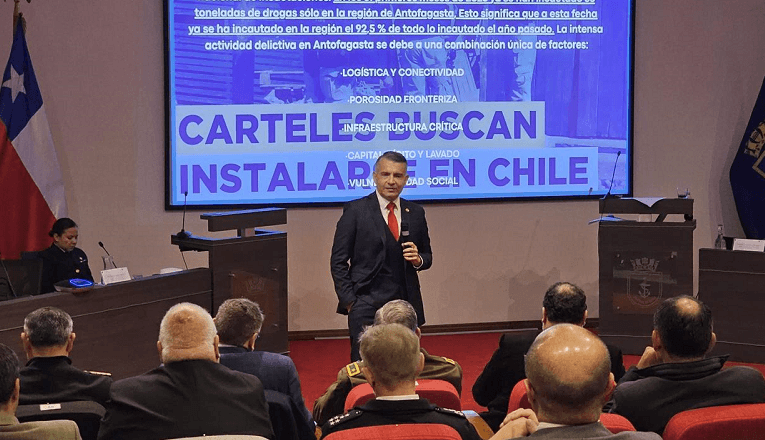
The regional prosecutor of Antofagasta, Juan Castro Bekios, presented at a seminar an assessment of the criminal impact that the upcoming launch of the Capricorn Bioceanic Corridor (CBC) could have, accompanied by a proposal for urgent actions to mitigate such effects.
The regional prosecutor described the current scenario of various criminal phenomena facing the north, including drug trafficking, where Antofagasta is setting national milestones, with 36 tons seized this year, representing 60% of all national seizures.
'The case of Antofagasta is noteworthy because it shares a border with Bolivia, one of the world's largest cocaine producers, in addition to being the region that seized the most drugs nationwide during 2025, exceeding 38 tons,' Castro indicated.
The official also drew attention to cigarette smuggling, mainly of Paraguayan origin, detailing that in 2025, 11,603,063 packs were seized in the region, with a 49.4% increase compared to 2024, a figure that is again on track to be surpassed this year.
After reviewing the historical figures, the prosecutor added that the CBC could become a structural multiplier of criminal threats for Chile and, especially, for the Antofagasta Region, with impacts in a series of areas.
Among the most critical, he mentioned the arrival of new criminal organizations, maritime and terrestrial drug trafficking, money laundering, the emergence of synthetic drugs, illegal mining and copper theft, as well as possible links with terrorist organizations, institutional corruption, smuggling, and cybercrime.
Another important aspect was the connection of the CBC with the area known as the Triple Frontier (Paraguay, Brazil, and Argentina), where tremendously dangerous criminal organizations, such as the First Capital Command, are present, and which has also been linked to the financing of organizations like Hezbollah.
Regarding the eventual criminal consequences of the Triple Frontier for Chile, Castro Bekios mentioned drug and arms trafficking, organized crime, insecurity and violence, irregular migration, human trafficking and migrant smuggling, contraband, and money laundering.
He also warned of the possibility of an "extra-hemispheric projection," thanks to the maritime networks connecting Chile with distant destinations, its extensive logistical capabilities, and the interest of distant criminal organizations, such as the Jalisco New Generation Cartel, which has already attempted operations in the country.
Juan Castro Bekios raised the existence of four critical nodes in the region: an unsupervised strip at border crossings, deficient intelligence coverage, lack of infrastructure and non-continuous hours, in addition to low container inspection coverage in the region's ports.
The prosecutor emphasized that such threats 'are not faced solely with more controls or operations, but with an institutional reengineering in security, intelligence, and criminal prosecution.'
At this point, he proposed a series of measures that should be implemented in the near future, including the creation of a Joint Port Intelligence Center, continuous coverage by Carabineros (Chilean national police) and PDI (Investigations Police of Chile) at border crossings, the creation of a permanent interagency team for mining crimes, an increase in criminal analysts, the creation of a registry of exporting companies and contractors (with information cross-referencing with Interpol), electronic sealing of containers, an increase in the percentage of containers inspected at origin, and the signing of an 'intelligence protocol' for destination ports.
The prosecutor stated that the Bioceanic Corridor is a 'strategic opportunity' for the development of the region and the country, but at the same time a 'critical threat,' urging not to lose sight of the problems and challenges it could bring. 'The corridor does not create the problem; it scales it,' he affirmed.
In the final part of his presentation, Castro Bekios stated that the window of response to these threats is limited. 'Chile has a critical horizon between 2026 and 2028 to strengthen its preventive capabilities before the phenomenon consolidates,' he maintained.
'The rule of law in northern Chile is at stake in the corridor,' stated the prosecutor, amplifying an idea he has been presenting in various forums.