• 4 min de lectura
• 4 min de lectura
The development of the II Swell Workshop, held on May 28 in Valparaíso, confirmed that the country has advanced in the technical understanding of these phenomena, although it also revealed a persistent gap between the available knowledge and its application in operational decision-making in the port sector.
From a general perspective, the event organized by the National Oceanographic Committee (CONA) showed a robust scientific and technical agenda, but one that still needs to consolidate its translation into more integrated and consistent management processes in the maritime-port system.
Modeling and understanding the phenomenon: a solid, but still developing, foundation
The presentation by Dr. Matías Gómez reaffirmed one of the key points in the discussion of swells in Chile: the relevance of far-field events and their differentiated impact on the national coast. The emphasis on episodes such as those in 2015 and 2024 allowed for an understanding that these are not exceptional phenomena, but recurrent conditions that particularly affect bays open to the north.
While progress in modeling and observation is significant, the challenge lies in how these models manage to permeate concrete operational decisions, especially in environments where uncertainty remains high.
Threat mapping: concrete progress towards risk management
In this vein, María Paz Escalona's presentation stood out for showing tangible progress: the construction of the Valparaíso Swell Threat Map, developed based on requirements from the national risk management system Senapred. This type of instrument represents a significant step towards evidence-based territorial planning. However, its true impact will depend on its ability to be incorporated into decision-making processes, both in urban and port areas. The projection towards new developments in Viña del Mar and Concón suggests a consistent line of work, although still incipient in terms of national coverage.
Swell warnings: available information, but with challenges in its use
For his part, Sebastián Morales's presentation focused on the evolution of swell warning systems, showing sustained progress in the generation and systematization of information since the early 2000s.
However, the critical point does not seem to be the availability of data, but its interpretation and use. The existence of historical series and verification systems is a relevant asset, but the dispersion of criteria and the lack of standardization in the reading of this data continue to be factors that limit its contribution to operational decision-making.
Port operation: the point where gaps converge
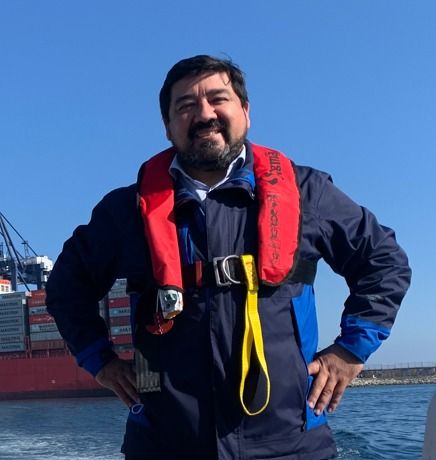
In this technical scenario, I was tasked with trying to connect the technical world more directly with operational reality. And my approach is clear: the problem is not the existence of information, but how it is obtained, processed, and with what quality decisions are made.
From this perspective, its focus on the need to integrate measurement, forecasting, operation, and governance is particularly pertinent.
The emphasis on three dimensions—better measurement, better dissemination, and teaching how to interpret information—points directly to a structural weakness of the system: the lack of a common language among the different actors.
Likewise, I proposed the core idea that safety, operational continuity, and resilience are not opposing concepts, but complementary ones, questioning the historical tendency to resolve risk exclusively by closing ports.
Furthermore, my diagnosis of the lack of data integration, the limited local validation of forecasts, and the need to move towards decisions based on multiple variables, and not on isolated indicators, reflects a problem widely recognized in the industry, but still unresolved.
An agenda that requires articulation
The workshop confirmed that Chile has relevant capabilities in terms of swell observation, modeling, and analysis. However, the main gap remains in the articulation between these developments and their application in the daily operation of ports.
In this context, CONA's role as an articulator between science and decision-making appears strategic, but also challenging, considering the need to coordinate multiple actors with different objectives.
Final reflection
The II Swell Workshop leaves a clear conclusion: the country has advanced in generating knowledge, but now the challenge is to integrate it.
The evidence presented shows that data, models, and tools exist. However, as long as these are not translated into more consistent, coordinated, and quality information-based decision-making processes, the system will continue to face the same dilemmas in the face of each swell event.
Ultimately, more than new diagnoses, what is required is to consolidate operational risk governance, where science ceases to be a parallel input and becomes a central component in port management.
Source: Portal Portuario