• 4 min de lectura
• 4 min de lectura
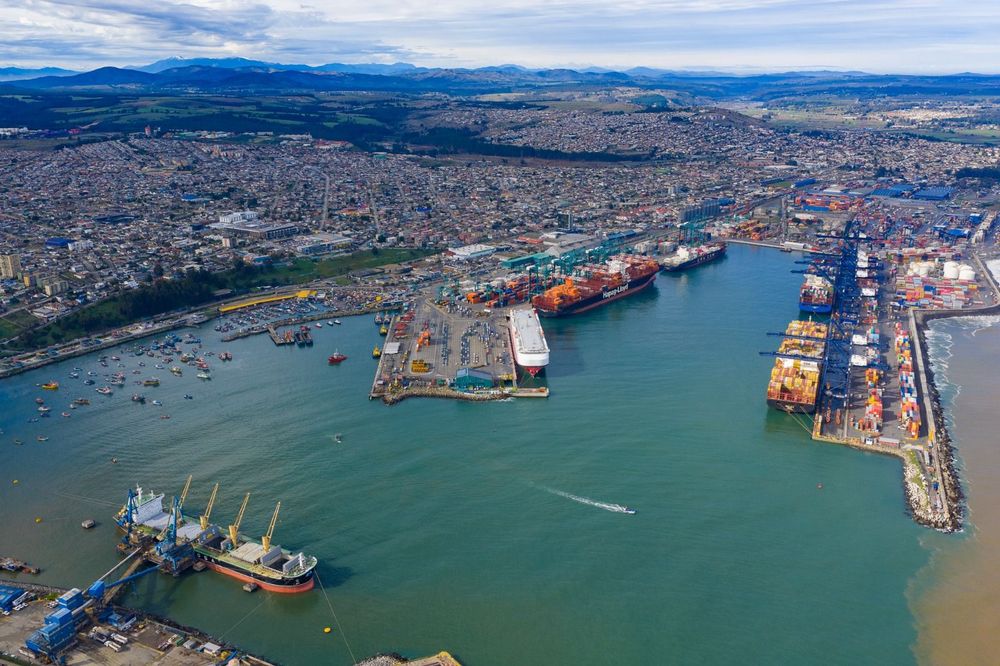
The Undersecretary of Transport, Martín Mackenna Rueda, highlighted the impact of ports as an engine of the Chilean economy. In this regard, he pointed out the urgency of promoting investments in the sector, but noted that obtaining financing for such projects is a challenge that requires being addressed "with the utmost seriousness."
The statement was made by the Chief of Staff of the Undersecretariat of Transport during the InfraChile seminar, organized by the Infrastructure Policy Council (CPI).
The meeting also included the participation of the President of the Republic, José Antonio Kast; the biminister of Public Works and Transport, Louis de Grange; undersecretaries Nicolás Balmaceda (Public Works) and Romina Garrido (Telecommunications), as well as former Ministers of Finance Felipe Larraín and Mario Marcel.
At the event, Mackenna stated that "ports are key to our country's international trade; more than 90% of foreign trade moves through ports. Of course, we see that all port investments on the radar are necessary, but we must be clear that these are projects with high investment amounts; in the Port of San Antonio alone, USD 4.5 billion is required. Therefore, the way to obtain and structure financing for this type of investment is a challenge that must be addressed with the utmost seriousness, with the greatest creativity, and also with the best data available at all times, bearing in mind that these are state policies that are progressing and are long processes."
"Progress is being made, for example, with environmental processes, which are being approved, and to that extent, one is already delimiting where that infrastructure is going. I also believe it is very important that we focus on thinking about how to best use the infrastructure we already have available when we are also thinking about such high investments. Therefore, we must also look at regulatory issues of facilitation and coordination among the different actors in the public sector, which often seem not to be up to the speed required by cargo movement, considering its importance for the country's growth, the country's supply, and for the quality of life of all people," he added.
In this sense, the Undersecretary of Transport emphasized that "the important thing is to continue advancing in these large port projects, which will materialize at different times to increase the total supply. We must also look at them with the associated infrastructure that is needed, for example, for ferro-port corridors. We have the Barrancas Intermodal Terminal that will be inaugurated in San Antonio and will multiply by five the capacity of containers arriving at the port by rail."
"Also consider highway infrastructure for access to ports in Bio Bio, look broadly at the central macro-zone, also incorporating Bio Bio within the different alternatives to solve the same future demand problem, but with optimal investments to always be ahead of said demand," he added.
Within the framework of the meeting, President Kast and Biminister De Grange highlighted the strategic role of port infrastructure for the country's development. In his speech, the president quoted former President Eduardo Frei to define the port as the way that "opens a region to the world," also emphasizing the relevance of key terminals throughout the territory, such as in Tocopilla, Valparaíso, San Antonio, and in the Bio Bio port complex.
For his part, the Biminister of Public Works and Transport greeted the head of the San Antonio Port Company (EPSA), Sergio Merino, highlighting that the state company faces "extraordinary and beautiful challenges for the future development of our country," which would be in reference to the Outer Port project.
It should be remembered that the Government of Chile recognized that financing the San Antonio initiative is "extremely complex," as it would detract from covering social emergencies. Specifically, the objections are to the state investment cost involved in the construction of the breakwater (USD 1.95 billion).
Meanwhile, recently, EPSA announced the decision to restructure the bidding process for the port project into two independent and parallel stages. One is aimed at awarding the construction of the enabling works and the other focused on the specific ones to create the breakwater, which was valued by former ministers and experts.