• 4 min de lectura
• 4 min de lectura
Negotiations between Iran and the United States appear to be continuing, but with misleading statements emerging from both sides as to how much progress is being made. Those leaking information about the negotiations seem more interested in influencing the progress of the talks than in conveying the truth. But it seems likely that both sides are aiming initially for an extension of the ceasefire to then facilitate further negotiations, accompanied by some form of reopening of the Strait of Hormuz.
Despite bluster and bluff, both sides seem keen to find a settlement, President Trump wanting to secure his political position before the midterm elections. Iran needs to gain immediate relief from the crippling economic and financial effects of sanctions and the blockade, with shortages threatening internal unrest in Iran unless resolved quickly. Whether Israel or the Gulf States, who are not direct parties to the negotiations, will be happy with what is agreed bilaterally is far from certain, and these interested outsiders might do much to sabotage any agreement made by Iran and the United States if threats are not removed and freedom of navigation in the Strait of Hormuz is not re-established.
If, however, an extension to the ceasefire is agreed, it would be destabilizing if either Iran or the United States were involved in clearing the Strait of Hormuz, ready for the huge volume of shipping that will seek to either leave or enter the Strait. With the inward and outward channels of the Traffic Separation Scheme (TSS) in the narrows both lying in Omani territorial waters, and as a state that has sought both to remain neutral and observant of the IMO's existing 1966-based Strait of Hormuz TSS, Oman will be ready to marshal traffic in the Strait from its naval Hormuz Control station on the island of Didamar, which lies mid-Strait.
But clearance of the water from the threat of mines is a very different matter.
Oman's Maritime Security Centre warned all shipping on May 29 that an object floating close to the inner/northernmost channel of the TSS was probably a sea mine, cautioning shipping to be on special alert and to report any suspicious sightings. Several days later, a well-informed source told The Maritime Executive that about 20 possible floating mines had been identified in high-resolution satellite imagery of the same area. Whatever the case, ship owners will seek to have some assurance that the TSS navigation channels are free of mines before transits commence.
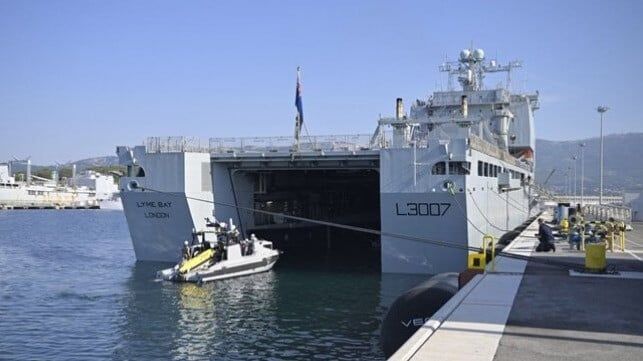
A naval force is forming up to take on the mine clearance mandate. Developed as an Anglo-French coordinated coalition of over 40 nations, the flagship of the force is likely to be the French aircraft carrier FS Charles de Gaulle (R91), which is already in position in the Arabian Sea with escorts including the Royal Navy air defense destroyer HMS Dragon (D35). The UK's RFA Lyme Bay (L3007) is likely to be the main mothership for the deployment of autonomous mine clearance drones, and having loaded British equipment in Gibraltar on May 26, arrived in Toulon on May 30 to load French autonomous mine clearance equipment. The landing ship dock RFA Lyme Bay is well-suited to the role, having a well deck and being equipped with bow and azimuth thrusters.
More conventional mine clearance capabilities may be delivered by the Italian Navy's ITS Crotone(M 5558) and ITS Rimini(M 5561), supported by the patrol vessel ITS Montecuccoli(P455), which all left Italy for the Gulf in mid-May. The Dutch minesweeper HNLMS Willemstad(M864) was nearing Gibraltar on June 4.
The German Defense Minister Boris Pistorius has announced the forward deployment to the Mediterranean of the minesweeper FGS Fulda(M1058), with a supporting air defense frigate, the Elbe Class replenishment ship FGS Mosel(A512), and a maritime surveillance aircraft, ready for a move into the Gulf once it is safe.
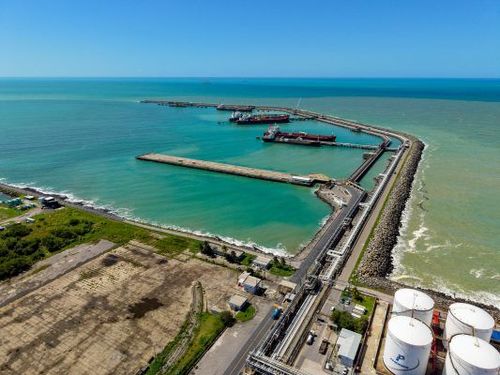
Many other nations, including those from Asia, have declared readiness to join the force, but integrating non-NATO ships will probably be a second-phase activity once command and control arrangements are well established. Once the force is activated, many ships are likely to use the shore and replenishment facilities at the port of Duqm, which are designed for this purpose and can be short-leased.
Fuente: Maritime Executive