• 4 min de lectura
• 4 min de lectura
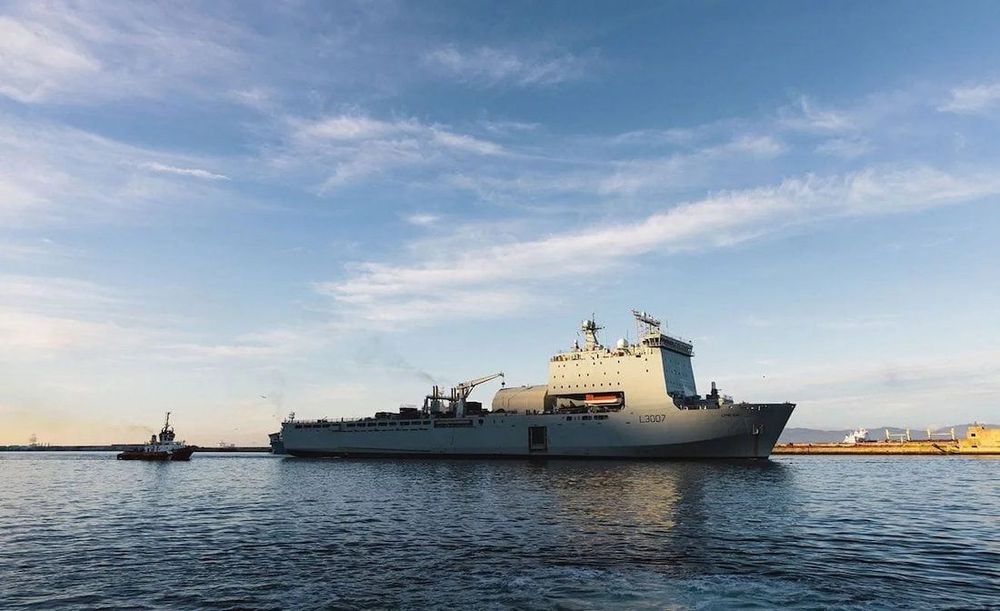
The United Kingdom's specialist mine countermeasures force has arrived in the Middle East, marking a significant step toward restoring commercial confidence in the Strait of Hormuz as Western allies prepare for what could be a lengthy multinational effort to make the vital shipping lane safe for normal trade once again.
The Royal Fleet Auxiliary ship RFA Lyme Bay safely transited the Red Sea escorted by the Royal Navy destroyer HMS Dragon and accompanied by German naval vessels, carrying more than 270 personnel and an array of advanced autonomous mine-hunting systems intended to locate and neutralize mines without placing sailors directly in danger.
The deployment comes as European leaders formally endorsed a UK-France led Multinational Military Mission for the Strait of Hormuz aimed at protecting merchant shipping, reassuring insurers and shipowners, and verifying demining efforts as commercial traffic gradually returns to the waterway.
In a joint statement released Wednesday following a meeting in Berlin, the leaders of France, Germany, Italy, Poland and the United Kingdom reaffirmed their commitment to "unconditional and unrestricted freedom of navigation in the Strait of Hormuz" and pledged participation in the multinational mission as conditions permit.
"It could play an important role in reassuring the shipping industry and re-opening the Strait including through verification of demining," the leaders said.
The political backing adds momentum to an initiative first announced in April when British Prime Minister Keir Starmer and French President Emmanuel Macron convened an international summit involving more than 50 countries and the International Maritime Organization. At that meeting, the two leaders announced plans for an "independent and strictly defensive multinational mission" tasked with protecting merchant vessels, reassuring commercial operators and conducting mine clearance operations once a sustainable ceasefire had been reached.
"The right of transit passage without restrictions or tolls is the bedrock of international trade. Freedom of navigation means navigation must be free," the joint Franco-British statement said.
In May, Britain announced plans to contribute autonomous mine-hunting systems, counter-drone technology, Royal Air Force Typhoon fighter jets, and the air-defense destroyer HMS Dragon as part of a UK-France led mission involving more than 40 nations.
British officials have repeatedly emphasized that the operation is intended to be "strictly defensive," focused on mine clearance, protecting merchant shipping and restoring confidence among commercial operators rather than conducting offensive operations. The effort mirrors Europe's maritime security mission in the Red Sea, with a heavy emphasis on autonomous systems, aerial protection and safeguarding freedom of navigation through one of the world's most strategically important waterways.
The Bay-class RFA Lyme Bay has been rapidly converted into a "minehunting mothership" capable of deploying autonomous surface vessels, remotely operated underwater vehicles, mine disposal systems and advanced sonar technology designed to survey and clear hazardous waters.
The ship carries Royal Fleet Auxiliary mariners alongside more than 100 Royal Navy mine warfare, diving and explosive ordnance disposal specialists, as well as Royal Marines, British Army personnel, medics and French sailors.
"A huge number of people from across Defence and industry have worked exceptionally hard over the past few weeks to bring together experts and cutting edge mine detection and clearance technology on to Lyme Bay," said Commander Gemma Britton, Commander United Kingdom Mine Countermeasures Force.
"We've trained hard and are enormously keen to utilise our skills on live operations that have such significance, not just to families and friends at home, but around the globe. This will be a multinational effort; the Royal Navy is ready to deliver."
Lyme Bay sailed in company with German command and support ship FGS Mosel and minehunter FGS Fulda, escorted through the Red Sea by HMS Dragon.
The deployment follows last week's U.S.-Iran Memorandum of Understanding, which ended active hostilities and initiated the reopening of the Strait of Hormuz. But while diplomacy has reduced the immediate security threat, naval mines remain one of the biggest obstacles to restoring normal commercial shipping.
Industry groups, including BIMCO and INTERTANKO, have repeatedly warned that shipowners and marine insurers are unlikely to fully embrace the reopening until credible mine clearance operations are underway and navigation routes are independently verified as safe.
Experts believe dozens of mines may still be present in the Strait's former Traffic Separation Scheme, which carried as many as 130 to 140 vessels per day before the conflict. As a result, much of the recent traffic has been routed along temporary coastal corridors near Oman and Iran while authorities assess conditions in the central shipping lanes.