

The National Agri-Food Health and Quality Service (SENASA) and the Food and Agriculture Organization of the United Nations (FAO) conducted the "Regional Workshop and Field School" to strengthen technical and institutional capacities in the prevention, early detection, and control of the red palm weevil in the countries that are members of the Plant Health Committee of the Southern Cone (COSAVE) and the Andean Community (CAN).
On the first day, held at the "Malvinas Argentinas" Convention Center in Gualeguaychú, Entre Ríos, experts from FAO and the National Plant Protection Organizations (NPPOs) of Uruguay and Argentina presented the importance of coordinating actions at a regional level and the tasks developed in both countries in relation to this pest, and shared experiences on how outbreaks were managed.
For its part, the National Parks Administration (APN) highlighted the importance of conserving natural protected areas and the risk that the red palm weevil represents. Likewise, the province of Entre Ríos explained the progress in legislative matters for the protection of native palm groves and the regulations associated with the use of phytosanitary products. The first day concluded with a tour of the urban area and a practical demonstration, where the municipality explained the active prevention actions it has been carrying out for the care of palm trees of patrimonial value, located in the main public spaces.
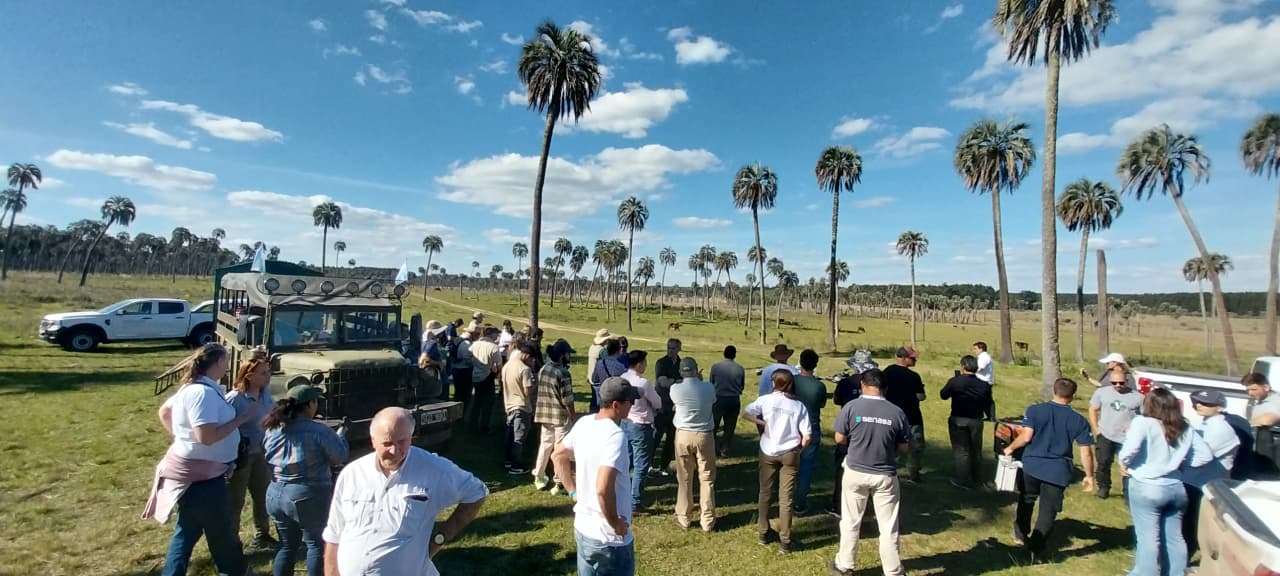
Subsequently, participants visited El Palmar National Park, where APN technical personnel conducted a demonstration (drill) of felling a palm tree, and explained personal safety guidelines, and the biosecurity procedures and measures established by SENASA that must be implemented for the control of an affected palm tree. After this activity, participants toured the preventive monitoring plots carried out by the park ranger corps.
Participants moved to the "La Aurora del Palmar" reserve, where APN presented the risk management approach it carries out, as well as the action plan developed as an adaptation of the Contingency Plan prepared by SENASA, to the territorial conditions of natural areas. The day concluded with a dynamic exhibition, coordinated by the Benet Foundation, in the heart of the natural reserve, which included a simulation of phytosanitary application using a drone and a series of presentations in which the private sector shared different alternatives available worldwide for the management and control of this pest.
The Red Palm Weevil
Rhynchophorus ferrugineus is a curculionid beetle native to tropical Asia, which has behaved as a pest for more than a century. It affects more than 30 species of palm trees, some of great economic importance globally, such as the coconut tree (Cocos nucifera), the African oil palm (Elaeis guineensis), and the date palm (Phoenix dactylifera).
Argentina preserves areas of incalculable value that safeguard emblematic native palm groves, mainly concentrated in the NEA (Argentine Northeast) region, bordering Uruguay. This heritage includes 12 species of native palm trees, such as the yatay (Butia yatay), the pindó (Syagrus romanzoffiana), and the caranday (Copernicia alba), present in national parks such as El Palmar, Iberá, Mburucuyá, Río Pilcomayo, and Chaco, among others.
In Entre Ríos, the yatay palm was also declared a Natural Monument. Palm trees also constitute a landscape element of great value in public spaces and private developments, which adds a potential risk to civil infrastructure (buildings, power lines, etc.) in the event of an infestation. In terms of food, in 2025 the yatay fruit was incorporated into the Argentine Food Code (CAA) as a "vegetable food," which provides a regulatory framework for its commercialization throughout the country and contributes to preserving biodiversity, revaluing traditions, and respecting food sovereignty.
SENASA Resolution 544/2026 extended the Phytosanitary Alert in relation to the pest throughout the national territory until June 30, 2028. Likewise, the Phytosanitary Emergency is in force in the provinces of Buenos Aires and Entre Ríos, declared by SENASA Resolution 133/2026. Its early detection is essential to implement measures that reduce the risk of dispersion to new areas.
In the presence of suspicious specimens or symptoms compatible with the presence of the Red Palm Weevil, notify SENASA


