• 4 min de lectura
• 4 min de lectura
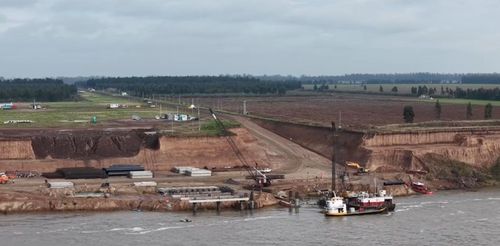
The Government of Tucumán reported on the reactivation of the Ingenio Cruz Alta railway siding, a project entirely executed by Compañía Azucarera Los Balcanes that recovered an infrastructure that had been inactive for more than 45 years and will connect the company's production with the Argentine ports of Campana and Rosario.
"The commissioning of the siding will directly link sugar production with the ports of Campana and Rosario, optimizing logistics and strengthening the sector's export capacity. The infrastructure was designed to mobilize an average of 60,000 tons of raw sugar annually, both in bulk and in big bags," the government of the Argentine province communicated.
The project, developed with IETSA engineering, included the construction of more than two kilometers of new tracks, prepared for ten-wagon broad-gauge trains; more than 1,000 cubic meters of embankments; a logistics platform exceeding 4,500 square meters; concrete pavement in the loading area; two track switches; and a new security system.
"Los Balcanes and Ledesma are putting a branch line into operation that will connect Tucumán's production with the ports and, from there, with the world. I feel enormous satisfaction and gratitude because there are issues, such as connectivity, where the State must be present. It's not enough to produce; we also have to sell that production and reach international markets, because that means foreign currency, income for our province and our region, and it translates into well-being for the community," stated Miguel Ángel Acevedo, Vice Governor of the Province of Tucumán.
"These companies decided to bet on infrastructure and invest, and that is fundamental. We have to work in coordination because we want the same objective: for Tucumán to grow, for the North to develop, and for our people to have work and be able to develop with dignity," he added.
Likewise, Acevedo highlighted the recovery of the railway as a tool to project provincial development. "It is a historic day, not because we are recovering something from the past, but because we are looking to the future. This means growth, hope, and development for Tucumán and the region," he emphasized.
"The State does not generate wealth by itself; those who generate it are productive activity and private companies. We, as the State, have to create the conditions for these companies to operate, work, and develop. In difficult times, we have to work in a coordinated manner and support each other," he elaborated.
For his part, the Secretary of State for Production of the Province of Tucumán, Eduardo Castro, stated that "there are more than two kilometers of new tracks, and it was a project that required a lot of work. For Tucumán, it means an advance for production, especially for our main regional economy, which is sugar. This will allow us to move production to the ports and, from there, to different parts of the world."
Castro also explained that increasing exports contributes to the balance of the sugar market. "All exported sugar is welcome because it reduces the amount remaining in the domestic market, which helps strengthen its price. These types of initiatives and projects should be applauded," he added.
"I believe this is the first project of its kind to be carried out in Tucumán, and others will follow. Industrialists can adopt this model to transport not only sugar but also lemons, strawberries, and other products. It is an advance for the Tucumán industry and, above all, for transportation, which has a very significant impact on costs," he added.
Meanwhile, the Executive Director of Compañía Azucarera Los Balcanes, Catalina Rocchia Ferro, highlighted that "I am passionate about the sugar industry and its history. For me, it represents identity built on rails, it represents work, and also the possibility of forming alliances with companies like Ledesma. This is key for the sector and for its professionalization," she stated.
"We need to be competitive, especially when exporting. Having completed this branch line gives us a significant advantage in terms of freight, considering the distance we have from the ports. Being able to load directly here, from production to the wagon, represents a saving of resources and allows us to gain competitiveness," she concluded.