• 3 min de lectura
• 3 min de lectura
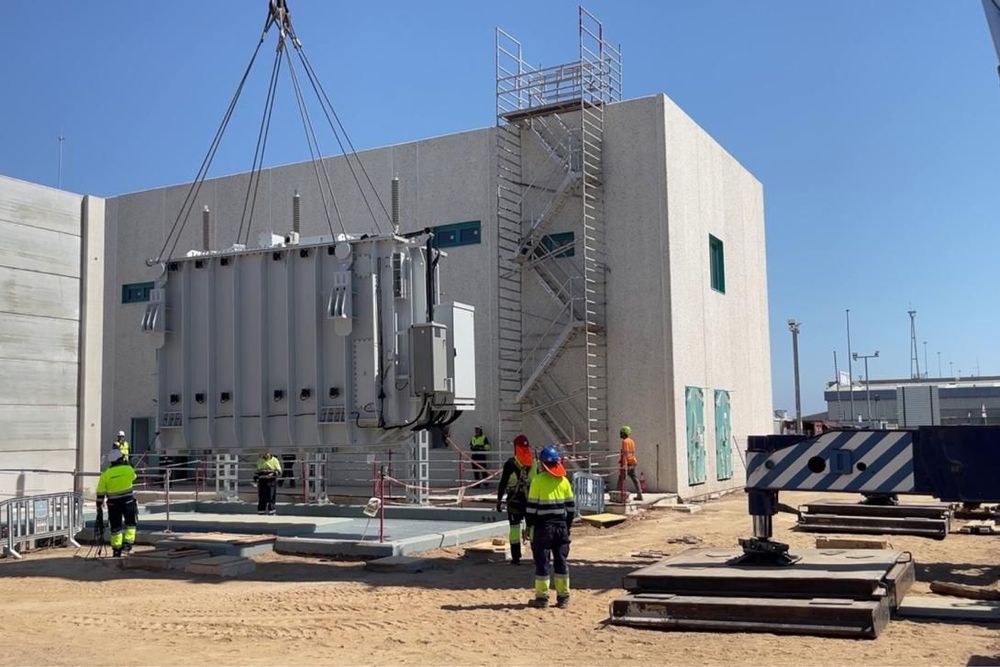
This September, the Port of Barcelona received the main transformer for the Port Substation. The arrival of this element, one of the key pieces of the new substation, represents a very important step in the development of the Nexigen Shore Power Electrification Plan, one of the main pillars of the Port of Barcelona's environmental sustainability strategy. The new substation represents the central node of the network that will power the full deployment of the Nexigen plan and will allow for the provision of renewable energy to all OPS (Onshore Power Supply) systems, making it possible for ships connected to the network to turn off their auxiliary engines during their stay in port.
The Port Substation, which will be ready to operate in the first quarter of 2027, is in the final phase of its construction, with the installation of the various electromechanical elements. During the first half of 2026, the construction of the substation and all the necessary auxiliary piping infrastructure for the installation of its systems were completed. This equipment arrived during the summer, notably the main transformer, which arrived in September.
The Nexigen Plan foresees the electrification of the main docks of the Port of Barcelona, which is why the Port Substation has been designed taking into account the future needs of this network. Thus, the transformer that has just arrived occupies one of the three available spaces for this equipment, ensuring the Port Substation maintains the necessary flexibility to adapt to future energy requirements and new consumption scenarios.
Deployment of the Nexigen network
In parallel with the completion of works at the Port Substation, progress is also being made on other works included in the Nexigen Plan. On one hand, a high-voltage underground pipeline is being built to connect the Port Substation with Red Eléctrica's Cerdà Substation. On the other hand, the medium-voltage network that will carry energy to the Adossat dock is being deployed, including underwater drilling between the Energía and Adossat docks, to supply energy to the OPS system for cruise ships under construction at Terminal H, operated by MSC, and to the OPS project for the future Terminal G, which will be operated by Royal Caribbean.
Currently, the Port of Barcelona already has two OPS systems in operation at Hutchison Ports' BEST container terminal, the first container terminal in the Mediterranean to have this technology, and at Grimaldi Terminal Barcelona's ferry terminal, which connects ships daily.
The Nexigen Plan, in which more than 200 million euros will be invested, supplies 100% renewable energy to ships, allowing them to stop their auxiliary engines while moored, with the aim of reducing emissions and improving air quality in the port environment. Nexigen is a key piece in the Port of Barcelona's Energy Transition Plan and its objective of being a climate-neutral port by 2050.