

• 9 min de lectura
• 9 min de lectura
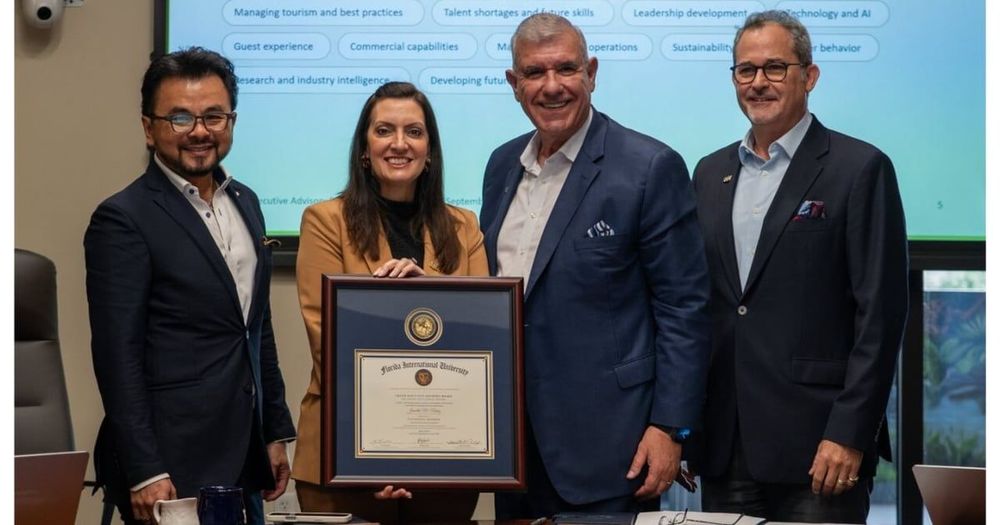
Building a talent pipeline and providing relevant research and industry intelligence are the two initial priorities Florida International University should focus on, according to FIU's newly formed Cruise Executive Advisory Board (CEAB).
The Miami-based university is located in the heart of the global cruise industry. The CEAB — part of Chaplin School of Hospitality & Tourism Management's Cruise Excellence Center — is key to FIU's aim to bridge the gap between academics and industry, ensuring an education that prepares students for meaningful careers and addressing cruising's growing need for shipboard and shoreside talent.
The CEAB draws on some of cruising's seniormost leaders.
They are David Bernstein, CEO, Carnival Corp.; Michael Bayley, president and CEO, Royal Caribbean International; Marc Kazlauskas, president, Norwegian Cruise Line; Neil Palomba, EVP operations, MSC Cruises; Tracy Wilson, SVP and GM, Disney Cruise Line; Jonathan Wilson, president and CEO, Aman at Sea; Christopher Prelog, president, Windstar Cruises; and Samuel Chamberlain, CEO, Americas, Ponant Explorations.
CEAB members also include three industry and enterprise leaders: Michelle Paige, CEO, Florida-Caribbean Cruise Association; Matthew Upchurch, chairman and CEO, Virtuoso; and Robin Lindsay, CEO, Apollo Maritime Services.
The CEAB met for the first time on Friday, welcomed by FIU President Janet Nuñez and Chaplin School Dean Michael Cheng, along with founding CEAB Chairman Larry Pimentel, FIU's distinguished cruise executive in residence, and Vice Chairman Thatcher Brown, FIU's senior tourism industry fellow.
The handpicked CEAB spans a wide cross-section of cruising, from mainstream to luxury, hotel brands to small-ship exploration. Together, 85% of cruising's lower-berth count is represented. There is diversity in expertise, from finance to operations, newbuilding to sales, and generational range, too, from veterans with decades of experience to newly appointed CEOs and rising stars.
Chaplin's hospitality program is ranked No. 1 in Florida, No. 3 in the United States and 23rd globally (top 1%) by the 2026 QS World University Rankings. When it comes to research and innovation, FIU has a Carnegie R1 ranking (top 3% in research production). It is also first in upward economic mobility, according to US News & World Report, 2026.
"We are building on a strong foundation," said Pimentel, who was appointed by Chaplin's Dean Cheng to help ensure the academic curriculum aligns with the business world.
"With FIU as a top university and Miami as the cruise capital of the world, there's a natural logic to building a serious cruise knowledge center here, a hub for research, talent development and white papers," Pimentel said. "It benefits everybody, and we'll be a resource for other universities. This is an open-source effort.
"If industry is supportive it means jobs, opportunity and, the crowning glory, the most meaningful cruise-focused center created with industry instead of just about the industry."
"We're also going to create it with the students and what they need, for a rounded approach," Brown added. "This is about changing lives, launching careers and aligning with industry. It will also feed the Florida economy."
FIU President Janet Nuñez is committed to making the university a force for student success and Florida's prosperity.
"A priority of mine is to align with industry, that we understand what the needs are. We know higher education has a lot of challenges — affordability, ROI and students questioning the value of a degree. FIU is the test case of why that negative narrative is inaccurate," Nuñez told the CEAB.
"Under the leadership of Dean Cheng and the School of Hospitality, we decided FIU needed to be more strategic about our role with the cruise industry. We want to be the academic port," Nuñez continued. "We want to be sure the cruise industry understands we not only provide the talent and the pipeline, we can provide solutions. But it has to be in partnership."
Cheng said: "Tell us where the gaps are, how FIU can make a meaningful contribution and hold us accountable."
The FIU Cruise Excellence Center is being led by hospitality but this is beyond just a hospitality intiative, Pimentel said. Other schools and departments are eager to participate, especially when it comes to research.
"We want to know the issues that keep the cruise executives up at night and apply research to that. I think it could make a huge difference," Cheng said.
Nuñez told the CEAB: "We have experts that can help. So every time you're trying to tackle a problem, think about it from the lens of how FIU can bring ideas and solutions."
Academic areas that could get involved include entrepreneurship, engineering & computing, information systems & business analytics, full stack engineering, environmental & sustainability, public policy, public health, logistics, legal, regulatory, marketing, communications and more, powering the FIU Cruise Excellence Center with an array of resources to draw on.
The CEAB is action-oriented, with working groups to be established in key areas that will report up to the board, which will meet thrice yearly.
"I truly appreciate how the board members were 100% leaning in and engaged," Cheng said of the first meeting. "They were here because they really care and the discussion flowed. It was hard to get a word in."
"This is not a ceremonial board. It was a working meeting," Pimentel said. "Their willingness to engage was tremendous."
"Everyone participated and was so motivated," Brown said. "There was no 'I'll get back to you' or silence. It gelled."
The starting point for the inaugural meeting was "What should the FIU Cruise Excellence Center solve?" The CEAB identified two priority areas: talent and workforce development and relevant industry research.
"One of the challenges our company has is recruiting," Carnival Corp.'s Bernstein said. "Finding the smart young people to build the pipeline and move up is probably one of the biggest challenges, more so shoreside than shipboard because Florida is so expensive. It's a challenge recruiting people from other parts of the country to South Florida."
MSC Cruises' Palomba cited a shortage of certified officers across all marine roles and the need to reskill workers, for example, training engineers in future fuels. And, while in the past people ran ships; now they're running computers that run ships, requiring different knowledge and training.
When a new ship is launched, experienced crew are brought over, but now capacity growth is so fast, it becomes challenging to maintain the same service level fleetwide. This also often means promotion by necessity rather than merit.
Executive and mid-career development are other needs.
Furthermore, the CEAB identified dynamic research as a priority to help strengthen cruise lines by making them better able to predict commercial and operational needs. Quarterly indexing of key topics could be very useful, the cruise leaders said.
Research could include future fuels and sustainability solutions, how travel advisors contribute, understanding the differences between cruise ships and hotels since many hotel brands entering cruising are facing challenges they hadn't anticipated, and analyzing economic conditions across different countries, source markets and categories and how those impact booking curves.
The FCCA's Paige suggested research on best practices for managing tourism could be useful for destination partners in the Caribbean, Mexico and Latin America.
Accordingly, the first two working groups established by the CEAB are Talent and Workforce Development and Research and Business Intelligence.
Carnival Corp.'s Chief HR officer Bettina Deynes will chair the Talent and Workforce Development group, liaising with FIU academics and fellow cruise line HR professonals.
Among their focus areas will be aligning curriculum to be innovative and responsive to industry needs, the possible development of a universal internship program for shoreside and shipboard jobs and weeklong seminars or master classes for executives and mid-career employees to learn about new areas and hone leadership skills.
Windstar Cruises' Prelog called the CEAB's first meeting a "great kick-off session," adding "A lot of good momentum will come from it for FIU as well as the cruise industry."
Virtuoso's Upchurch "loved the holistic approach ... the idea this is an interdisciplinary approach, solutions-oriented.
"It's open-source, a modern approach," he continued. "This could add tremendous value when nested and connected with tourism as a whole.
"It felt practical, accretive to the goals we all have in travel and tourism. We've (Virtuoso) been huge beneficiaries of cruise since the beginning so this is an opportunity for me to give back.
"And nothing is more energizing than being around young people."
How many students participate in cruise-related programs, how many find jobs within a year of graduation, median income and the impact of research will be among the many ways success is measured. Very specific metrics will track effectiveness and ROIC.
"What we implement has to benefit the student and the industry. Not just for immediate placement but for long-term career growth," Cheng said. "We should be adding new knowledge to the industry, solving problems. Hopefully, as an independent university that's not affiliated with any brands, we can be a trusted source of information that they want to share and we can disseminate."
According to FIU President Nuñez, Pimentel "wants all of our students to understand the cruise industry is an excellent industry to fulfill their careers. No matter if they are part of the Chaplin School, the business school or the engineering school. The opportunities for our students are fascinating and they're above and beyond hospitality."
"We have our work cut out for us," CEAB Vice Chairman Brown said. "We have to make a road map so each step counts. And we aspire to excellence."
Pimentel added: "I believe cruising is one of the most exciting global industries and it has the potential to positively impact a lot of young lives."
The CEAB's next meeting is scheduled for Jan. 15.
Look for an in-depth report on the Cruise Center of Excellence and the work of the Cruise Executive Advisory Board in an upcoming issue of Seatrade Cruise Review