• 4 min de lectura
• 4 min de lectura
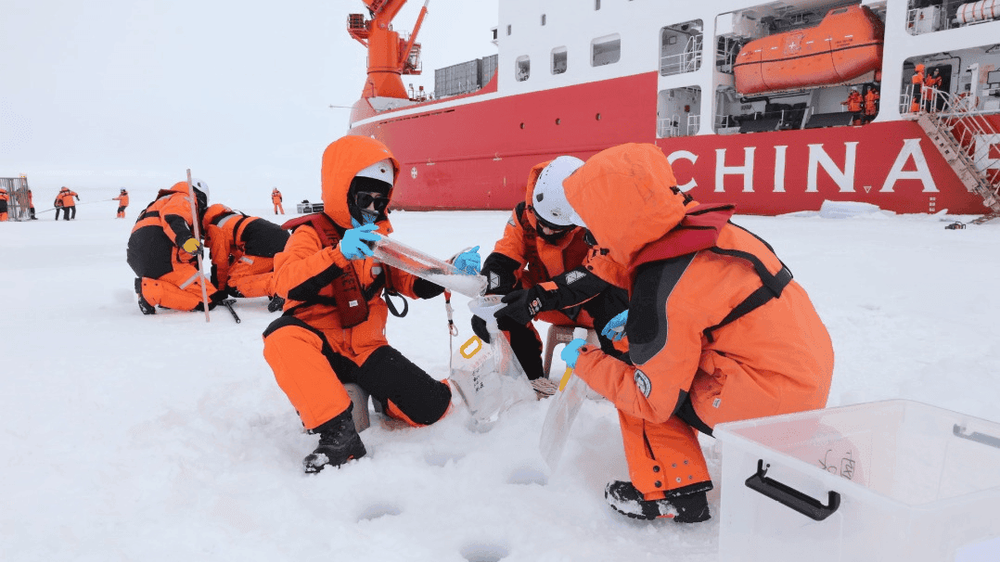
A U.S. Coast Guard icebreaker and Canadian warship have spent nearly a month monitoring a Chinese research icebreaker in the Arctic as it conducts an unusually extensive survey operation, including the deployment of more than 30 ice-based buoys across the high Arctic.
The USCGC Storis and Royal Canadian Navy's HMCS Max Bernays have closely tracked the Chinese research vessel Xue Long since July, with AIS data showing the American and Canadian ships at times operating only a few nautical miles from the Chinese vessel.
Xue Long departed Dalian in early July, followed several days later by Storis from Seattle. Max Bernays, the third Harry DeWolf-class Arctic and offshore patrol vessel, departed on July 11. Since then, the two vessels have followed Xue Long around the Bering Strait and Beaufort Sea, but did not follow the Chinese icebreaker into the highest northern latitudes.
Xue Long's research work has included an extensive deployment of autonomous observation equipment.
The vessel completed 12 ice-station operations during China's 16th Arctic expedition, the largest number carried out by a single Chinese vessel during one Arctic mission, according to China's Ministry of Natural Resources. The stations were all north of 82 degrees north, and more than 30 ice-based buoys of various types were deployed across the survey area.
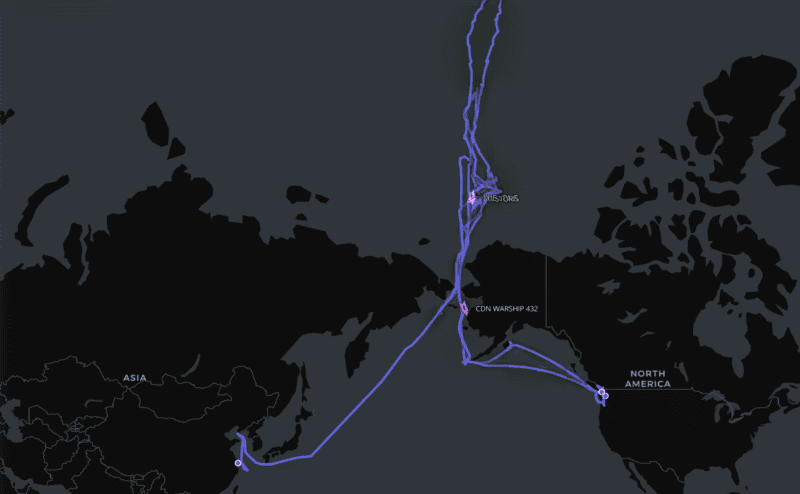 AIS tracks of Xue Long, Storis, and Max Bernays. (Source: MagicPort Maritime Intelligence)
The buoys are designed to collect data on sea-ice movement and conditions, ocean properties and the atmosphere, with some intended to remain in place after the research ship departs. Xue Long 2 is conducting a separate series of ice-station operations near 84 degrees north and is also deploying ice-based buoys.
"The system uses integrated acoustic, optical and electrical sensing to carry out long-term, continuous observations of the atmosphere, ice, sea and ecology beneath the ice in the central Arctic," an expedition member told Chinese state television.
The scale and persistence of the Chinese observation network are drawing attention as Beijing expands its scientific and maritime presence in the Arctic. The U.S. Coast Guard has explicitly framed the Chinese activity as a security concern. In July it said Xue Long had transited through the U.S. exclusive economic zone and over the U.S. extended continental shelf in the Bering Sea, while Xue Long 2 was also heading toward the Arctic.
Rear Adm. Bob Little, commander of the Coast Guard Arctic District, said the United States and its partners were responding to "competitor activities across an increasingly contested Arctic."
While the stated purpose of the instruments is scientific research, detailed information about sea ice, ocean conditions and the Arctic operating environment could also have value for future commercial and military operations.
Storis' monitoring mission has become particularly important because the Coast Guard's other medium icebreaker, Healy, has been sidelined since suffering a significant engineering casualty on July 13.
The cutter was towed to Seattle for an investigation and major repairs, and the Coast Guard has announced no timetable for its return.
That has left Storis as an increasingly important Arctic security asset. The commercially acquired icebreaker is conducting its second summer of patrols around Alaska and is proving to be a valuable stopgap while the Coast Guard waits for new polar-capable ships.
Construction of those vessels is finally moving forward. The first Arctic Security Cutters began construction in Finland, with the first vessels expected in 2028.
At Bollinger Mississippi Shipbuilding, the first Polar Security Cutter, Polar Sentinel, is also taking shape. Bollinger recently told Congress that 33 of the ship's 85 modules were under construction, with 43 expected to be underway by the end of 2026. Recent photographs show the ship's massive stern section ready to be welded in place.