


15 Oct 2026
United Nations regional commission today launched its annual report International Trade Outlook of Latin America and the Caribbean 2026.
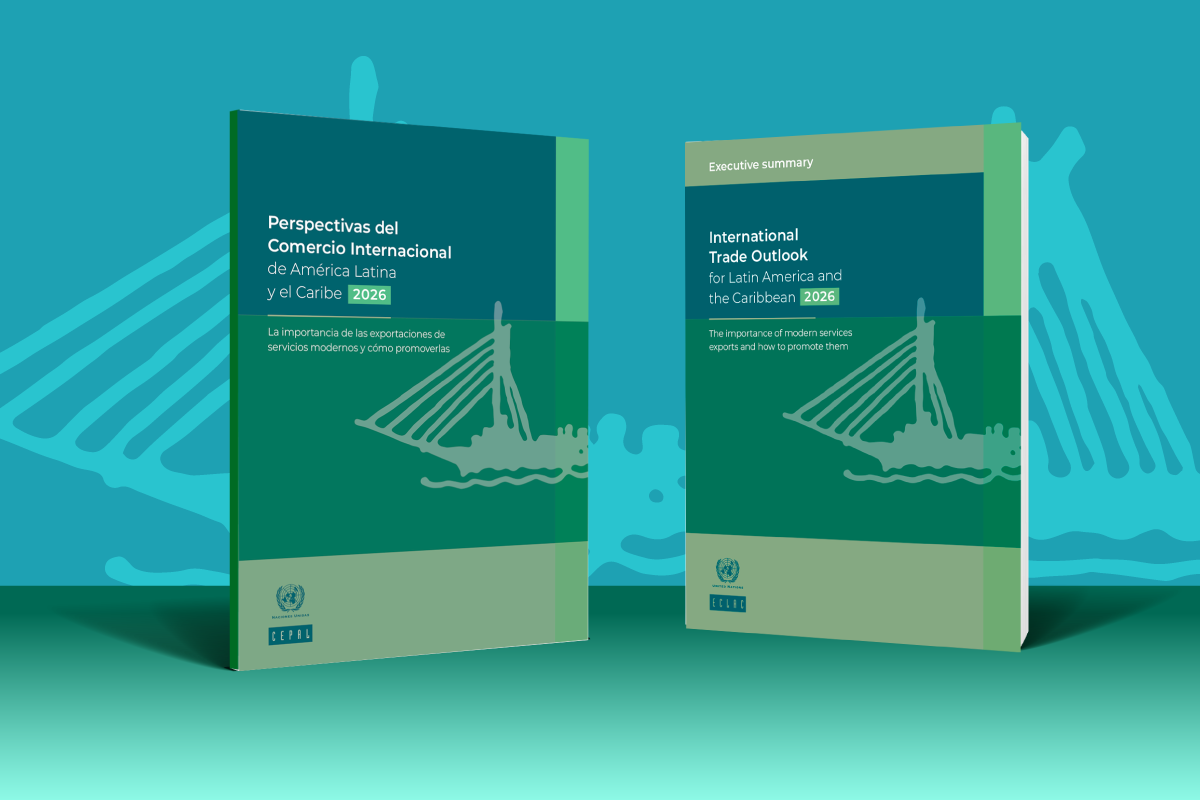
The Economic Commission for Latin America and the Caribbean (ECLAC) today released a new edition of its annual report International Trade Outlook of Latin America and the Caribbean 2026: The Importance of Modern Services Exports and How to Promote Them, in which it forecasts a significant increase in goods exports for 2026 and highlights the opportunities offered by modern services to diversify exports and boost growth and productivity.
The document, presented at a press conference led by ECLAC Executive Secretary José Manuel Salazar-Xirinachs, addresses the profound reconfiguration that global trade is undergoing, influenced by economic security, resilience, and sustainability objectives, by the instrumentalization of interdependence, and marked by the rapid advance of emerging technologies, the resurgence of productive development policies, and the geographical reorganization of value chains.
The report projects a 20% growth in the value of goods exports in 2026, the largest since the post-pandemic rebound of 2021. This result would be driven by an 11% rise in export prices and a 9% increase in export volumes, which would grow for the sixth consecutive year. It also warns that performance would be uneven among subregions: South America would benefit from the commodity price cycle, while Mexico would stand out for the dynamism of its manufacturing exports.
Services exports would grow by 11%, driven by the recovery of transport and travel, and the resilient dynamism of modern services. Merchandise trade increased demand for logistics and international transport, while tourism favored travel exports, especially in Central America and the Caribbean.
For its part, ECLAC projects that regional goods imports will grow by 16% in value, driven by a 12% expansion in volume and a 4% increase in prices. The dynamism of imports reflects a recovery in domestic consumption and a growing demand for intermediate inputs and capital goods.
In line with the favorable projections for the region as a whole, 28 of its 33 countries are projected to register increases in the value of their goods exports in 2026, reaching double digits in 16 of them.
In its second part, the document analyzes the current situation of modern services exports in the region—business, professional, financial, audiovisual, creative, information technology, and research and development services—and the strategic opportunity they represent.
The report indicates that global trade in services, driven mainly by modern and digital services, is the most dynamic component of international trade. In 2025, it reached 9.6 trillion dollars, with an average annual growth of 6.6% over the last decade. In Latin America and the Caribbean, modern services exports multiplied by more than 3.5 in the last two decades, compared to an increase of about 1.6 times in traditional services. Despite this progress, the region accounts for only 2% of global modern services exports.
These services offer opportunities to diversify exports, generate foreign exchange and quality employment, and increase the productivity of other sectors, such as agriculture, mining, and manufacturing. To harness this potential, an integrated strategy is required that combines export promotion, attraction of foreign direct investment, and human talent development, with effective coordination between the public and private sectors. The chapter examines experiences from several countries in the region and highlights, in particular, the cases of Costa Rica and Uruguay, which have articulated these areas into sustained strategies.
“The region faces significant challenges in an uncertain geopolitical environment. Geopolitical tensions, disruptions in logistics routes, and the unpredictability of trade policy pose risks to trade. Competition for critical minerals and new environmental demands are also reconfiguring value chains and market access conditions,” emphasized the ECLAC Executive Secretary.
Daniela García, Director of the International Trade and Integration Division, highlighted that the favorable trade situation observed in the region during 2026 offers an opportunity to connect trade, productive development, and investment policies with new global economic trends.
In summary, the International Trade Outlook 2026 report delivers three key messages:
The trade geography is changing. The greater weight of Asia and regional integration can open markets and diversify goods and services exports.
Trade maintains its dynamism, but its benefits are uneven. The export prospects for Latin America and the Caribbean are favorable, although they vary among countries and sectors.
Seizing opportunities requires clear strategies, sustained efforts, and solid institutions. In modern services, export promotion, investment attraction, and talent development must advance in a coordinated manner with the private sector and with the support of solid institutions.

