DestacadasMedia IntelligenceAgenda
/
ESENPT
DataPortuaria
PortsForeign TradeLogisticsAgro
DataPortuaria

El portal de referencia del sector portuario y marítimo de Latinoamérica. Noticias, análisis y datos en tiempo real.

Seguinos:

Secciones

AgroAnalysisBiofuelsCruisesCurrent AffairsEnvironment and EnergyForeign TradeInterviewsLogisticsPortsShipbuildingShippingWaterway

Ediciones

ArgentinaBrasilEcuadorEspañaInternacionalMexicoPanamaPeru

Servicios

Media IntelligenceAgenda

Legal

AboutPrivacy policyCookie policyTerms of useContact

© 2026 DataPortuaria. Todos los derechos reservados.

Inicio›Logistics

Off-peak transport makes supply chains faster and more reliable

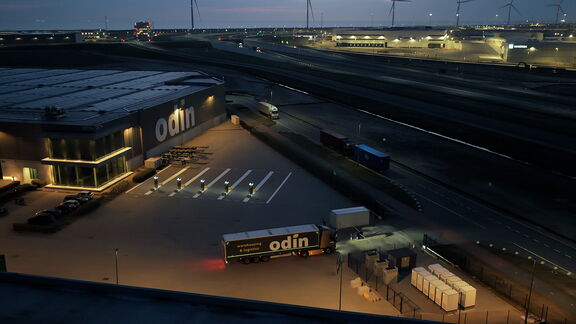
ODIN Warehousing & Logistics, one of the first logistics providers in the port of Rotterdam, has shifted significant container flows to off-peak hours (6 pm to 6 am) using electric trucks. According to CEO Alain Grotenhuis, off-peak transport reduces waiting times, increases predictability, and boosts productivity. The company invested in its own fleet of electric trucks charged with green electricity, demonstrating how night-time operations create greater terminal capacity and more reliable supply chains while reducing emissions and congestion.

Últ. Actualización 8 de jun 2026|Lectura: 5 min

Imagen de portada - El transporte fuera de horas punta hace que las cadenas de suministro sean más rápidas y fiables

Seguí a dataPORTUARIA en Google News

Agregá este medio como fuente preferida y no te pierdas las últimas noticias.

Agregar como fuente preferida

Increasing container traffic in the port of Rotterdam is putting ever-greater pressure on roads, terminals and logistics processes. As outlined in our white paper on road transport , traffic congestion, longer waiting times and limited capacity during peak hours are making supply chains less predictable. Transport during off-peak hours, between 6 pm and 6 am, provides a solution. ODIN Warehousing & Logistics showcases how this off-peak transport using electric trucks contributes to a more efficient, reliable and sustainable supply chain.
Odin

ODIN Warehousing & Logistics is one of the first logistics service providers in the port of Rotterdam to switch to off-peak transport. At multiple locations on the Maasvlakte, the company shifted a significant part of its container flows to the evening and night hours. According to CEO Alain Grotenhuis, the decision is a direct result of the increasing congestion at terminals and on the roads.

Whereas five years ago you could easily pick up six containers between 6 am and 6 pm, now you can often only pick up two or at most three. Given the volumes we handle, off-peak transport was the only logical step,' says Grotenhuis.

**Greater predictability during night-time hours**

According to Grotenhuis, the benefits of off-peak transport are immediately noticeable. During the night, terminals have greater capacity, more time slots are available and waiting times are significantly reduced. This allows drivers to work more efficiently and makes planning more reliable

'During daytime, uncertainty is much greater. Due to traffic congestion and waiting times, we can provide less predictable services. At night, however, conditions are more stable, and we can offer our customers greater reliability,' says Grotenhuis.

According to the CEO, that reliability is of great value to both shippers and forwarders. Shorter waiting times at terminals make arrival and departure times more predictable. At the same time, congestion on the roads leading to the hinterland decreases. This can provide a significant advantage, especially for longer transport distances.

Te puede interesarAPS mobilizes R$ 99.1 million works on Ilha Barnabé pier in Santos

**Higher productivity with the same capacity**

In addition to operational benefits, off-peak transport also delivers efficiency gains. Because drivers spend less time in traffic and waiting in queues, more containers can be handled within the same time frame using the same truck and driver.

Grotenhuis: 'With off-peak transport, we significantly increase productivity. This not only benefits our own operations but also enables us to offer customers reliable service at competitive rates. As traffic congestion and waiting times at terminals increase, logistics service providers such as ourselves will have to adapt.'

ODIN's operations are fully geared toward a continuous flow of goods. Containers arriving at the warehouses during weekday evenings are unloaded immediately. If they arrive after 11.30 pm, they are decoupled and processed the following morning. This allows drivers to return directly to the terminal for their next trip.

**Investing in a reliable and sustainable supply chain**

To further enhance supply chain reliability, ODIN has invested in its own fleet of electric trucks. These are deployed alongside the transport capacity provided by its regular partners. The electric trucks can be charged on-site using sustainably sourced green electricity.

According to Grotenhuis, electric trucks are well-suited to off-peak transport. During night-time hours, vehicles operate with fewer stops and a more consistent speed pattern, resulting in more efficient energy use. At the same time, electric transport contributes to lower emissions and reduced noise pollution around logistics corridors and urban areas.

The investments are not limited to trucks alone. To ensure operational continuity, ODIN has also invested in additional company-owned container chassis. These investments will not be reflected in customer rates, notes Grotenhuis: 'We recoup those investments by increasing productivity and utilising equipment and drivers more efficiently.'

Te puede interesarPanama Canal Authority to Define Consortia for Corozal and Telfers Terminals by 2026

**Collaboration in the supply chain remains essential**

ODIN believes that the key to further growth in off-peak transport lies in collaboration across the entire supply chain. Not only terminals, but also empty depots and other supply chain links should be accessible in the evenings and at night to maximise the benefits of this approach. Grotenhuis is seeing positive developments: 'We're hearing more and more positive feedback about pilot projects and extended operating hours. Once companies take the first steps, the benefits soon become apparent. I am convinced that more supply chain partners will follow shortly.'

**Off-peak transport emerges as the new standard**

The experiences in the port of Rotterdam show that off-peak transport is no longer a future vision, but a practical solution that can be implemented today. By shifting road transport to off-peak hours, more capacity is created on the roads and at terminals, while the supply chain becomes more reliable, flexible and sustainable. 'Off-peak transport is not a future scenario at all. We're already doing it, and it works. I'm convinced this approach is really going to take off in the coming years,' Grotenhuis concludes.

Off-peak transport is rapidly emerging as a key solution to congestion, capacity shortages and sustainability in the supply chain. Interested in learning more about the opportunities, challenges and developments? Read the full white paper here.

Handout for implementing off-peak distribution (.pdf)


Fuente: Port of rotterdam

Temas:DistributionoperationsTransportTerminalsinvestments
Compartir esta nota

Seguí leyendo

MTC Projects for 2031: New Central Highway and Corío on the Agenda

Port of Alicante to Host Railway Conference for Businesses on December 1st

PortCastelló Presents Progress on its Rail Hub in Brussels

Most read

  1. 01Peruvian Ports Mobilized Over 101 Million Tons by September 2026
  2. 02Port of Itajaí surpasses 2025 container movement in ten months
  3. 03PortCastelló Presents Progress on its Rail Hub in Brussels
  4. 04APS Enhances Security at Port of Santos After Cyber Incident
  5. 05Port of Oakland names Colleen Liang as new chief operating officer