• 3 min de lectura
• 3 min de lectura
The European Imagine-B5G project successfully concluded with the deployment and operation of 5GVLCPortLab, an advanced private 5G network that acts as a testbed within the Port of Valencia. This initiative, co-financed by the Horizon Europe program, globally coordinated by the Universitat Politècnica de València (UPV) and with the active participation of the Valenciaport Foundation, was made possible thanks to the close collaboration of the Port Authority of Valencia, which provided the necessary facilities to experiment and validate industrial applications based on latest-generation mobile communications in a real environment.
The scope of the results has been directly supported by the European Commission. The community institution has officially included the five technological pilots developed in the Valencian precinct within the select group of the ten greatest achievements in port technological innovation across the continent.
The involvement of the Valenciaport Foundation in this type of international consortium responds to its strategic objective of introducing disruptive technologies into the port environment. Through digital transformation and experimentation in real scenarios, the Foundation actively collaborates in improving the efficiency, sustainability, and competitiveness of the entire logistics-port cluster, also laying the technological foundations for the future evolution towards 6G.
The developed network infrastructure has served as a testbed for executing five pilot projects aimed at solving critical day-to-day needs of the port.
One is Adapt-G (Drone Surveillance), an advanced security system that combines unmanned aerial vehicles and mixed reality glasses for real-time monitoring of access points and restricted areas.
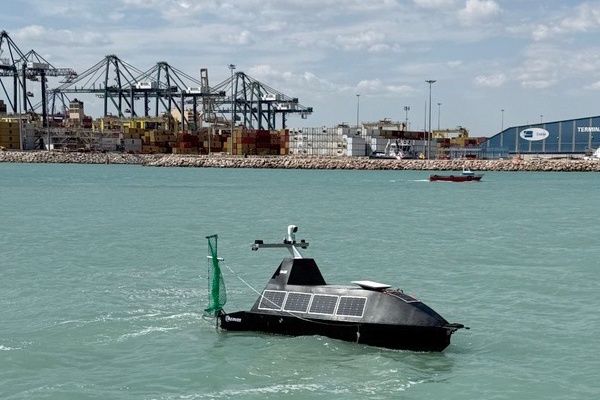
The second is Rescue-5G (Maritime Rescue Operations), which involves remote and real-time control of an unmanned surface vessel for visual inspection, search, and rescue missions at sea.
Meanwhile, 5G-Virtufix (Assisted Maintenance) is a solution that allows operators to repair complex machinery with remote support from experts and artificial intelligence through augmented reality glasses, reducing downtime.
Portsafe-B5G (Occupational Safety and Intelligent Analytics), on the other hand, is a platform that integrates security cameras, drones, and automated ground vehicles to detect unauthorized access and verify the use of personal protective equipment.
Finally, Abyss-5G (Maritime Security and Monitoring) is a system that integrates 5G connectivity and an unmanned surface vehicle for autonomous surveillance, environmental control, and coastal rescue missions in real-time, reducing costs and human risks.
The practical knowledge acquired in the deployment, management, and optimization of these private networks paves the way for expanding the technology to higher-demand operational areas, such as container terminals.
To continue this line of work, the Valenciaport Foundation is already participating in new initiatives such as the 5G-Valenciaport (CEF) and Cop-Pilot (Horizon Europe) projects, which will allow further development of technological solutions applied to transport and logistics.