

06 Nov 2026
We are closely monitoring the evolving situation in the Middle East and would like to provide you with an update on what it means for your shipments and our services across the region. As conditions develop, we are taking proactive measures to protect our people, safety, safeguard cargo integrity and maintain the stability of our network.
Please note that the following information is subject to change due to the highly volatile situation in the region.
Landside update
Landbridge solutions in Saudi Arabia, Kuwait, Bahrain, UAE, Qatar and Iraq
Please find the continued expansion of our multimodal transport solutions across the Gulf region.
Please note that the information below is only relevant for landside transportation. Please note that all transportation services are subject to availability, and in accordance with applicable laws and regulations.
Please note that we are temporarily pausing landside bookings:
- on cargo going from UAE and Qatar via Jeddah port and Oman port
- on cargo going from Jeddah Port to UAE, Oman and Qatar
- on cargo going from Salalah and Sohar to UAE, Saudi Arabia, Kuwait, Bahrain, and Qatar
Available landside solutions :
Export – Carrier Haulage Land Bridge Solutions
- From Kuwait, Qatar, Bahrain, and the UAE via Salalah Port and Khor Fakan
- From Iraq via Aqaba Port
Import – Domestic Services
- From Jeddah Port to Riyadh and Dammam Carrier Haulage
- From Khor Fakkan, Fujairah, Jebel Ali, and Abu Dhabi ports to the rest of the UAE
- From Salalah to inland destinations across Oman
Import – Land Bridge Solutions
- From Khor Fakkan and Fujairah to UAE
- From Aqaba to Iraq
Accepted Cargo Types (subject to capacity availability)
- Dry cargo
- Frozen cargo
Ocean update:
Cargo Booking
| Cargo Type | Cargo booking: |
|---|---|
| Reefer | Suspension of all bookings to and from Iraq, Kuwait, Qatar, Bahrain, Saudi Arabia (Dammam, Al Jubail and King Abdullah port), Jordan* and to the UAE (excluding Khor Fakkan and Jebel Ali (via Landbridge) with exceptions from the ports mentioned below*. Bookings are accepted to /From Lebanon, Israel, Oman (Salalah and Sohar) and Khor Fakkan (UAE) – import only) *Temporarily suspension of bookings to Jordan on all reefer Container Yard Jebel Ali acceptance *Shipments that contain critical foodstuff, medicine and perishable goods, we will do our utmost to ensure special attention is given. The suspension applies to cargo originating from, destined for, or transhipping through these countries (exception Salalah transhipment to non-upper gulf Countries or between non-upper gulf countries, or between non-upper Gulf countries, for example shipping from Seychelles to Turkey, transhipping in Salalah). |
| DG | All bookings to and from Iraq, Kuwait, Qatar and Bahrain are suspended. Bookings from UAE and Oman remain suspended Bookings accepted to - UAE(Khor Fakkan) subject to available capacity and existing safety protocols except for - IMO class 1, 5.2 and 7 that requires approvals from authorities - IMO class 2.1, 3, 4.1, must be on direct delivery. - IMO Class 5.1 requires approvals from authorities and must be on direct delivery All cargo accepted via Khor Fakkan will be moved via Sajaa ICD. - Customers registered in Khor Fakkan or Sharjah can clear the cargo at Sajaa by paying the applicable GT charges directly. - For customers who are not registered and need delivery to Jebel Ali or Abu Dhabi, Maersk can arrange a double-bonded movement (KHO–SAJAA–JAL/AUH). Charges will be billed based on the haulage rates. - UAE ( Fujairah) subject to available capacity except for - IMO class 1,5 and 7 requires approval from the authorities - Cargo will be cleared in Jebel Ali - Oman - Sohar except for IMO class 1,5,and 7 must be on direct delivery. - Salalah IMO class 7 not accepted. IMO class 1 requires permits from the authorities, IMO class 5 must be on direct delivery. - Saudi Arabia - Suspended to/from Dammam and Jubail - Bookings open to from Jeddah and King Abdullah Port - (Jeddah) for local consignees only. Emergency Freight rate cost of USD 3800 will be applicable. - Jordan- Bookings for both imports and exports remain open. However, we are not accepting bookings for cross-border cargo transiting via Jordan at this time. All bookings are subject to standard safety protocols. - Bookings accepted for transhipment via Salalah excluding bookings to Qatar, Saudi Arabia, Bahrain, Kuwait and Iraq - Israel ports: DG restrictions in Israel have been lifted. DG bookings are now fully accepted at Haifa and Ashdod in line with local regulations. Booking systems have been updated accordingly. |
| OOG | Suspension of all bookings to and from the UAE (including Khor Fakkan), Iraq, Kuwait, Qatar, Bahrain, Jordan (Aqaba), and Saudi Arabia (Jeddah, King Abdullah, Dammam & Al Jubail) and Oman. Booking acceptance on transshipments via Salalah to non-upper Gulf countries remain open. |
| In-Gauge | Suspension of all bookings to and from Iraq Booking acceptance to and from Bahrain, Jordan (Aqaba), Kuwait, Oman (Salalah, Sohar) Qatar, Saudi Arabia (Jeddah, King Abdullah, Dammam & Al Jubail and UAE (Khor Fakkan) |
| Dry cargo | Suspension of all booking to and from UAE (except for Khor Fakkan and Jebel Ali), Iraq, Saudi Arabia (Dammam & Al Jubail). Shipments that contain critical foodstuff, medicine and perishable goods, we will do our utmost to ensure special attention is given. We accept bookings to /From Saudi Arabia (Jeddah & King Abdullah port), Jordan, Oman (Salalah, Sohar), UAE (Khor Fakkan – only imports, and Jebel Ali (via Landbridge), Lebanon, Kuwait, Qatar, Bahrain and Israel. |
| MLL | All above restrictions are not applicable for MLL operator bookings. |
Please note that we are in the process of updating Jebel Ali contract rates via Khor Fakkan. So, the rates showing at the time of booking may change and get updated before the Price calculation Date.
This doesn’t impact SPOT bookings where the rates are already updated.
Flex Hub/Flex route (sales on water) – In line with the ongoing contingency and workaround plans, Maersk will not accept any Flex Hub/Flex route (Sales on Water) requests with immediate effect until further notice for Hub- Salalah, Oman. Alternative hub acceptance is subject to operational feasibility.
Khor Fakkan: Operational Constraints and Changes to Final Destination
Vessel congestion and limited berthing availability at Khor Fakkan, together with high yard utilisation, road congestion and extended truck waiting times, are delaying cargo clearance. These conditions may affect import and export movements, including bonded transport to and from Ajman, Jebel Ali and other destinations. To ease congestion, the terminal is relocating containers to ICD Sajja, which may affect collection arrangements.
Maersk is preserving originally booked destinations wherever possible. However, the Final Port of Destination for selected shipments booked to CY Khor Fakkan will change to Jebel Ali, either through discharge at Fujairah followed by bonded landside transport, or through direct discharge at Jebel Ali where the feeder can transit the Strait of Hormuz.
Customers may experience longer transit and delivery times, changes to collection arrangements, and additional transportation, handling, clearance or storage costs. Alternative arrangements and related costs will be subject to Maersk’s applicable Terms for Carriage. Impacted customers will receive shipment-specific details separately.
Shipments on vessels transiting the Strait of Hormuz will incur an additional fee of USD 1,000 per container, covering costs including insurance premiums and crew risk compensation. This replaces the separately charged costs of the current Landbridge solution for shipments using this sea routing. For Middle East imports, the fee will be invoiced to the local consignee as basic ocean freight, payable through MyFinance on maersk.com.
Fujairah: operational constraints and onward bonded movement to Jebel Ali
Due to ongoing operational constraints and yard density at Fujairah Terminal, the terminal has, at its discretion, begun shifting selected full laden containers with a final place of delivery of Jebel Ali to the Al Hayl off-dock yard, Fujairah. Customers whose containers are affected will be notified.
Maersk is working closely with its delivery partners to continue the bonded movement of cargo to the final place of delivery as soon as practicable.
Additional shifting, handling and storage costs incurred at Al Hayl will be recoverable from the Merchant in accordance with the applicable Maersk Terms for Carriage and Tariff. Details will be provided to affected customers.
Existing Ocean bookings and cargo in transit
Due to the volatility of the ongoing situation, there is a need for alternative solutions to bringing your cargo to final destination, including finding alternative routing and storage in transit. To do this, we are adding an Emergency Freight rate on cargo loading from or destined to ports in Iraq, Kuwait, Saudi Arabia (Damman & Jubail), Bahrain, Qatar, the United Arab Emirates, and Oman (except Salalah). It is based on your container category and subject to required regulatory approvals. See below:
| Cargo type | Cost per container |
|---|---|
| 20’ dry container | USD 1800 |
| 40’ dry container | USD 3000 |
| Reefer, Special and DG container | USD 3800 |
Any vessels transiting the Strait of Hormuz will incur an additional fee of USD1000/container. The fee would cover added costs for e.g. insurance premiums and crew risk compensation and replace our separately charged costs for our current landbridge solution. The 1000 USD fee would be on top of the Emergency Freight Rate which covers the added costs for onwards transportation to/from the upper Gulf.
Why are we implementing this
We are implementing this Emergency Freight rate to arrange alternative routing to final destination including finding potential storage solutions, additional charters and so forth. This fee includes transportation from temporary storage to final destination, when safe to complete the voyage.
Please note that that due to the fluidity of this situation, the Emergency Freight rate may be adjusted.
Options for cargo en route:
We will do our utmost to support you through this disruption and avoid abandonment of carriage. To facilitate this, we have the following options for you to choose from:
| Option | Cost | Additional information |
|---|---|---|
| A) Complete the planned voyage, with temporary storage | Strait of Hormuz Emergency Freight rate (as mentioned above), which covers 14 days of storage in transit. Beyond this there will be storage fee of USD 25 per TEU day plus reefer monitoring and plug-in fee where applicable as per the location tariff. This will be invoiced fortnightly. |
Your cargo will be placed in long-term storage in a port, selected by Maersk. Onwards voyage will be initiated as soon as safely and practically possible, and covered by the rate Maersk reserves the right to declare abandonment of carriage. In such an event, no waivers or refunds will apply to charges already billed or paid. |
| B) Return to Origin | Freight payer pays the standard COD fee and pricing, alongside additional freight cost. This is subject to operational acceptance | This solution is subject to operational feasibility. if the decision is taken before the container reaches the affected region, the SoH Emergency Freight charge will not apply; only COD and differential freight charges will apply. If chosen after the container reaches the affected region or within 72 hours of planned discharge, the SoH Emergency Freight charge will be applied. |
| C) Change of Destination | Freight payer pays the standard COD fee and pricing, alongside additional freight cost. This is subject to operational acceptance | This solution is subject to operational feasibility. If the decision is taken before the container reaches the affected region, the SoH Emergency Freight charge will not apply; only COD and differential freight charges will apply. If chosen after the container reaches the affected region or within 72 hours of planned discharge, the SoH Emergency Freight charge will be applied. |
Important Notes
- Storage fees will apply from the 15th day after discharge at storage port until one of the following occurs:
- Container is loaded to complete the originally planned onward voyage.
- Container is loaded for return to origin (Option B).
- Container is loaded for onward journey to the new POD (Option C).
- Delivery/gateout from the port in cases where the carriage is abandoned or the customer chooses to take delivery at the storage in transit port.
Transshipments via Jeddah
Cargo booked to Kuwait, Iraq, Qatar, Bahrain and the UAE - cargo will now transship via Salalah and Khor Fakkan, then move by Landbridge to Sharjah, before connecting to final destination through our intra-Gulf feeder network. It will not go via Jeddah*
Cargo booked for Jeddah where the consignee is not based in Saudi Arabia If cargo is booked to Jeddah but the consignee is in another Middle East country, it will not be discharged in Jeddah. It will instead be routed to the consignee's country via Khor Fakkan.*
*Please note there may be additional charges in connection with rerouting. All impacted customers will receive a separate email with the details.
Saudi import and export cargo - Cargo Port of Discharge or Place of Delivery in Saudi Arabia will continue to move through Jeddah. This includes cargo destined to Riyadh and Dammam, via the established Jeddah Landbridge solution.
For more information, see here.
For Cargo en route and discharged in Jebel Ali, UAE, the following will apply
- Transshipment cargo:
For cargo remaining under transshipment (including cargo staying at port or moving onward under a landbridge transshipment solution), a temporary storage charge will be payable by the freight payers of USD 25 per TEU/ per Day from the day of discharge, with reefer plug‑in charges applied at actuals, where applicable.
- All other cases (Import or COD to Jebel Ali):
Where cargo is cleared as import in Jebel Ali, including cases involving a change of destination (COD), storage and plug‑in charges will be billed directly by the terminal to the customer, as per terminal tariffs and timelines.
- Port storage and other pass through out of the pocket terminal charges are applicable, as per terminal tariff
Quick reference guide for UAE Export shipments on merchant haulage
- Place your booking on www.maersk.com with load ports as either Salalah, Jeddah or Sohar.
- Inform you would like to pick up the empty container(s) in a different city.
- Type empty pick-up location as “Jebel Ali, United Arab Emirates” while placing the booking
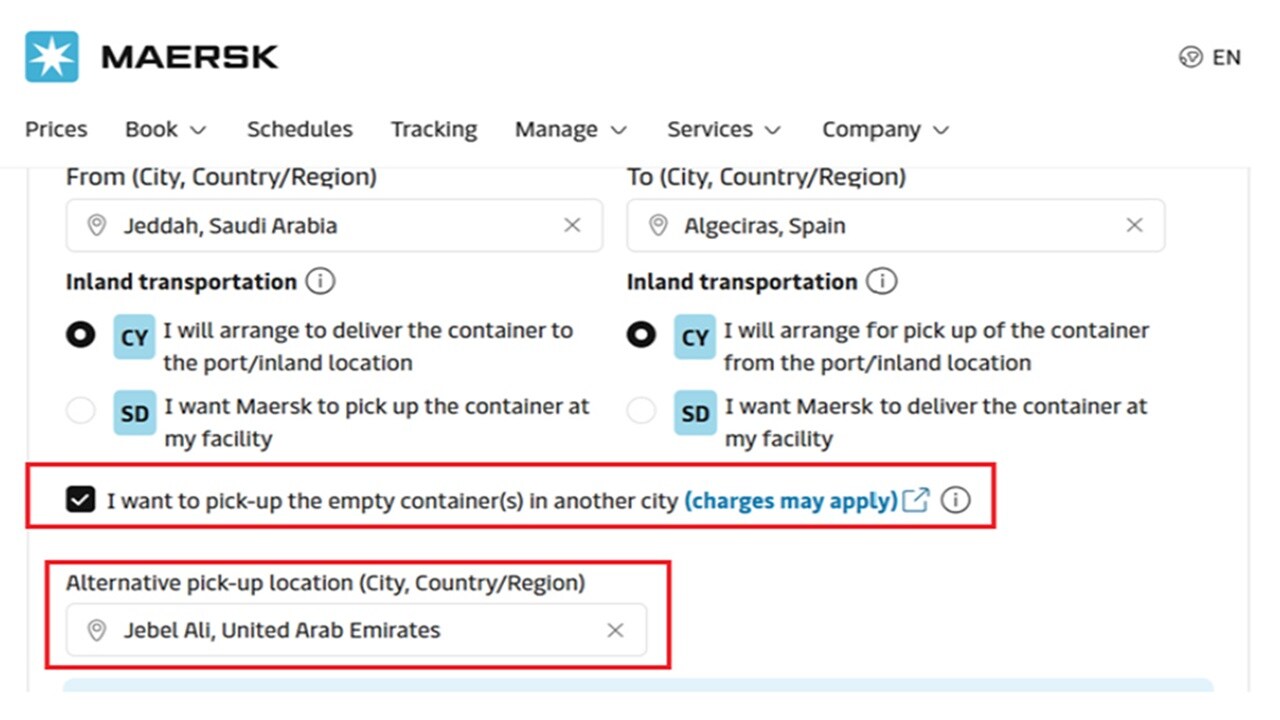
- Proceed with nominating Haulier and e-Token generation in Dubai Trade system
- Arrange empty pick from Jebel Ali terminal.
- Once empty container is picked-up, please send back the CONTAINER GUARANTEE FORM received from your Customer Service agent to ae.export@maersk.com with subject line " Container Guarantee - booking no XXXXXXX
- Note: If there are multiple containers in a single booking, please attach a signed and stamped list.
- Please adhere to deadlines such as Shipping Instruction, VGM Submission, container gate-in timelines based on each vessel and port from which shipment is planned for loading
- Kindly complete customs formalities according to your shipment and applicable regulations.
- Please note that, for Sohar, only local trucks are allowed inside terminal
- Customers must deliver all containers in the booking ready for carriage: no earlier than: (a) 6 days before vessel departure, if from Salalah, and (b) no 10 days before vessel departure if from Jeddah.
Detention & Demurrage
The local D&D tariff applicable at the designated return locations, subject to local laws, can be found here https://www.maersk.com/local-information/imea > Select your country > Import.
If cross‑border return to a designated location is unlawful or materially prevented by authorities, please contact your Maersk representative within 7 days of this notice so we can agree with a compliant interim solution and the applicable D&D handling.
Access the latest update on Hormuz Disruption Update 9: Temporary Line Detention | Maersk
Maersk Cargo Insurance continues to offer cover per policy terms across the Middle East; however the situation is under close and ongoing review. A number of insurance companies have reduced or withdrawn coverage for shipments into the Red Sea, Gulf of Oman and Persian Gulf regions, particularly with respect to insurance coverage on the vessels themselves, and Maersk is also reducing operations in the region (find the latest Maersk operational update here). This may reduce options to ship into the region, however as and when operations resume, Maersk Cargo Insurance will endeavour to be available to insure your cargo interests.
Returning and picking up of empty containers update:
Returning of empty container in region
In light of the evolving situation affecting navigation and port operations in and around the Strait of Hormuz, and in order to protect the safety of our vessels, crews and your cargo, Maersk is implementing temporary empty-container return arrangements.
Effective immediately and until further notice, for existing and new import shipments into the UAE, Qatar, Bahrain, Kuwait, Saudi Arabia (Jubail), Iraq and Oman (Duqm), empty containers will not be accepted at their usual return locations.
Instead, empties should be returned only to the designated depots listed below.
Designated empty return depots:
- Oman – Salalah
- Saudi Arabia – Jeddah
Limited acceptance with Drop off (DRP) charges please refer to the table below
| Drop off charges | 20' | 40' | Reefers 20' & 40' |
|---|---|---|---|
| Oman (Sohar & Salalah) | Free | Free | Free |
| Saudi Arabia (Jeddah) | Free | Free | Free |
| UAE (Abu Dhabi) | $600 | $1200 | $1200 |
| UAE (JebelAli) (effective 17-Jul-2026) | $1000 | $1200 | $1200 |
| UAE (Ajman) | $2055 | $2175 | $2175 |
| UAE (SAJAA Dry port effective 6-Nov- 2026) | $1,000 | $1,200 | $1,200 |
| Bahrain | Free | Free | $1250 |
| Kuwait | $400 | $800 | $800 |
| Qatar (effective 27-Jun-2026) | $600 | Free | $1200 |
| Jordan (Aqaba) | Free | Free | Free |
| Saudi Arabia (Dammam & Jubail) (Effective 17-Sep-2026) |
Free | Free | Free |
| Oman (Sohar) | Empties accepted only for customers who have cargo discharged in Oman (Sohar) only |
| Jordan (Aqaba) | Empties accepted only for customers who have cargo discharged in Iraq and Aqaba |
| UAE (SAJAA Dry port) | For shipments cleared at SAJAA Dry Port, empty containers must be returned to SAJAA Dry Port. |
For containers already discharged where Delivery Orders have been issued:
- If the DO states a return location that is in “empty acceptance” status at gate‑in, return may be made to that stated location.
- If the stated location is not accepting empties at the time of return, Maersk will issue an updated instruction to an available designated depot
For more info see here: https://www.maersk.com/news/articles/2026/03/17/hormuz-closure-empty-returns-suspension-update-march
- If Option B or Option C is selected after previously selecting Option A, or after the containers have been discharged at the storageintransit port, the SoH Emergency Freight fee will continue to apply by default and will not be waived or refunded.
Empty Pick-Up Charge
Maersk is implementing PickUp Charge Export (PIC) for all nonpreferred empty pickup locations. PIC is applied per container as stated below, effective as of 6 April 2026.
| Pick up charges | 20' | 40' | Reefers 20' & 40' |
|---|---|---|---|
| UAE (Jebel Ali) | Free | $300 | $300 |
| Saudi Arabia (Dammam & Jubail) (Effective 10-Sep-2026 for non regulated markets / 20-Sep-2026 for regulated markets) |
Free | Free | Free |
Emergency Operational Cost Recovery Surcharge (OCR)
Maersk is introducing an Emergency Operational Cost Recovery Surcharge for all contract bookings to the Bahrain (BH), Qatar (QA), Kuwait (KW), Iraq (IQ) and United Arab Emirates (UAE) from worldwide origins, excluding Far East Asia. Please refer to the UAE advisory Middle East OCR Surcharge Revisions | Maersk for applicable rates, effective dates and conditions.
Fuel Update
For more information on this: Maersk Emergency Bunker Surcharge (EBS) 2026
Air Update
Due to ongoing developments in the Middle East, global aviation fuel markets are experiencing volatility.
In order to ensure prices remain relevant to the market we will be using a Fuel Surcharge (FSC) linked to market-based indices. FSC will represent a minimum of 15% of the transportation rate. The situation remains fluid, and we will continue to keep you updated on any market changes affecting costs or operations.
Port update
For information on ports in the impacted area, please click here: Middle East Port Operations Update | Maersk
We will continue to keep you updated on the situation, via our Red Sea / Gulf of Aden / Hormuz Strait situation page. Should you have further questions please do not hesitate to reach out to your local Maersk representative. Our teams are on hand to support with your planning, should you need any assistance.


