

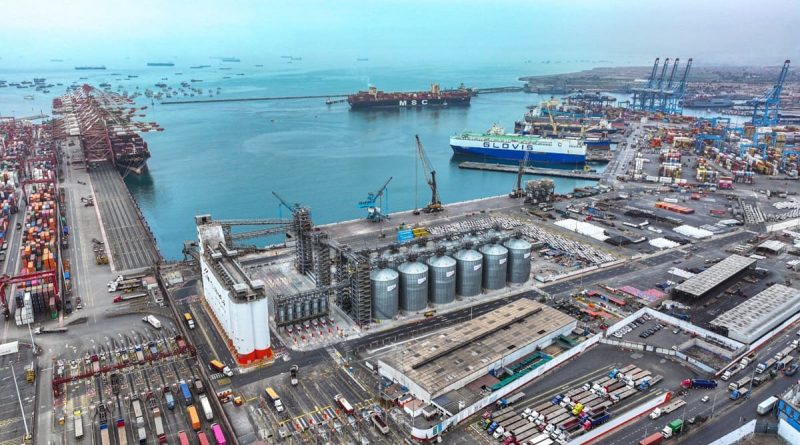
The operator of the North Terminal of Callao enables cabotage in anticipation of possible road closures due to El Niño and prepares a proposal to extend its concession. What works does it propose?
APM Terminals prepares its next venture in Callao while starting a US$ 550 million project
APM Terminals Callao, operator of the North Multipurpose Terminal of the Port of Callao and part of the A.P. Moller-Maersk group, is already advancing in the next stage of its mandatory investments and, in parallel, is preparing a proposal to extend its concession in exchange for new investment commitments, including outside the terminal. All of this, while preparing for a 2027 marked by the El Niño phenomenon.
What investments are underway and what does it propose to access the extension?
José Antonio Robles, CFO of APM Terminals Callao, explained to Gestión, within the framework of Economic Perspectives 2027, that with one quarter remaining in the year, the terminal's operation shows mixed growth among different types of cargo.
The greatest dynamism is recorded in rolling cargo, i.e., vehicles, which grew by around 40%. "It is unprecedented growth, which largely reflects the optimism of the population about what is to come," Robles said.
Breakbulk cargo also advanced, albeit at a moderate pace, driven by preparation for El Niño, with the entry of machinery and materials. In all other cargoes, he added, growth has been basically organic.
El Niño: APM Terminals Callao bets on cabotage in the face of road closures
Regarding El Niño, the executive anticipated an impact that will affect all industries, although it will be stronger in agro-exports and fishing, particularly fishmeal. In his opinion, the effect will be concentrated between the last quarter of 2026 and the first four months of 2027.
In response, the terminal is working on three fronts. The first is to protect critical infrastructure and equipment, in addition to having rapid response measures for any contingency. The second is to enable early entry windows for refrigerated cargo from agro-exporters, in order to give them greater flexibility when entering the port.
The third is cabotage. "We are enabling a cabotage service, which is basically the transport of goods by sea between ports within Peru instead of by road. In the event of road interruptions, we are prepared for that cargo to reach its destination," he explained.
The measure applies to both export cargo, which must go abroad, and import cargo. According to Robles, cabotage was enabled by a law approved last year, is already in force and available to whoever requires it: clients only need to coordinate it with their shipping company.
APM Terminals is in the process of executing Stage 3B (the next phase of terminal modernization), a project of around US$ 600 million.
APM Terminals Callao looks outside the port to extend its concession
Regarding investments, Robles specified that APM Terminals Callao has invested US$ 800 million to date. Today it is in the process of executing Stage 3B (the next phase of terminal modernization), a project of around US$ 600 million, of which nearly US$ 100 million has been advanced. The remaining US$ 500 million will be invested in the next three years.
"It is part of the obligations we have in the contract, which are US$ 1,200 million, which we will exceed," he affirmed.
Beyond its contractual commitments, the company is evaluating a proposal to extend its concession via greater investments, which it is currently working on and expects to present to the authorities. Robles did not specify timelines or amounts for this new plan.
The interesting thing, he explained, is that the regulations allow for investments both inside and outside the port. "This allows us to address structural problems we have today: we have a world-class port with accesses that have not grown at the same speed as the port," he said.
Therefore, APM Terminals Callao proposes to intervene in areas outside the terminal to solve the problem of truck traffic, with measures ranging from ante-ports and special viaducts to more complex interventions that they are already carrying out, related to the relocation of communities.
Looking ahead to 2027, the CFO foresees a generally complicated year, with a moderate impact from El Niño. Even so, he was optimistic about the economy's ability to sustain its pace. "We hope that the economy will be resilient and continue to grow," he concluded.
@Gestion


