

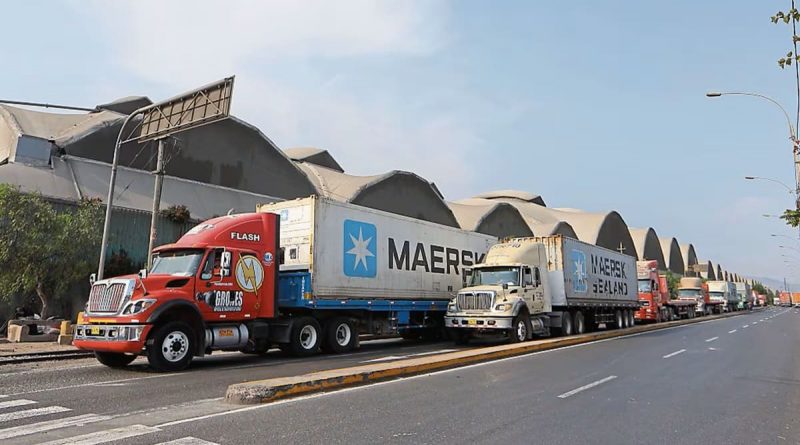
The National Port Authority (APN) of Peru identified land access to ports as one of the main obstacles to improving the country's logistics competitiveness, despite accumulated investments in concessioned port terminals reaching USD 2.5 billion.
Within the framework of the Sustainable Transport 2026 forum, Álvaro del Carpio, APN's Director of Planning and Economic Studies, pointed out that port facilities must be understood as part of an integral logistics chain, whose operation also depends on road infrastructure, digitalization, and coordination among its different actors.
The representative of the organization stated that the Port of Callao has consolidated itself "as the main port on the west coast of South America, surpassing countries like Chile."
In this context, the official explained that the new port master plans, projected for a 30-year horizon, incorporate the development of land access to the terminals.
Del Carpio also addressed the progress in the framework of public-private partnerships (PPPs), which would allow port concessionaires to execute investments outside their concession areas, including foreports and segregated lanes to facilitate the entry and exit of goods.
For her part, Tiyi Mata, legal head of Ransa Comercial, warned that one of the main problems lies in the lack of articulation between the departure of cargo from the ports and its transfer to distribution centers.
The executive noted that there are "discrepancies in circulation schedules and a lack of harmony in zoning regulations, situations that affect logistics operations."
Mata suggested that the development of ring roads should be complemented by the installation of distribution centers in the vicinity of these corridors, although she warned that the absence of clear rules hinders the materialization of investments that require planning horizons of between 20 and 30 years.
Meanwhile, Rafael del Campo, president of the National Council of Users of the International Physical Distribution System (Conudfi), pointed to the comprehensive digitalization of logistics processes as one of the alternatives to improve competitiveness in the short term.
"The country still presents limitations in technological infrastructure, such as data centers and fiber optic networks," he stated.
"Peruvian ports have modernized facilities, but there is still a need to strengthen access control and logistics coordination to reduce costs and facilitate exports," he added.
From the perspective of road safety, Carmen Quispe, president of the NGO Luz Ámbar Perú, supported the implementation of segregated corridors, logistics platforms, and distribution centers that allow the removal of heavy vehicle traffic from urban areas.
Likewise, Quispe maintained that the planning of logistics corridors must "prioritize the protection of life and avoid disorderly coexistence between trucks and urban transport," incorporating road safety criteria from the design stage of infrastructure works.
@PortalPortuario


