• 3 min de lectura
• 3 min de lectura
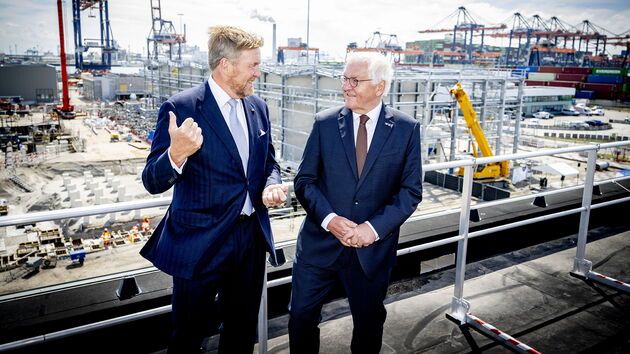
The German Federal President, Frank-Walter Steinmeier, and King Willem-Alexander visited the Port of Rotterdam on the afternoon of Wednesday 10 June. The visit was part of the Federal President's state visit between 9 and 11 June 2026.
The heads of state first visited the Porthos CO₂ transport and storage project on the Maasvlakte, where they were given a guided tour of the construction site. They viewed the compressor station where compressors (manufactured by Everllence) will pressurise the captured CO₂ from companies in the port for transport to empty gas fields beneath the seabed, 20 kilometres off the coast. From the roof of the main building, they could see the CO₂ injection platform lying at that distance.
Following their visit, they visited the Portlantis port experience centre on the Maasvlakte. There, Boudewijn Siemons, CEO of the Port of Rotterdam Authority, spoke about the significance of the Port of Rotterdam for the German economy and the ARRRA cluster (Antwerp-Rotterdam-Rhine-Ruhr Area), together with his colleague Markus Bangen CEO of the world's largest inland port in Duisburg. In a follow-up discussion at Portlantis, Minister Stientje van Veldhoven of Climate and Green Growth spoke about CO₂ transport and storage in the Netherlands, supplemented by key players in this field: Aramis, OGE, Gasunie, EBN, Shell and Air Liquide.
Afterwards, the heads of state boarded a boat for a tour of the port, passing APM, SIF and Neste, where they spoke with the CEOs of these companies, each of which has links with Germany. Mayor Carola Schouten and the German Minister of Defence, Boris Pistorius, spoke with the CEO of the Port of Rotterdam Authority and representatives of the Dutch Ministry of Defence about the role of ports in Europe's military mobility and resilience.
Boudewijn Siemons, CEO of the Port of Rotterdam Authority: "We are proud to have welcomed the heads of state of Germany and the Netherlands to discuss the development of the Port of Rotterdam and cooperation between the Netherlands and Germany in the fields of logistics, the energy transition and defence. We are already connected in many ways, and future infrastructure such as the Delta Rhine Corridor for hydrogen and CO₂ can further strengthen our cooperation."
The state visit is a confirmation of the intensive and multifaceted relations between the two countries, in political, economic and cultural-historical terms. As a neighbouring country, Germany is the Netherlands' most important trading partner, and an ally in the European Union, the United Nations and NATO. Conversely, the Netherlands is Germany's third-largest trading partner. During this state visit, the diversity of the partnerships, the importance of shared values and a forward-looking agenda for both countries will be highlighted.
Fuente: Port of rotterdam