• 3 min de lectura
• 3 min de lectura
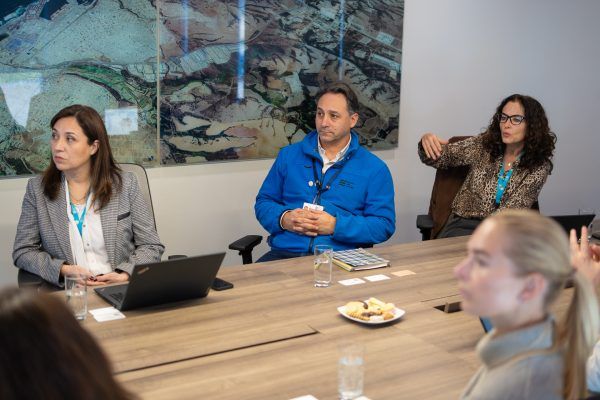
A delegation from the Maersk Mc-Kinney Møller Center for Zero Carbon Shipping visited the facilities of the Port of San Antonio to analyze the port infrastructure and evaluate the potential development of green maritime corridors, focusing on trade flows between Chile and Europe.
During their visit, part of a mission in Chile that also took them to other maritime hubs in the north and south of the country, the delegation toured the DP World concessionaire and was received by executives from the San Antonio Port Company, who provided details of current operations and the progress of the Outer Port.
Cristóbal Triviños, Senior Manager at the Maersk Mc-Kinney Møller Center for Zero Carbon Shipping, commented that Chile has significant conditions to advance in this area.
"We see a great opportunity to decarbonize maritime transport through green fuels, and we believe that port infrastructure can be a key enabler to drive this transition," he stated.
Triviños highlighted that "the measures being promoted with the Outer Port are moving in the right direction because a port expansion must incorporate a vision of decarbonization and more sustainable operation."
Mark Stark, leader of the Green Corridors team at the entity, explained that the center has worked for four years with the Chilean industry on projects linked to green corridors and the adoption of alternative fuels. "In 2026, we are starting a project on green port nodes to determine which Chilean ports could be most suitable to become future low-carbon fuel supply centers. San Antonio is part of that analysis, and we are very interested in learning more about its facilities and infrastructure," he indicated.
For the Manager of Sustainability and Public Affairs (i) of Port San Antonio, Consuelo Cánaves, this visit "is very relevant because it allows us to learn firsthand about the work being developed internationally in maritime decarbonization and to showcase the efforts we are making as a port system to move towards a more sustainable operation. The Maersk Center is analyzing opportunities in Chile for the decarbonization of the maritime-port sector, and their visit reflects the interest in our role as the country's main port and in the expansion projects we are developing."
Juan Pablo Fuentes, Manager of Safety and Environment at DP World San Antonio, noted that "it is very important for us to receive this type of visit. The Maersk Center is a strategic international partner, and at DP World, we are always open to showing the efforts we are making to contribute to energy efficiency and environmental care. These instances also allow us to receive feedback, identify opportunities for improvement, and continue advancing towards an increasingly sustainable operation."
Future Port
Among the aspects considered for the future operation of the Outer Port are initiatives that will reduce emission levels and move towards a more efficient and sustainable port operation.
One of the main elements of the project is that the internal design of the terminals aims to move up to 40% of cargo by rail, which will reduce atmospheric emissions per TEU transported compared to a model based exclusively on road transport.
Additionally, technological systems will be implemented at the port's entrances and exits to streamline vehicle flow, reduce waiting lines, and decrease engine idling time, thus contributing to a more efficient logistics operation with less environmental impact. The design contemplates advancing in decarbonization through the use of 100% electric cranes and port machinery and onshore power supply systems, which will allow berthed vessels to turn off their auxiliary engines and connect to the port's electrical grid for power.