• 3 min de lectura
• 3 min de lectura
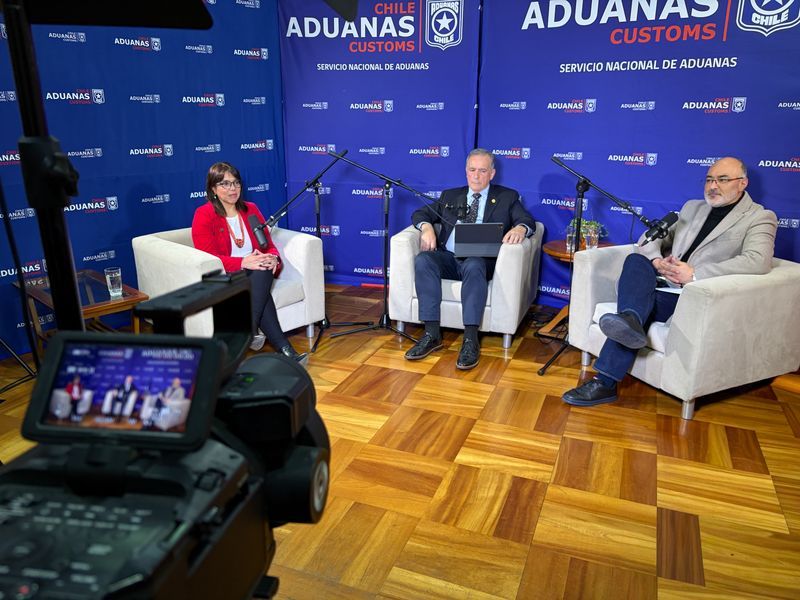
The National Customs Service of Chile held its Participatory Public Account 2026. The agency provided details of the main advances in institutional modernization, border control, and foreign trade facilitation.
Through a press release, Customs provided details of this milestone, stating that "the presentation by the customs authority was made in a podcast format broadcast live from Valparaíso, where she was accompanied by the president of the Civil Society Council (Cosoc) of the National Customs Directorate and academic from the University of Valparaíso, Marcelo Arancibia, and the president of the Customs Chamber, Felipe Serrano, as representatives of some of the public and private actors with whom the Service interacts daily."
Regarding the accountability report, "it was highlighted that in 2025, a new institutional structure derived from Law 21,713 was implemented, which allowed the creation of new Sub-directorates focused on borders and probity, as well as strengthening articulation with the regions and advancing in the strengthening of personnel, reaching a staff of 2,319 officials."
In this regard, the National Director of Customs, Alejandra Arriaza, indicated that "this strengthening allows decision-making to be brought closer to the territories, reinforcing regional response capacity and improving coordination between the different areas of the Service. It is an institutional framework designed for a country that has changed and for international trade that demands increasingly specialized capabilities."
Regarding inspection and the fight against organized crime, it was detailed that "the institution highlighted that 100% of the cargo is inspected thanks to the combination of risk analysis, use of databases, profiling, advanced analytics, and artificial intelligence, coupled with the deployment of scanners, canine units, and physical inspection."
"Last year, 1,468 procedures related to drugs and related crimes were registered, with significant seizures of illicit substances, including 5,366 kilograms of marijuana, cocaine, and "pasta base," and 796 kilograms of synthetic drugs such as ketamine and MDMA, in addition to 11,491 units of this type of substance," the statement added.
Regarding the implementation of technologies and tools for control, it was indicated that "currently, 6 new scanner trucks are operating, and another 2 are in the bidding process, reinforcing coverage at different points in the country, accompanied by the training of 254 specialized operators (172 men and 82 women)."
"The Service executed $6,645,532,535 in Information Technologies, promoting innovative solutions to improve control and traceability of operations. Among the highlighted initiatives are the strengthening of integrated and digitized smart borders, as well as the deepening of interoperability and the purification and automation of data in different systems," it was added.
At the event, the economic contribution of the institution to the country was also highlighted, where it was reported that "the Service collects 28% of Chile's total tax revenue, equivalent to US$ 17,829.9 million, and contributes 5% of the Gross Domestic Product (GDP)."
Finally, regarding governance and engagement with the environment, it was announced that "the role of the Public-Private Customs Council (CAPP) as a coordination space with the different guilds and companies linked to foreign trade. In addition, the "Aduana Conecta" program and the operation of the Civil Society Councils were highlighted, instances that allow progress with citizens and listen to the needs and proposals of communities and users," the circular concluded.