• 2 min de lectura
• 2 min de lectura
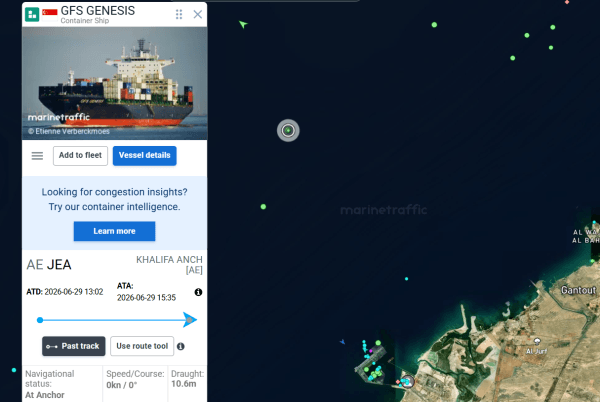
Container shipping services to the Persian Gulf are showing signs of recovery after disruptions caused by the recent conflict in the area.
Three container ships operated by Global Feeder Shipping (GFS) entered the Gulf between June 26 and 28. According to MarineTraffic, the vessels were the first of their kind with commercial links to major shipping companies to enter the region since the start of the conflict.
The development was considered significant, given that the territory is one of the world's main maritime trade zones, connecting the region's major energy producers and commercial ports with global shipping routes.
The Strait of Hormuz, located at the entrance to the Persian Gulf, is a crucial strategic point for global trade and energy flow. Any disruption in the area can affect vessel itineraries, insurance costs, and the movement of goods in regional and international supply chains.
The GFS Genesis, with a capacity of 4350 TEU, entered the Gulf on June 26 after calling at the Indian ports of Nhava Sheva and Mundra. It was followed by the GFS Precious, a 3,534 TEU vessel, on June 27 after sailing from the terminals of Sokhna and King Abdullah. The GFS Jade, of 2452 TEU, entered on June 28 after departing from the Pakistani port facilities of Karachi and Port Qasim.
According to MarineTraffic, the vessels appear on itineraries linked to shipping companies such as Maersk, Hapag-Lloyd and MSC, suggesting that cargo destined for major global shipping lines could be returning to circulate through feeder services in the Gulf, although large-scale container shipping activity has not yet returned to normal.
Feeders are smaller container ships that connect regional ports with larger global shipping networks, typically transporting containers between smaller regional ports and larger central ports served by major shipping lines.
This new activity could reconnect three regional trade routes—India, the Red Sea, and Pakistan—with Persian Gulf services. Additionally, it could offer a possible alternative route for MSC and cargo linked to Gemini Cooperation, the shipping alliance between Maersk and Hapag-Lloyd.